Japanese
English
- 有料閲覧
PPV購入案内
1,320円 (1,200円+税10%) こちらは、660ページから672ページの文献です。購入には医書.jp本会員登録が必要です。
会員登録完了後に改めて上記「購入サイトへ」を選択してください。
または「購入サイトへ」選択後に「購入ログイン」、「新規会員登録」の順に進んでください。
会員登録について詳しくはをご確認ください。
- Abstract 文献概要
- 1ページ目 Look Inside
- 参考文献 Reference
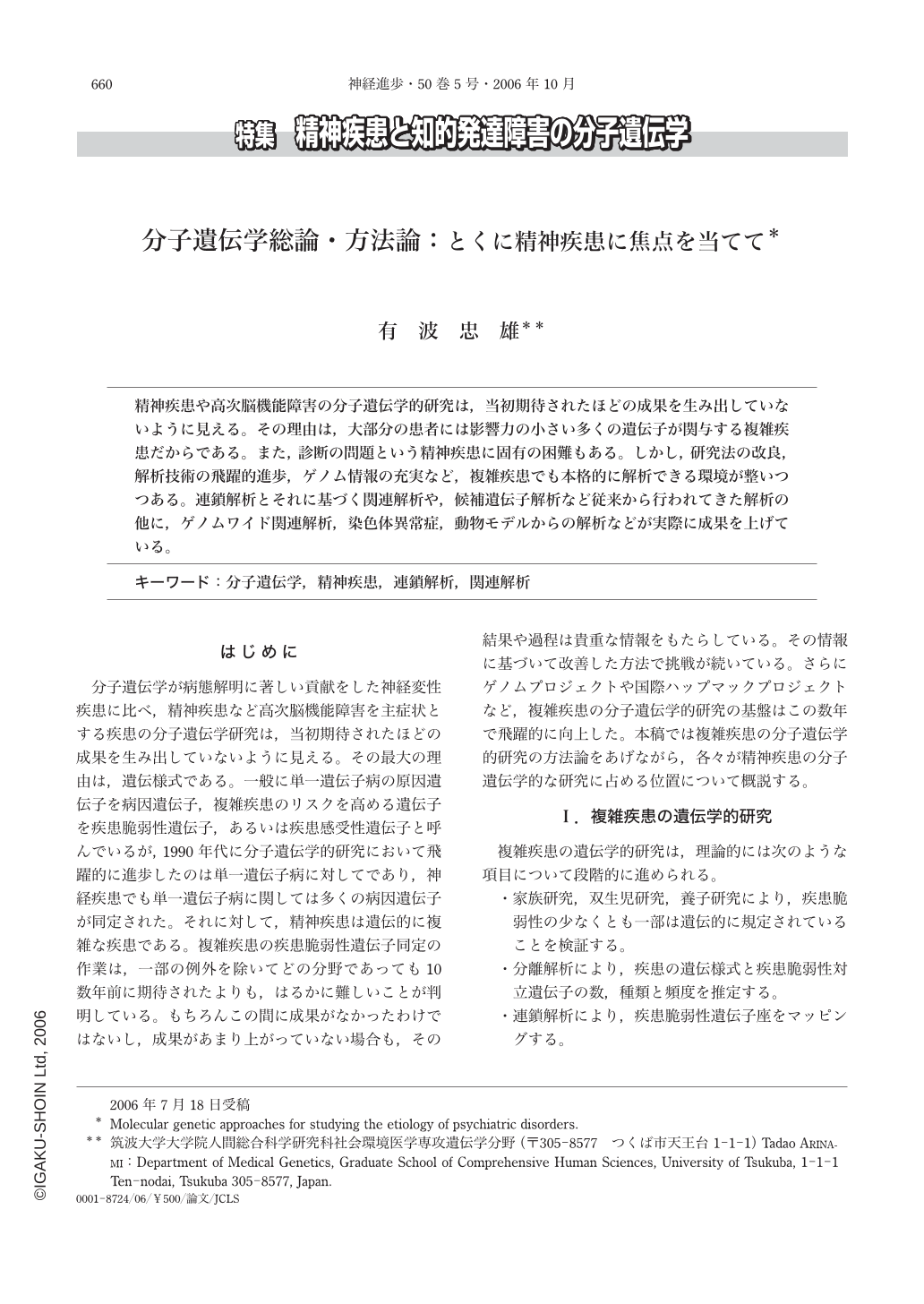
精神疾患や高次脳機能障害の分子遺伝学的研究は,当初期待されたほどの成果を生み出していないように見える。その理由は,大部分の患者には影響力の小さい多くの遺伝子が関与する複雑疾患だからである。また,診断の問題という精神疾患に固有の困難もある。しかし,研究法の改良,解析技術の飛躍的進歩,ゲノム情報の充実など,複雑疾患でも本格的に解析できる環境が整いつつある。連鎖解析とそれに基づく関連解析や,候補遺伝子解析など従来から行われてきた解析の他に,ゲノムワイド関連解析,染色体異常症,動物モデルからの解析などが実際に成果を上げている。
The majority of common psychiatric disorders still pose difficulties for geneticists because of their complex and non-Mendelian modes of inheritance. However, substantial progresses have been made in identifying genes associated with psychiatric disorders though genetic linkage and association studies, analyses of families with cosegregation of chromosomal translocations and psychiatric disorders, identifying contiguous gene microdeletion syndrome that increase risks for psychiatric problems and analyses of genetically engineered animal models. Furthermore, recent advance in the knowledge of the entire human genome and haplotype maps of the human genome will allow researchers to find genes and genetic variations that affect higher mental functions and to enable rational haplotype comparisons between studies. In addition, high throughput technologies such as arrays for genome-wide association studies, comparative genomic hybridization(CGH), DNA methylation profiling will lead to major advances in understanding of the molecular basis of mental illness. These formidable tasks will be accomplished by continuing to harness the synergy between human and experimental genetic approaches.
Copyright © 2006, Igaku-Shoin Ltd. All rights reserved.