Japanese
English
- 有料閲覧
PPV購入案内
1,320円 (1,200円+税10%) こちらは、273ページから281ページの文献です。購入には医書.jp本会員登録が必要です。
会員登録完了後に改めて上記「購入サイトへ」を選択してください。
または「購入サイトへ」選択後に「購入ログイン」、「新規会員登録」の順に進んでください。
会員登録について詳しくはをご確認ください。
- Abstract 文献概要
- 1ページ目 Look Inside
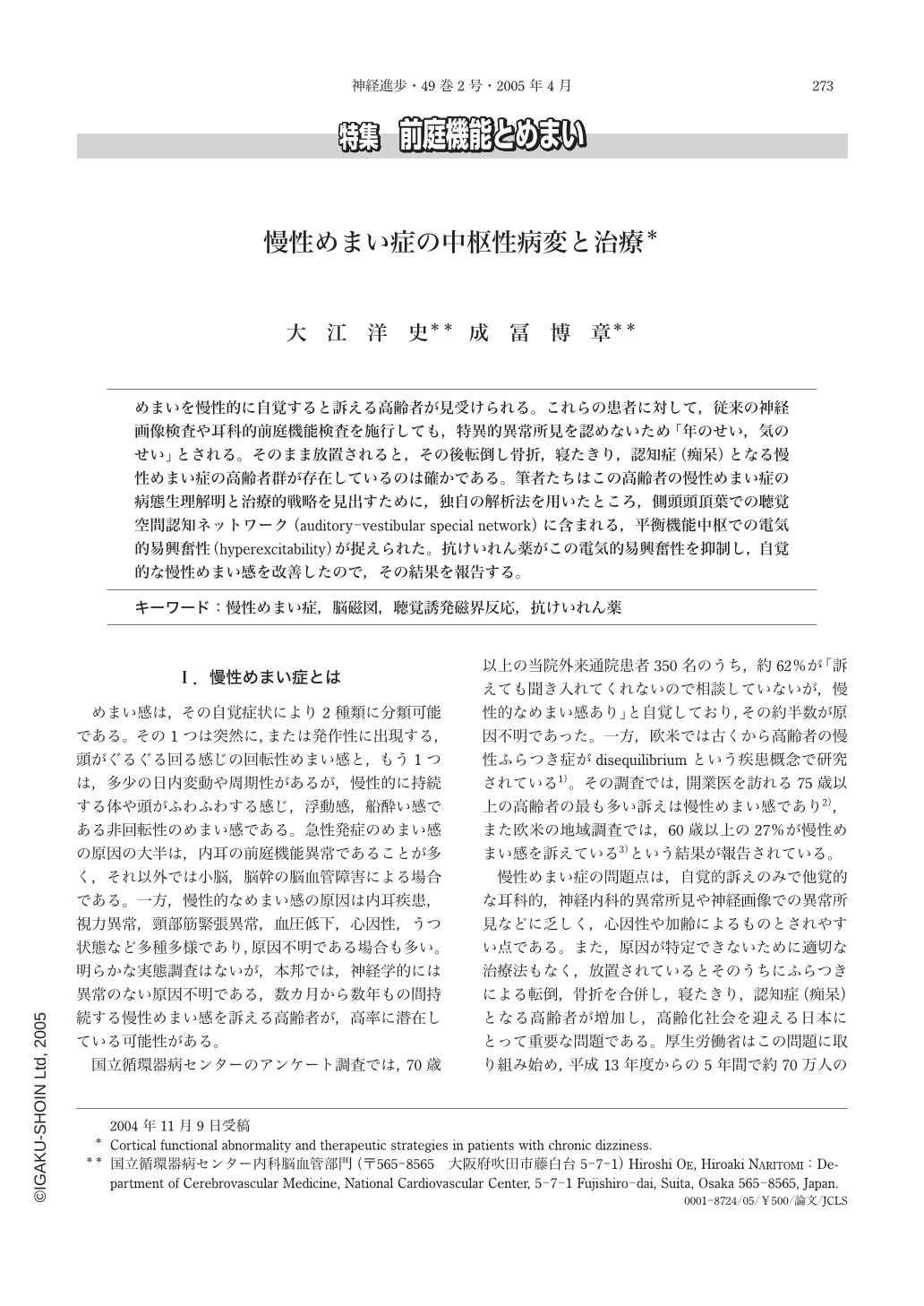
めまいを慢性的に自覚すると訴える高齢者が見受けられる。これらの患者に対して,従来の神経画像検査や耳科的前庭機能検査を施行しても,特異的異常所見を認めないため「年のせい,気のせい」とされる。そのまま放置されると,その後転倒し骨折,寝たきり,認知症(痴呆)となる慢性めまい症の高齢者群が存在しているのは確かである。筆者たちはこの高齢者の慢性めまい症の病態生理解明と治療的戦略を見出すために,独自の解析法を用いたところ,側頭頭頂葉での聴覚空間認知ネットワーク(auditory-vestibular special network)に含まれる,平衡機能中枢での電気的易興奮性(hyperexcitability)が捉えられた。抗けいれん薬がこの電気的易興奮性を抑制し,自覚的な慢性めまい感を改善したので,その結果を報告する。
Many old subjects suffer from chronic dizziness or floating sensation in spite of no abnormality in limb motor function or coordination. They often fall down or are scared of walking and may fall into a bedridden state after a long period. Unfortunately, none of clinical tests currently available can detect abnormality in the brain or vestibular system, and hence mechanisms of this chronic dizziness have yet remained unclear. The vestibular function, which is essential for maintaining the postural balance, is represented by auditory-vestibular special networks which are made of four different areas of the temporal and parietal cortices connected from the primary auditory center in the temporal cortex. Here, we show that measurements of auditory evoked magnetic fields(AEFs) in the parieto-temporal areas can detect functional abnormality of auditory-vestibular special networks specifically in patients with chronic dizziness. Electrical currents in the parieto-temporal areas were evoked by auditory stimulation, and their directions were demonstrated on a current-arrow map. In healthy subjects, the current-arrows always headed toward one direction in both sides of parieto-temporal areas. In patients with chronic dizziness, the current-arrows always showed a clockwise or counter-clockwise spinning pattern unilaterally or bilaterally. This abnormal pattern disappeared in patients whose dizzy sensation ameliorated following anticonvulsants. The detection of specific spinning pattern in AEFs is useful for evaluating electric hyperexcitability of the cortical auditory-vestibular special networks in patients with chronic dizziness of unknown cause and for elucidating the mechanisms of this dysequilibrium syndrome.
Copyright © 2005, Igaku-Shoin Ltd. All rights reserved.