Japanese
English
- 有料閲覧
PPV購入案内
1,320円 (1,200円+税10%) こちらは、485ページから490ページの文献です。購入には医書.jp本会員登録が必要です。
会員登録完了後に改めて上記「購入サイトへ」を選択してください。
または「購入サイトへ」選択後に「購入ログイン」、「新規会員登録」の順に進んでください。
会員登録について詳しくはをご確認ください。
- Abstract 文献概要
- 1ページ目 Look Inside
- 参考文献 Reference
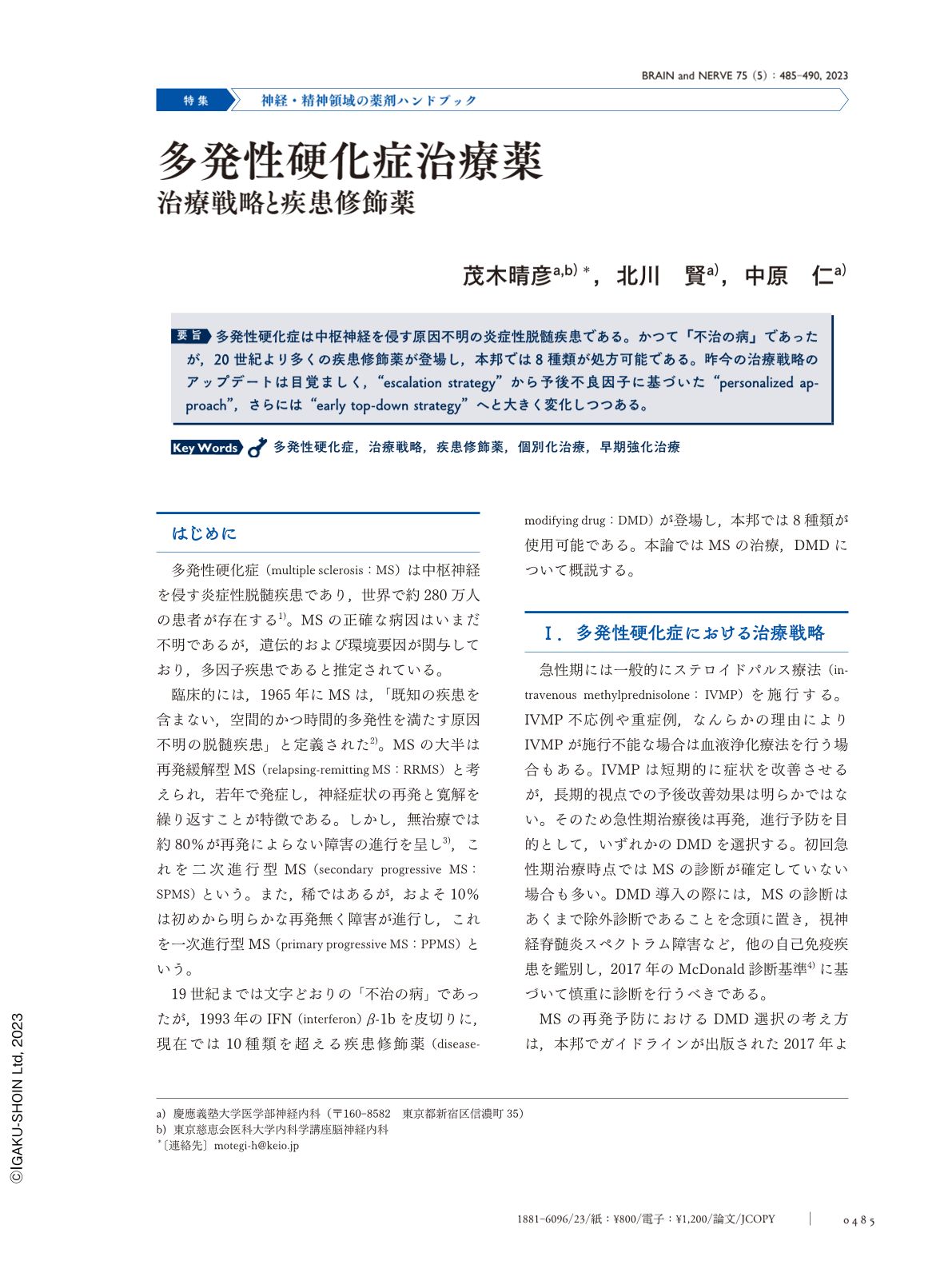
多発性硬化症は中枢神経を侵す原因不明の炎症性脱髄疾患である。かつて「不治の病」であったが,20世紀より多くの疾患修飾薬が登場し,本邦では8種類が処方可能である。昨今の治療戦略のアップデートは目覚ましく,“escalation strategy”から予後不良因子に基づいた“personalized approach”,さらには“early top-down strategy”へと大きく変化しつつある。
Abstract
Multiple sclerosis is an inflammatory demyelinating disease of unknown cause that affects the central nervous system. Although it was once deemed “incurable,” many disease-modifying therapies have been introduced since the beginning of the 20th century; eight of these are now available in Japan. Treatment for multiple sclerosis is undergoing a significant shift from the safety-oriented “escalation strategy,” in which the patient is initially administered medications with low risks of side effects but moderate efficacy, to a “personalized approach” based on individual prognostic factors followed by an “early top-down strategy” in which higher efficacy treatments are initiated first. Disease-modifying drugs for multiple sclerosis can be high- (fingolimod, ofatumumab, natalizumab) or moderate-efficacy (interferon beta, glatiramer acetate, dimethyl fumarate), and there are also disease-modifying therapies for secondary progressive multiple sclerosis (siponimod and ofatumumab). Approximately 20,000 Japanese patients have multiple sclerosis, and this number continues to increase. Many neurologists are expected to prescribe high-efficacy drugs in the future. The risk management of adverse events, particularly progressive multifocal leukoencephalopathy, is required to ensure that the importance of safety never be underestimated, even though treatment efficacy is the main focus.
Copyright © 2023, Igaku-Shoin Ltd. All rights reserved.