Japanese
English
- 有料閲覧
PPV購入案内
1,320円 (1,200円+税10%) こちらは、1371ページから1376ページの文献です。購入には医書.jp本会員登録が必要です。
会員登録完了後に改めて上記「購入サイトへ」を選択してください。
または「購入サイトへ」選択後に「購入ログイン」、「新規会員登録」の順に進んでください。
会員登録について詳しくはをご確認ください。
- Abstract 文献概要
- 1ページ目 Look Inside
- 参考文献 Reference
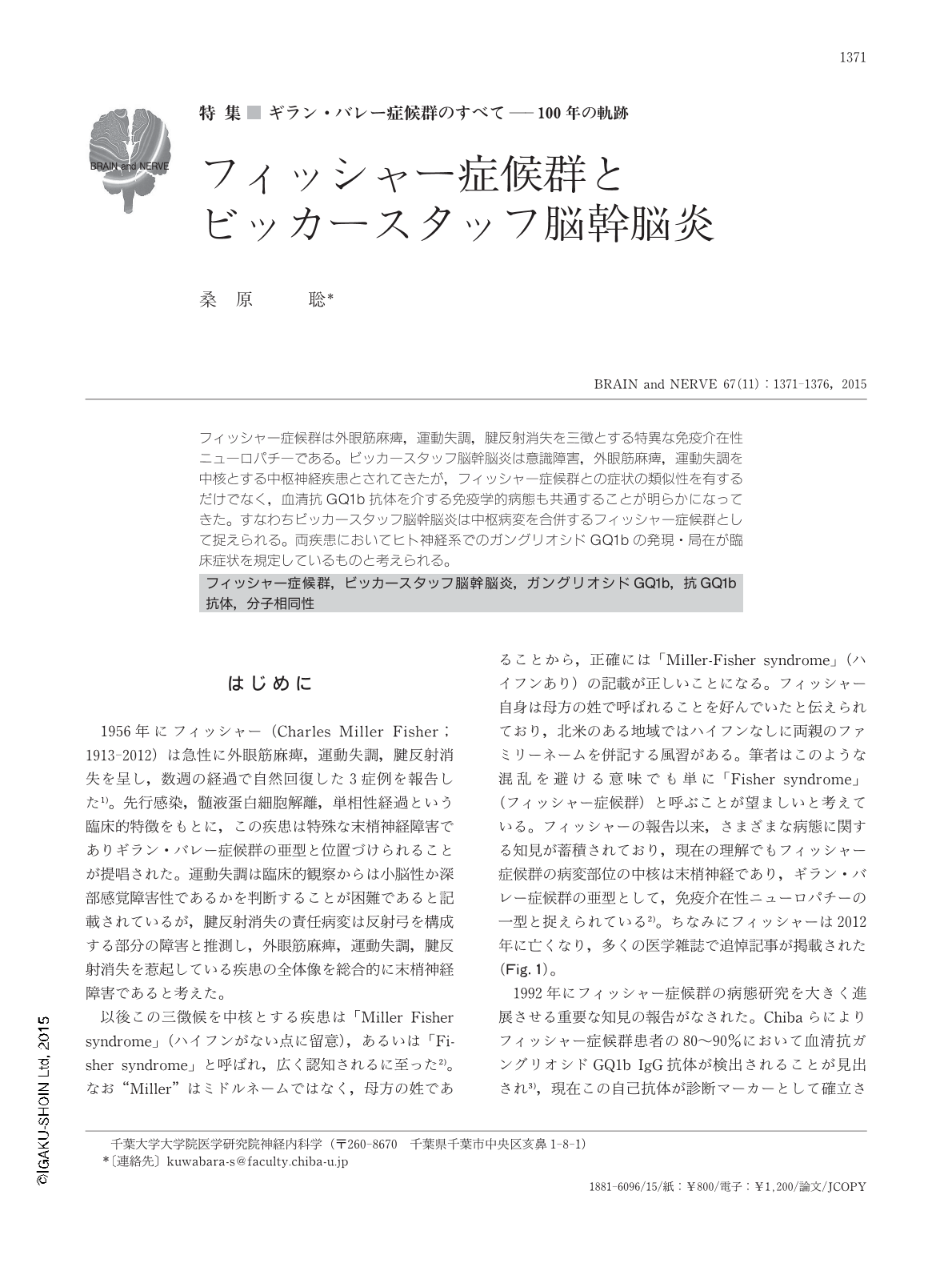
フィッシャー症候群は外眼筋麻痺,運動失調,腱反射消失を三徴とする特異な免疫介在性ニューロパチーである。ビッカースタッフ脳幹脳炎は意識障害,外眼筋麻痺,運動失調を中核とする中枢神経疾患とされてきたが,フィッシャー症候群との症状の類似性を有するだけでなく,血清抗GQ1b抗体を介する免疫学的病態も共通することが明らかになってきた。すなわちビッカースタッフ脳幹脳炎は中枢病変を合併するフィッシャー症候群として捉えられる。両疾患においてヒト神経系でのガングリオシドGQ1bの発現・局在が臨床症状を規定しているものと考えられる。
Abstract
Fisher syndrome has been regarded as a peculiar inflammatory neuropathy with ophthalmoplegia, ataxia, and areflexia, whereas Bickerstaff brainstem encephalitis has been considered a pure central nervous system disease characterized by ophthalmoplegia, ataxia, and consciousness disturbance. Both disorders share common features including preceding infection, albumin-cytological dissociation, and association with Guillain-Barré syndrome. The discovery of anti-GQ1b IgG antibodies further supports the view that the two disorders represent a single disease spectrum. The lesions in Fisher syndrome and Bickerstaff brainstem encephalitis are presumably determined by the expression of ganglioside GQ1b in the human peripheral and central nervous systems. Bickerstaff brainstem encephalitis is likely to represent a variant of Fisher syndrome with central nervous system involvement.
Copyright © 2015, Igaku-Shoin Ltd. All rights reserved.