Japanese
English
- 有料閲覧
PPV購入案内
1,320円 (1,200円+税10%) こちらは、669ページから678ページの文献です。購入には医書.jp本会員登録が必要です。
会員登録完了後に改めて上記「購入サイトへ」を選択してください。
または「購入サイトへ」選択後に「購入ログイン」、「新規会員登録」の順に進んでください。
会員登録について詳しくはをご確認ください。
- Abstract 文献概要
- 1ページ目 Look Inside
- 参考文献 Reference
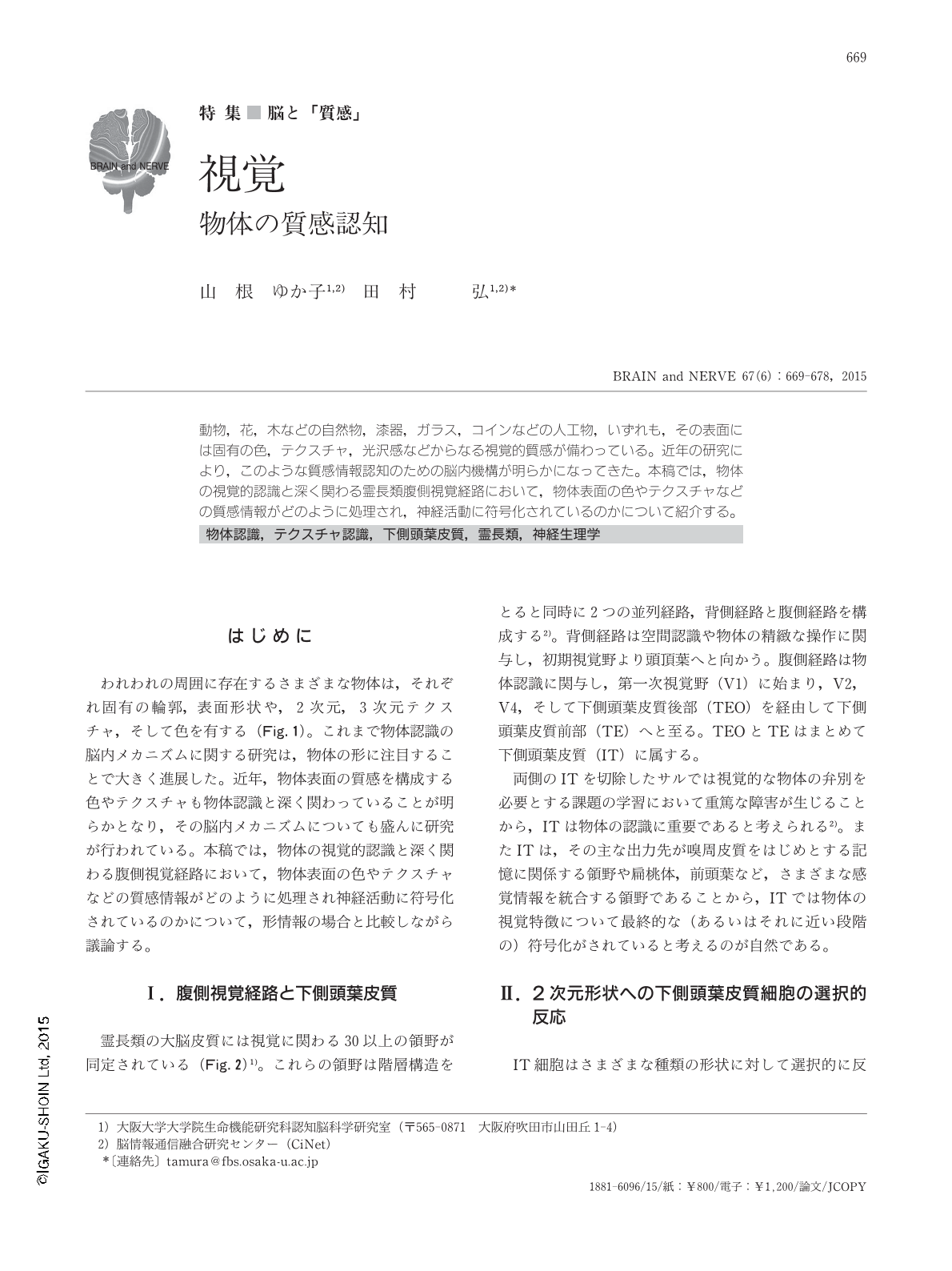
動物,花,木などの自然物,漆器,ガラス,コインなどの人工物,いずれも,その表面には固有の色,テクスチャ,光沢感などからなる視覚的質感が備わっている。近年の研究により,このような質感情報認知のための脳内機構が明らかになってきた。本稿では,物体の視覚的認識と深く関わる霊長類腹側視覚経路において,物体表面の色やテクスチャなどの質感情報がどのように処理され,神経活動に符号化されているのかについて紹介する。
Abstract
Natural objects, such as animals, flowers, and wood, as well as artificial objects, such as Japanese lacquerware, glass, and metal coins, have their own shape and surface appearances. Although object shapes play important roles in visual object recognition, the material properties or Shitsukan of objects are relevant for the recognition of visual objects. In this review, we introduce recent advances in the understanding of the neural basis of the cognition of Shitsukan. First, we introduce the results of single-neuron recording studies that examined neuronal activity in the inferior temporal cortex of macaque monkeys in response to the presentation of two-dimensional and three-dimensional shapes. Next, we introduce the studies of neuronal response property to the Shitsukan of objects, such as color, texture, glossiness, and the combinations of these features. Then, we discuss how the selective responses to Shitsukan are constructed by hierarchical processing in the ventral visual cortical pathway, which consists of V1, V2, and V4. Finally, we discuss the encoding of Shitsukan information in the inferior temporal cortex.
Copyright © 2015, Igaku-Shoin Ltd. All rights reserved.