Japanese
English
- 有料閲覧
PPV購入案内
1,320円 (1,200円+税10%) こちらは、283ページから288ページの文献です。購入には医書.jp本会員登録が必要です。
会員登録完了後に改めて上記「購入サイトへ」を選択してください。
または「購入サイトへ」選択後に「購入ログイン」、「新規会員登録」の順に進んでください。
会員登録について詳しくはをご確認ください。
- Abstract 文献概要
- 1ページ目 Look Inside
- 参考文献 Reference
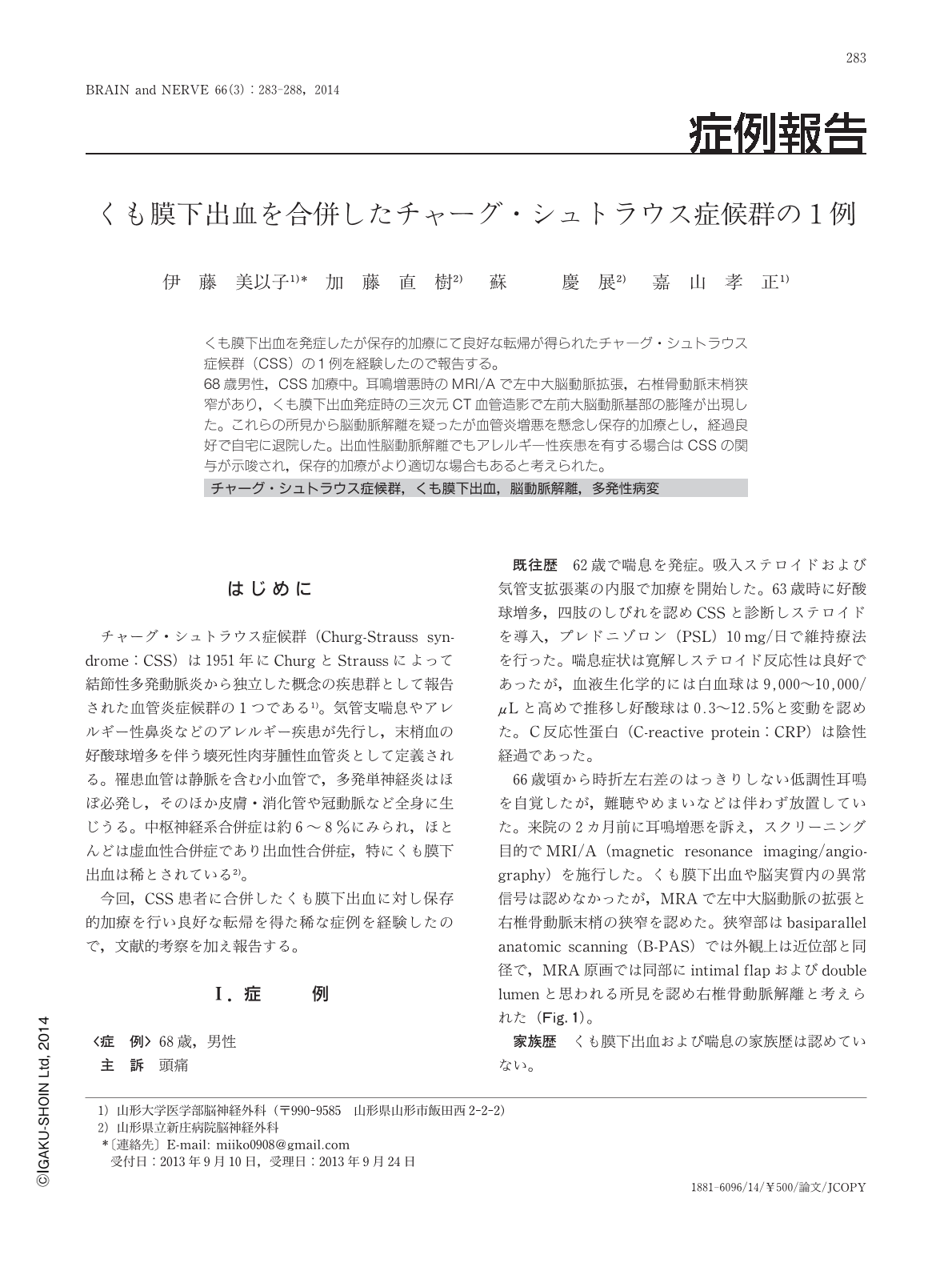
くも膜下出血を発症したが保存的加療にて良好な転帰が得られたチャーグ・シュトラウス症候群(CSS)の1例を経験したので報告する。
68歳男性,CSS加療中。耳鳴増悪時のMRI/Aで左中大脳動脈拡張,右椎骨動脈末梢狭窄があり,くも膜下出血発症時の三次元CT血管造影で左前大脳動脈基部の膨隆が出現した。これらの所見から脳動脈解離を疑ったが血管炎増悪を懸念し保存的加療とし,経過良好で自宅に退院した。出血性脳動脈解離でもアレルギー性疾患を有する場合はCSSの関与が示唆され,保存的加療がより適切な場合もあると考えられた。
Abstract
Churg-Strauss syndrome (CSS) is a vasculitis syndromes and is only rarely complicated by subarachnoid hemorrhage. In the current report, we describe a case of CSS with subarachnoid hemorrhage, which showed a favorable outcome following conservative treatment.
A 68-year-old man with CSS on maintenance steroid therapy underwent MRI/A during tinnitus aggravation, and showed dilation of the left middle cerebral artery and stenosis of the peripheral area of the right vertebral artery. After 2 months, he presented sudden pain in the occipitocervical area, and CT revealed subarachnoid hemorrhage. Intracranial 3D CT-A and MRI/A showed the development of a protrusion at the base of the left anterior cerebral artery. Although both findings suggested cerebral artery dissection, the source of hemorrhage could not be identified. The 2009 Japanese Guidelines for the Management of Stroke recommends early diagnosis and treatment of hemorrhagic cerebral artery dissection because of the high risk of re-bleeding. However, considering the risks of vasculitis aggravation, development of systemic complications, and recurrence, conservative treatment was selected. In addition, owing to the risk of complications associated with the frequent use of iodinated contrast agents and angiography procedures, patient was followed up using MRI. His course was favorable, and he was discharged despite mild right abducens paralysis.
When patients with hemorrhagic cerebral artery dissection have a history of allergic diseases, CCS should be considered; conservative treatment consisting of rest, strict blood pressure control, and steroid therapy may be the most appropriate option for certain patients.
(Receieved September 10, 2013; Accepted September 24, 2013; Published March 1, 2014)
Copyright © 2014, Igaku-Shoin Ltd. All rights reserved.