Japanese
English
- 有料閲覧
PPV購入案内
1,320円 (1,200円+税10%) こちらは、171ページから174ページの文献です。購入には医書.jp本会員登録が必要です。
会員登録完了後に改めて上記「購入サイトへ」を選択してください。
または「購入サイトへ」選択後に「購入ログイン」、「新規会員登録」の順に進んでください。
会員登録について詳しくはをご確認ください。
- Abstract 文献概要
- 1ページ目 Look Inside
- 参考文献 Reference
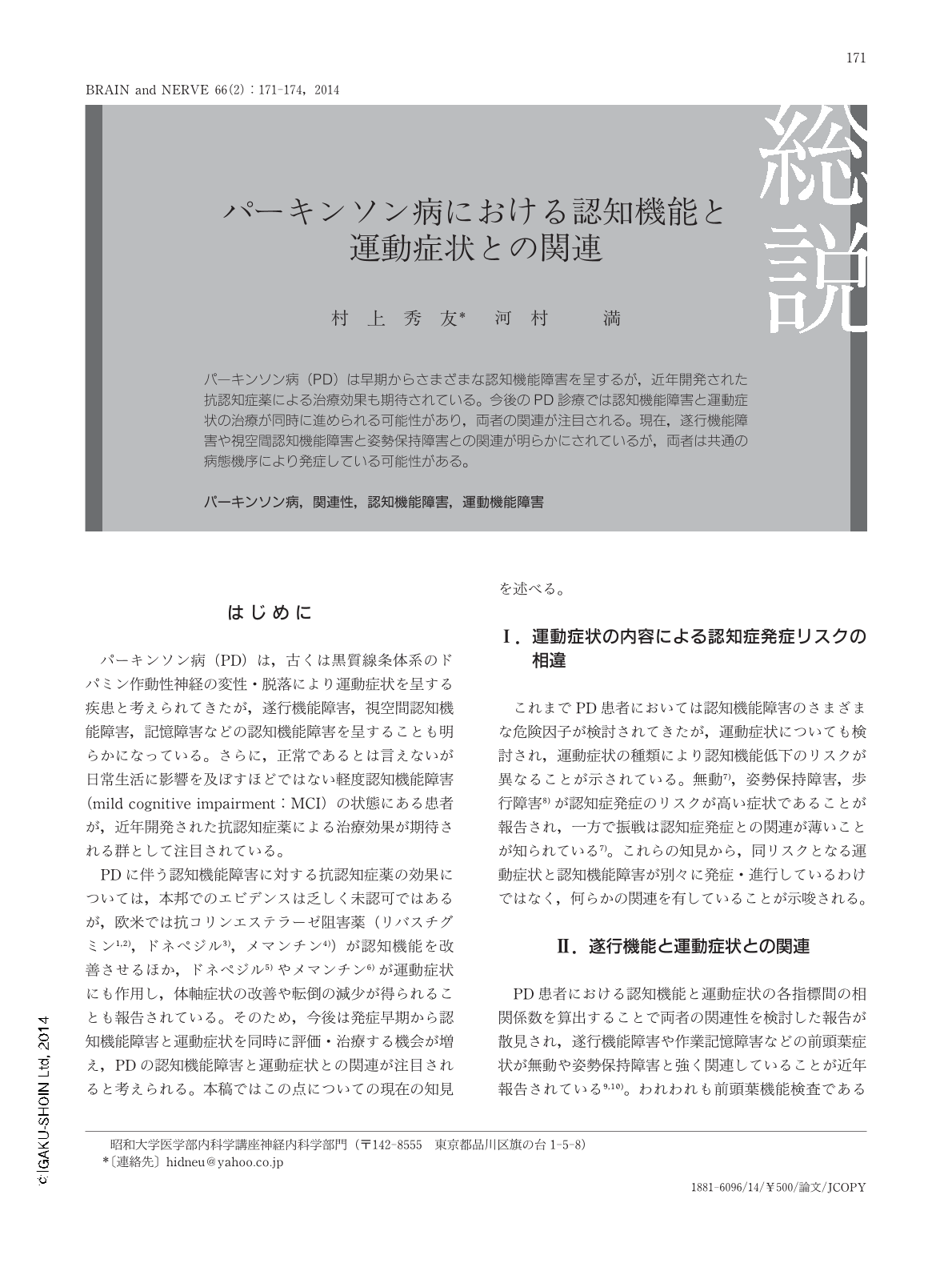
パーキンソン病(PD)は早期からさまざまな認知機能障害を呈するが,近年開発された抗認知症薬による治療効果も期待されている。今後のPD診療では認知機能障害と運動症状の治療が同時に進められる可能性があり,両者の関連が注目される。現在,遂行機能障害や視空間認知機能障害と姿勢保持障害との関連が明らかにされているが,両者は共通の病態機序により発症している可能性がある。
Abstract
Patients with Parkinson's disease (PD) have a number of cognitive impairments even in the early phase of the disease. Anti-dementia drugs such as cholinesterase inhibitors and N-methyl-D-aspartate (NMDA) receptor antagonists are suggested to alleviate such impairments. This supports the simultaneous treatment of both cognitive and motor dysfunctions. Thus, the correlation between these two functions is attracting an increasing clinical interest. Previous studies show a correlation between executive/frontal dysfunction and motor symptoms. This correlation is suggested to be mediated by a dysfunction in the fronto-striatal circuit as a common pathophysiology of executive/frontal and motor dysfunction. Recently, we showed that visuospatial/parietal dysfunction also correlates with motor symptoms, especially postural stability. We argued that the parietal lobe and basal ganglia are functionally connected and that visuospatial dysfunction and postural instability share a common pathophysiology. Anti-dementia drugs such as donepezil and memantine are also suggested to promote relief for postural instability. These drugs may possibly affect the common pathophysiology between both cognitive and motor dysfunctions. Analysis of outcomes using medications which target both cognitive and motor functions may serve as pharmacological tool to determine the pathophysiology of these dysfunctions.
Copyright © 2014, Igaku-Shoin Ltd. All rights reserved.