Japanese
English
- 有料閲覧
PPV購入案内
1,320円 (1,200円+税10%) こちらは、903ページから909ページの文献です。購入には医書.jp本会員登録が必要です。
会員登録完了後に改めて上記「購入サイトへ」を選択してください。
または「購入サイトへ」選択後に「購入ログイン」、「新規会員登録」の順に進んでください。
会員登録について詳しくはをご確認ください。
- Abstract 文献概要
- 1ページ目 Look Inside
- 参考文献 Reference
はじめに
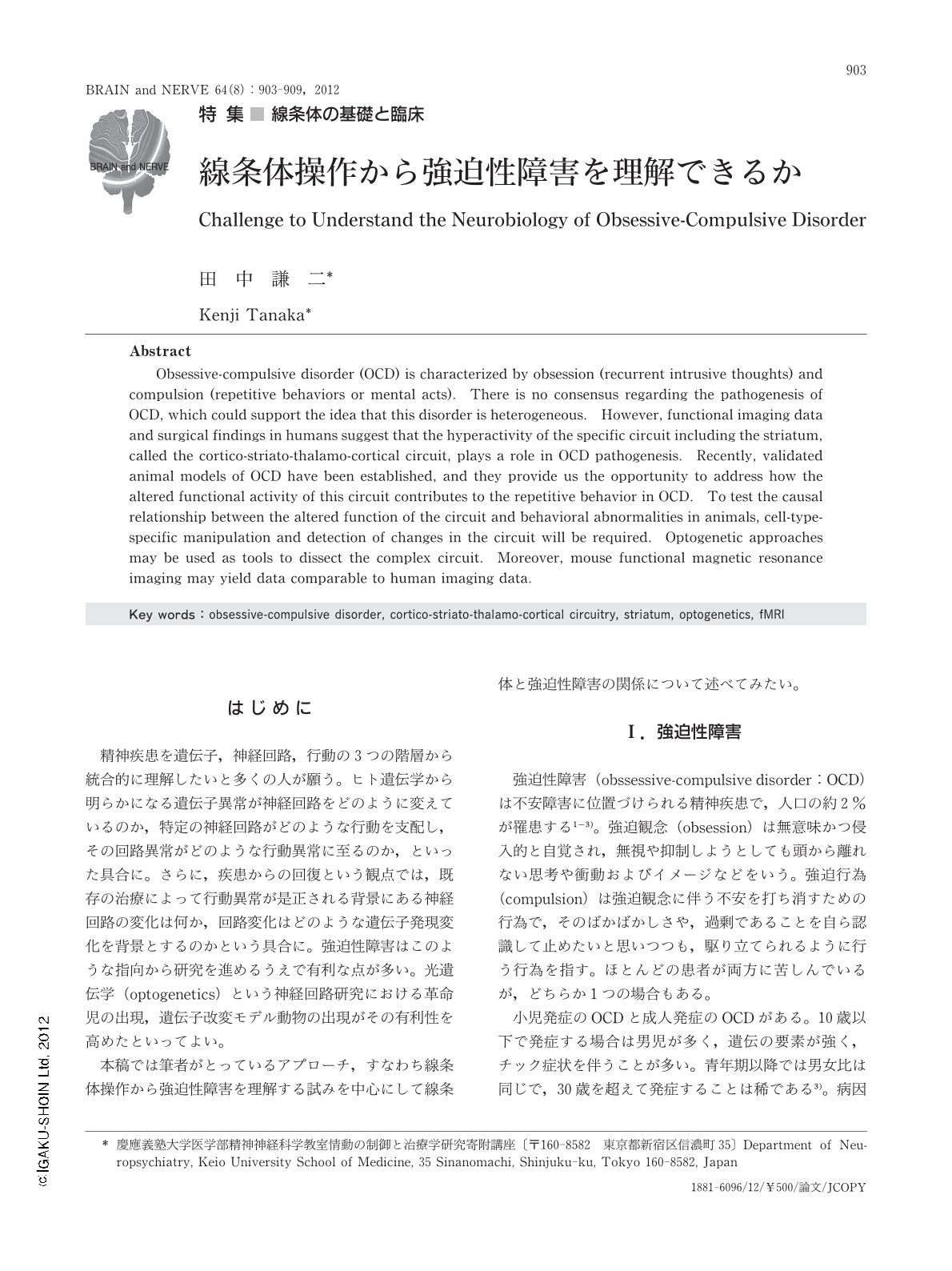
精神疾患を遺伝子,神経回路,行動の3つの階層から統合的に理解したいと多くの人が願う。ヒト遺伝学から明らかになる遺伝子異常が神経回路をどのように変えているのか,特定の神経回路がどのような行動を支配し,その回路異常がどのような行動異常に至るのか,といった具合に。さらに,疾患からの回復という観点では,既存の治療によって行動異常が是正される背景にある神経回路の変化は何か,回路変化はどのような遺伝子発現変化を背景とするのかという具合に。強迫性障害はこのような指向から研究を進めるうえで有利な点が多い。光遺伝学(optogenetics)という神経回路研究における革命児の出現,遺伝子改変モデル動物の出現がその有利性を高めたといってよい。
本稿では筆者がとっているアプローチ,すなわち線条体操作から強迫性障害を理解する試みを中心にして線条体と強迫性障害の関係について述べてみたい。
Abstract
Obsessive-compulsive disorder (OCD) is characterized by obsession (recurrent intrusive thoughts) and compulsion (repetitive behaviors or mental acts). There is no consensus regarding the pathogenesis of OCD, which could support the idea that this disorder is heterogeneous. However, functional imaging data and surgical findings in humans suggest that the hyperactivity of the specific circuit including the striatum, called the cortico-striato-thalamo-cortical circuit, plays a role in OCD pathogenesis. Recently, validated animal models of OCD have been established, and they provide us the opportunity to address how the altered functional activity of this circuit contributes to the repetitive behavior in OCD. To test the causal relationship between the altered function of the circuit and behavioral abnormalities in animals, cell-type-specific manipulation and detection of changes in the circuit will be required. Optogenetic approaches may be used as tools to dissect the complex circuit. Moreover, mouse functional magnetic resonance imaging may yield data comparable to human imaging data.
Copyright © 2012, Igaku-Shoin Ltd. All rights reserved.