Japanese
English
- 有料閲覧
PPV購入案内
1,320円 (1,200円+税10%) こちらは、527ページから531ページの文献です。購入には医書.jp本会員登録が必要です。
会員登録完了後に改めて上記「購入サイトへ」を選択してください。
または「購入サイトへ」選択後に「購入ログイン」、「新規会員登録」の順に進んでください。
会員登録について詳しくはをご確認ください。
- Abstract 文献概要
- 1ページ目 Look Inside
- 参考文献 Reference
はじめに
水頭症治療のV-Pシャントによる稀な合併症として,parkinsonismが報告されている1-15)。V-Pシャントによってparkinsonismをきたす原因としては,シャント機能不全による頭蓋内圧上昇16)のほかに,頭蓋内圧の変動が原因として推測されている1,9,12)。治療に関しては,既報告例の多くでlevodopaが有効であり,症状改善後にはlevodopaの漸減中止が可能になることが多い1-5,7-10,13-15)。今回われわれは,特発性中脳水道狭窄症による閉塞性水頭症に対しV-Pシャント術を施行した1年後から急速に進行するparkinsonismを呈し,levodopaが奏功した症例を経験したので報告する。
Abstract
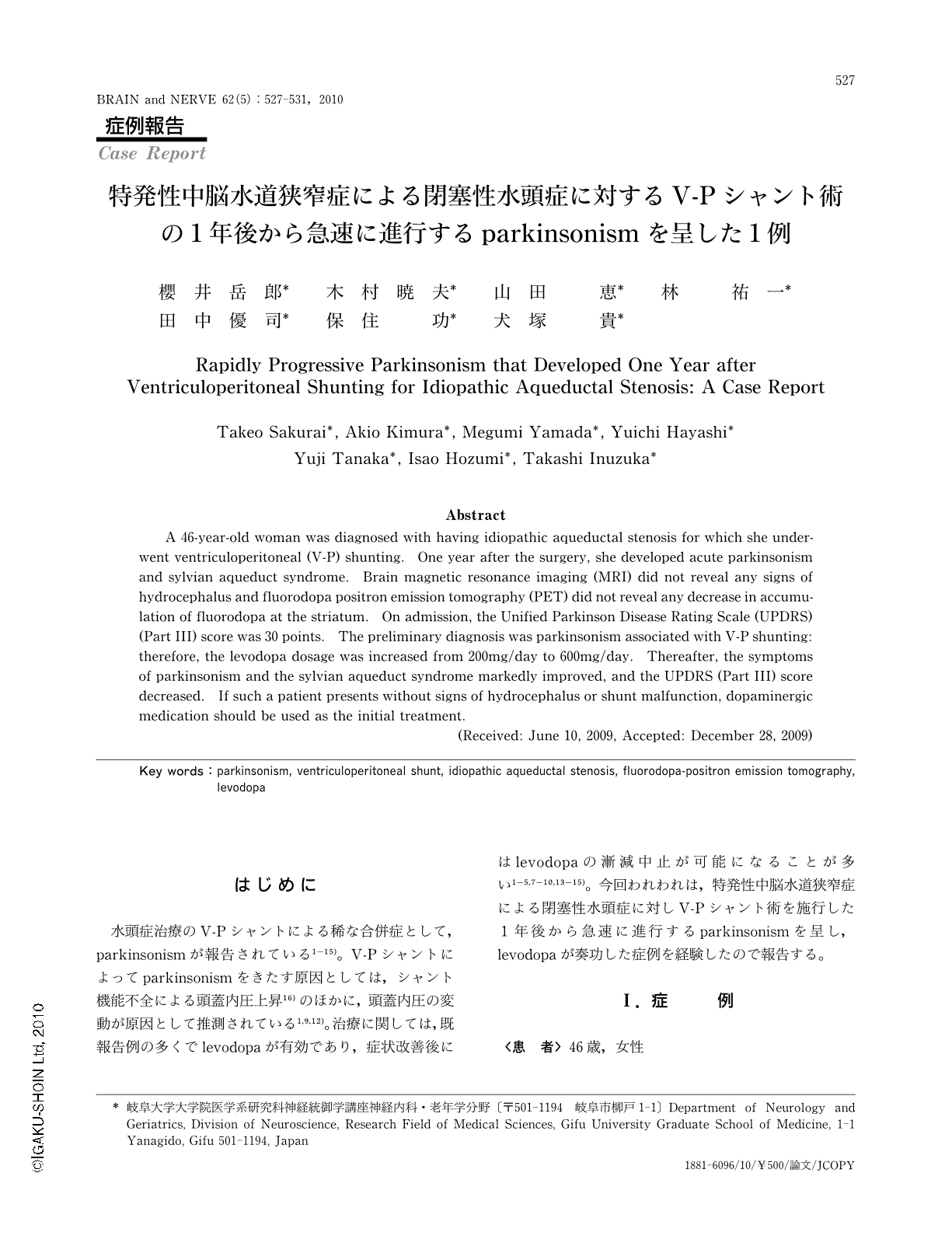
A 46-year-old woman was diagnosed with having idiopathic aqueductal stenosis for which she underwent ventriculoperitoneal (V-P) shunting. One year after the surgery, she developed acute parkinsonism and sylvian aqueduct syndrome. Brain magnetic resonance imaging (MRI) did not reveal any signs of hydrocephalus and fluorodopa positron emission tomography (PET) did not reveal any decrease in accumulation of fluorodopa at the striatum. On admission, the Unified Parkinson Disease Rating Scale (UPDRS) (Part III) score was 30 points. The preliminary diagnosis was parkinsonism associated with V-P shunting: therefore, the levodopa dosage was increased from 200mg/day to 600mg/day. Thereafter, the symptoms of parkinsonism and the sylvian aqueduct syndrome markedly improved, and the UPDRS (Part III) score decreased. If such a patient presents without signs of hydrocephalus or shunt malfunction, dopaminergic medication should be used as the initial treatment.
(Received: June 10,2009,Accepted: December 28,2009)
Copyright © 2010, Igaku-Shoin Ltd. All rights reserved.