Japanese
English
- 有料閲覧
PPV購入案内
1,320円 (1,200円+税10%) こちらは、781ページから789ページの文献です。購入には医書.jp本会員登録が必要です。
会員登録完了後に改めて上記「購入サイトへ」を選択してください。
または「購入サイトへ」選択後に「購入ログイン」、「新規会員登録」の順に進んでください。
会員登録について詳しくはをご確認ください。
- Abstract 文献概要
- 1ページ目 Look Inside
- 参考文献 Reference
はじめに
癌(悪性腫瘍)は組織学的な特徴として,細胞密度が高く,分裂像を多数認め,異常血管に富み,正常な組織構築を破壊して浸潤している。癌組織の個々の細胞を比較すると染色性や形態の異なるさまざまな細胞がみられ,免疫組織学的には分化マーカーと未分化マーカーそれぞれ陽性となる細胞が混在した不均一な集団と言える。さらに実験的には形質転換(癌化)させた細胞は足場非依存的な増殖能を獲得するが,実際に手術で得られた癌組織を酵素処理して得られた個々の癌細胞では足場非依存性に増殖し寒天培地内でコロニーを形成できるのは少数の細胞だけである。また,免疫抑制マウスへの移植実験においても少数の細胞の移植では腫瘍形成は難しく多数の細胞が必要である。つまり,癌組織は不均一な細胞集団であり,腫瘍形成能を喪失した大多数の癌細胞と,腫瘍形成能を維持している一部の癌細胞に分類できる可能性が示唆されていた。
神経幹細胞の報告以来,神経系細胞の培養技術や細胞精製技術が大きく進歩してきた。脳腫瘍においても組織中の個々の細胞に注目し細胞表面マーカーの発現によって精製すると,未分化マーカー陽性で腫瘍形成能の高い少数の細胞と,分化マーカー陽性で腫瘍形成能の低い(持たない)大多数の細胞に分類することができた。この腫瘍形成能を維持した少数の細胞は脳腫瘍“癌幹細胞”と呼ばれている。
悪性脳腫瘍,特にグリオブラストーマにおいてはこれまで30年来の研究にもかかわらず,残念ながら満足できる治療結果は得られていない。しかし,癌幹細胞を標的とした研究を融合させることで新たな治療法の創出が期待され,実際,近年脳腫瘍癌幹細胞を標的とした研究が散見される。本稿では癌幹細胞の発見によって新たな展開をみせているグリオブラストーマの治療法の可能性について述べる。
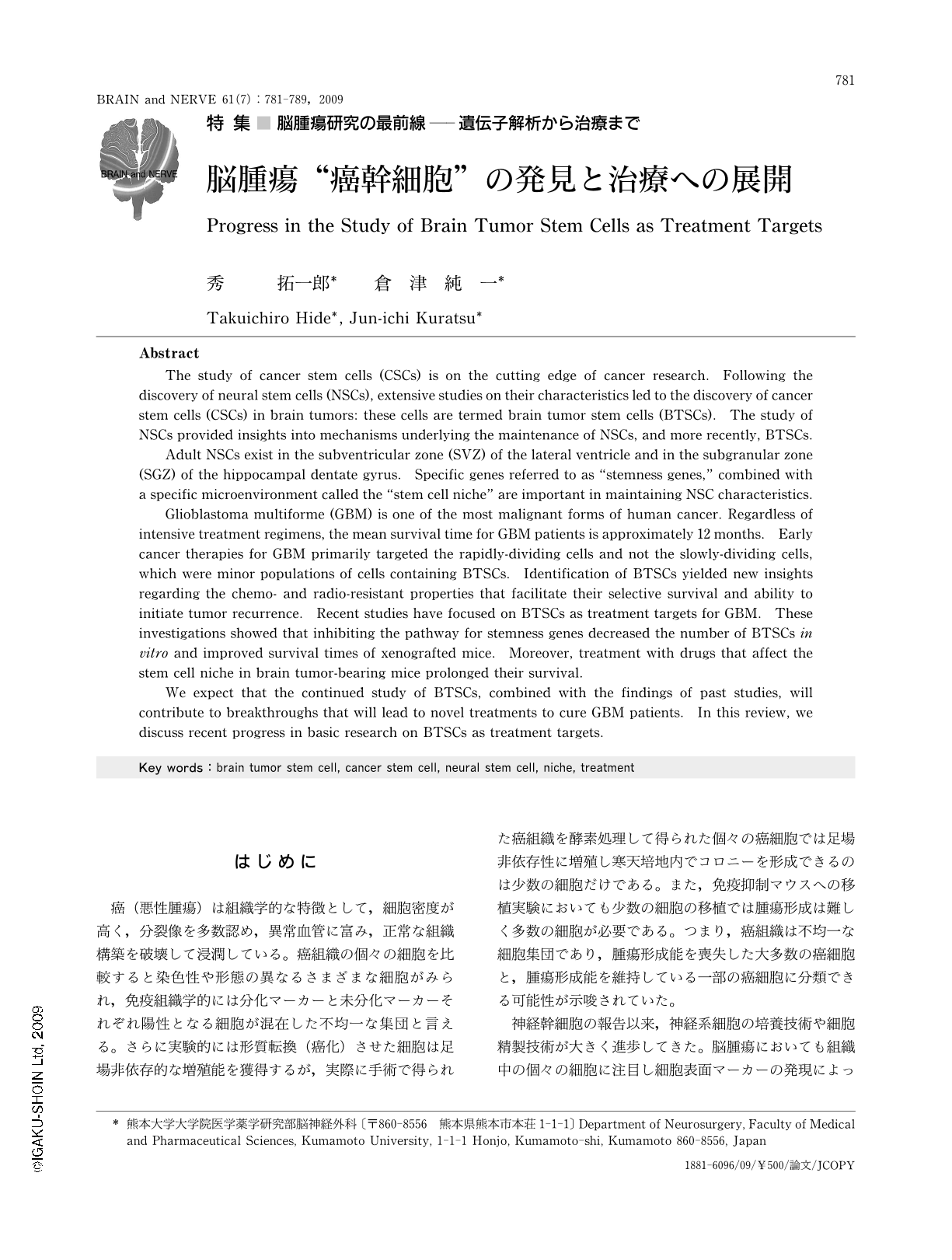
Abstract
The study of cancer stem cells (CSCs) is on the cutting edge of cancer research. Following the discovery of neural stem cells (NSCs), extensive studies on their characteristics led to the discovery of cancer stem cells (CSCs) in brain tumors: these cells are termed brain tumor stem cells (BTSCs). The study of NSCs provided insights into mechanisms underlying the maintenance of NSCs, and more recently, BTSCs.
Adult NSCs exist in the subventricular zone (SVZ) of the lateral ventricle and in the subgranular zone (SGZ) of the hippocampal dentate gyrus. Specific genes referred to as "stemness genes," combined with a specific microenvironment called the "stem cell niche" are important in maintaining NSC characteristics.
Glioblastoma multiforme (GBM) is one of the most malignant forms of human cancer. Regardless of intensive treatment regimens, the mean survival time for GBM patients is approximately 12 months. Early cancer therapies for GBM primarily targeted the rapidly-dividing cells and not the slowly-dividing cells, which were minor populations of cells containing BTSCs. Identification of BTSCs yielded new insights regarding the chemo- and radio-resistant properties that facilitate their selective survival and ability to initiate tumor recurrence. Recent studies have focused on BTSCs as treatment targets for GBM. These investigations showed that inhibiting the pathway for stemness genes decreased the number of BTSCs in vitro and improved survival times of xenografted mice. Moreover, treatment with drugs that affect the stem cell niche in brain tumor-bearing mice prolonged their survival.
We expect that the continued study of BTSCs,combined with the findings of past studies,will contribute to breakthroughs that will lead to novel treatments to cure GBM patients. In this review,we discuss recent progress in basic research on BTSCs as treatment targets.
Copyright © 2009, Igaku-Shoin Ltd. All rights reserved.