Japanese
English
- 有料閲覧
PPV購入案内
1,320円 (1,200円+税10%) こちらは、509ページから516ページの文献です。購入には医書.jp本会員登録が必要です。
会員登録完了後に改めて上記「購入サイトへ」を選択してください。
または「購入サイトへ」選択後に「購入ログイン」、「新規会員登録」の順に進んでください。
会員登録について詳しくはをご確認ください。
- Abstract 文献概要
- 1ページ目 Look Inside
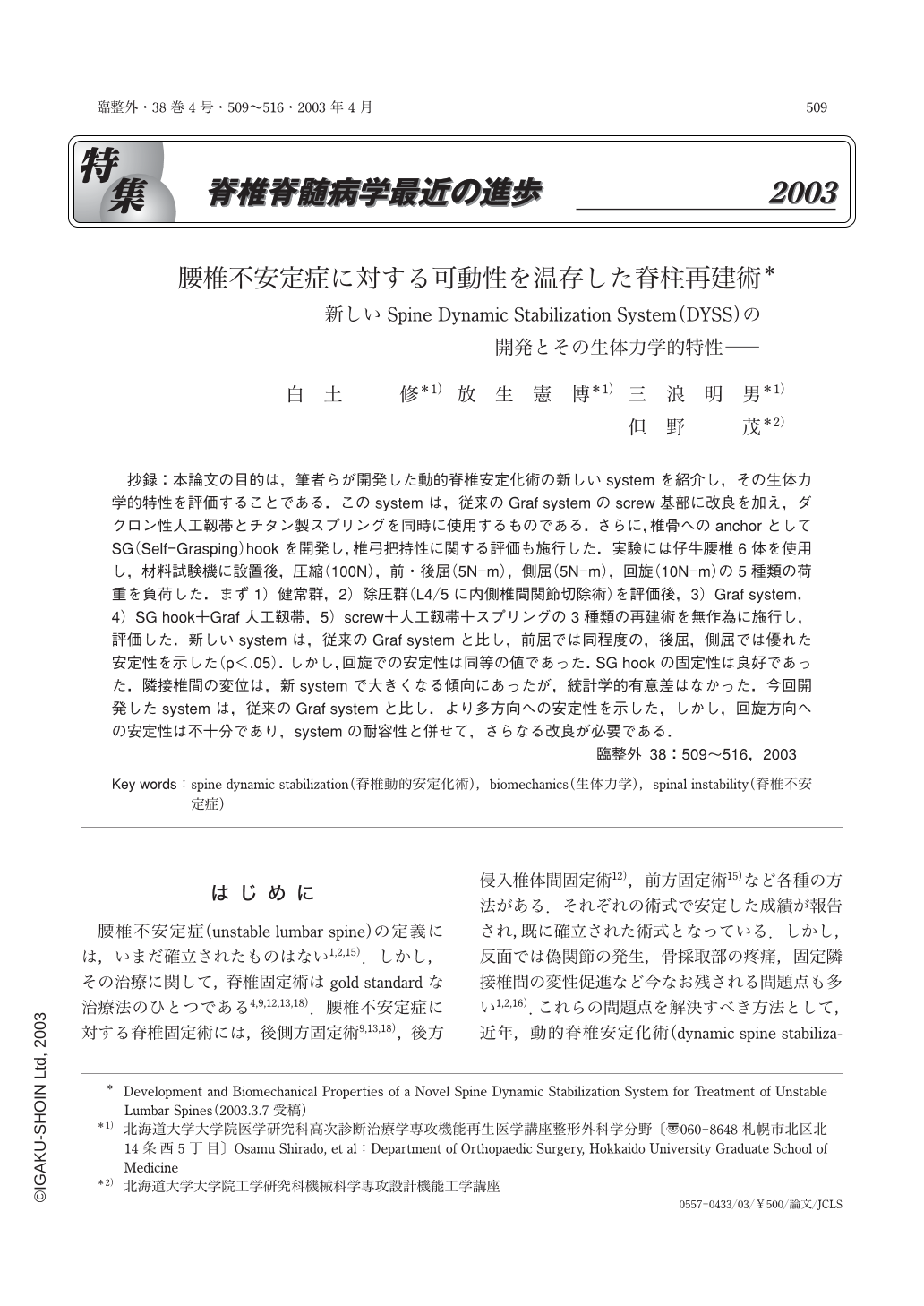
抄録:本論文の目的は,筆者らが開発した動的脊椎安定化術の新しいsystemを紹介し,その生体力学的特性を評価することである.このsystemは,従来のGraf systemのscrew基部に改良を加え,ダクロン性人工靱帯とチタン製スプリングを同時に使用するものである.さらに,椎骨へのanchorとしてSG(Self-Grasping)hookを開発し,椎弓把持性に関する評価も施行した.実験には仔牛腰椎6体を使用し,材料試験機に設置後,圧縮(100N),前・後屈(5N-m),側屈(5N-m),回旋(10N-m)の5種類の荷重を負荷した.まず 1)健常群,2)除圧群(L4/5に内側椎間関節切除術)を評価後,3)Graf system,4)SG hook+Graf人工靱帯,5)screw+人工靱帯+スプリングの3種類の再建術を無作為に施行し,評価した.新しいsystemは,従来のGraf systemと比し,前屈では同程度の,後屈,側屈では優れた安定性を示した(p<.05).しかし,回旋での安定性は同等の値であった.SG hookの固定性は良好であった.隣接椎間の変位は,新systemで大きくなる傾向にあったが,統計学的有意差はなかった.今回開発したsystemは,従来のGraf systemと比し,より多方向への安定性を示した,しかし,回旋方向への安定性は不十分であり,systemの耐容性と併せて,さらなる改良が必要である.
The Graf ligamentoplasty was developed to stabilize unstable lumbar spines without performing fusion and to prevent the adverse degenerative changes produced by motion of the adjacent segment, but the system has no stabilizing effect in regard to backward bending. A new dynamic stabilization system has been developed to solve this problem and provide multidirectional stability. The system comprises pedicle screws and self-grasping laminar hooks connected by artificial longitudinal ligaments and titanium springs. The purpose of this study was to evaluate the biomechanical effect of the new system on the stabilized and adjacent motion segments. The in vitro biomechanical tests were performed in a spine tester with six calf lumbar spine specimens (L2 to sacrum). The specimens were subjected to compression (100 N), flexion (5 N-m), extension (5 N-m), lateral bending (5 N-m), and rotation (10 N-m), and were tested under five conditions:intact, destabilization of L4/5, stabilization by the Graf system, stabilization by an SG hook and Graf ligament, and stabilization by screws, the Graf band, and titanium springs. Extensometers were applied to measure the strain in the stabilized (L4-5) and adjacent segments (L3-4), and the data were statistically analyzed by repeated ANOVA. The new system stabilized the instrumented segment more multidirectionally than the Graf system, but its the stability to rotation was inadequate. The SG hook securely held the lamina during the experiment. There was no statistically significant difference between the Graf system and the new system in regard to strain on the adjacent segment. The results of study demonstrated that the new spinal system provided a multi-directional dynamic stabilization effect for the unstable spine. Dynamic spine stabilization systems may be made feasible by modifying the Graf ligamentoplasty with posterior stabilizing implants. This has the potential to prevent the degeneration of the adjacent segment when properly applied to an unstable lumbar spine.
Copyright © 2003, Igaku-Shoin Ltd. All rights reserved.