Japanese
English
- 有料閲覧
PPV購入案内
1,320円 (1,200円+税10%) こちらは、360ページから365ページの文献です。購入には医書.jp本会員登録が必要です。
会員登録完了後に改めて上記「購入サイトへ」を選択してください。
または「購入サイトへ」選択後に「購入ログイン」、「新規会員登録」の順に進んでください。
会員登録について詳しくはをご確認ください。
- Abstract 文献概要
- 1ページ目 Look Inside
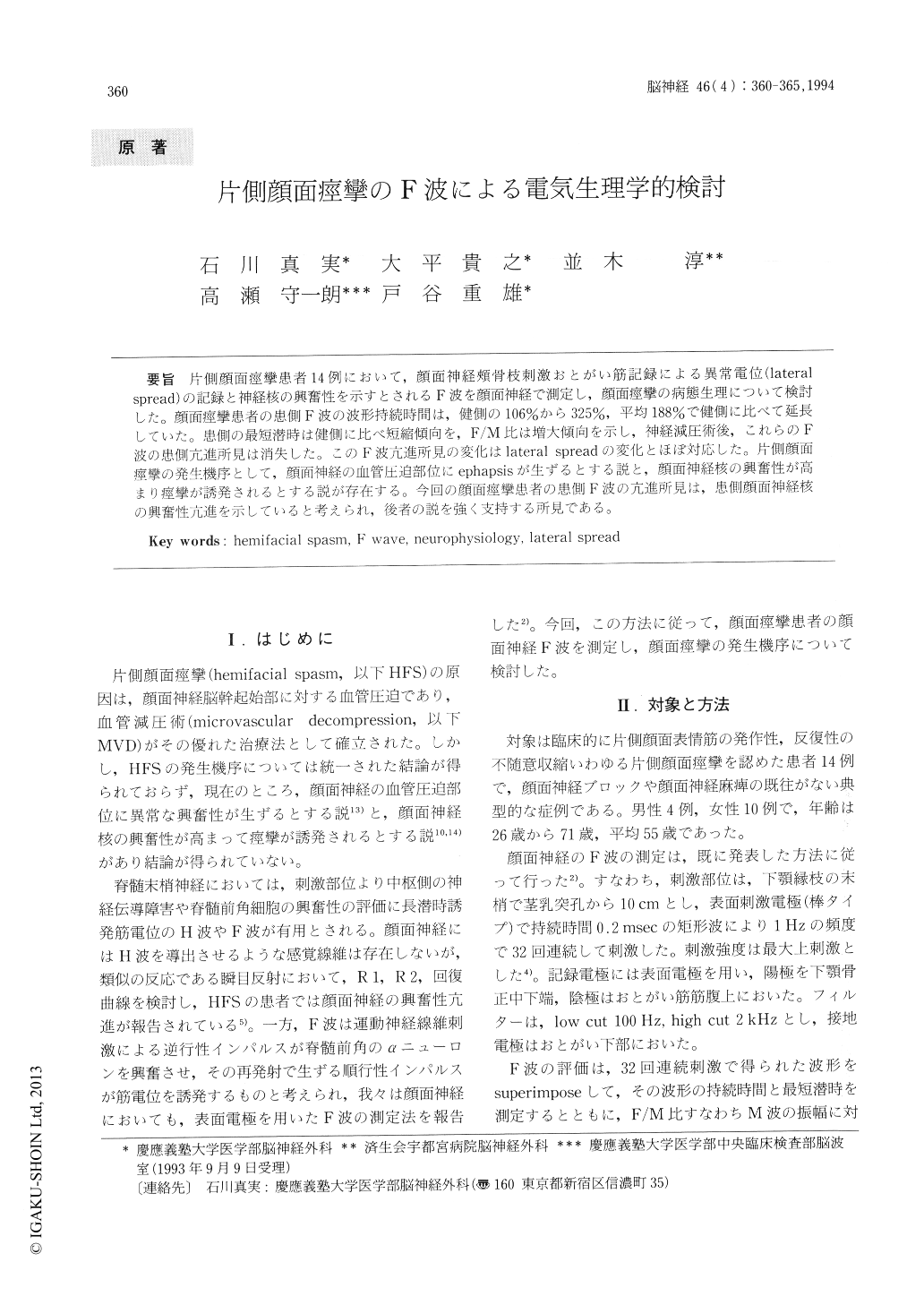
片側顔面痙攣患者14例において,顔面神経頬骨枝刺激おとがい筋記録による異常電位(lateralspread)の記録と神経核の興奮性を示すとされるF波を顔面神経で測定し,顔面痙攣の病態生理について検討した。顔面痙攣患者の患側F波の波形持続時間は,健側の106%から325%,平均188%で健側に比べて延長していた。患側の最短潜時は健側に比べ短縮傾向を,F/M比は増大傾向を示し,神経減圧術後,これらのF波の患側亢進所見は消失した。このF波亢進所見の変化はlateral spreadの変化とほぼ対応した。片側顔面痙攣の発生機序として,顔面神経の血管圧迫部位にephapsisが生ずるとする説と,顔面神経核の興奮性が高まり痙攣が誘発されるとする説が存在する。今回の顔面痙攣患者の患側F波の亢進所見は,患側顔面神経核の興奮性亢進を示していると考えられ,後者の説を強く支持する所見である。
We studied the F wave of the facial muscles on both the normal side and the spastic side in 14 patients with hemifacial spasm. The purpose of this study was to determine if the mechanism of hemifacials spasm originates in ephaptic transmis-sion in the facial nerve at the site of vascular com-pression or in a hyperexcited facial motor nucleus. Larger amplitude, longer duration and shorter latency F waves in the peripheral nerves than in normals indicate anterior horn cell hyperexcita-bility.
Copyright © 1994, Igaku-Shoin Ltd. All rights reserved.