Japanese
English
- 有料閲覧
PPV購入案内
1,320円 (1,200円+税10%) こちらは、561ページから567ページの文献です。購入には医書.jp本会員登録が必要です。
会員登録完了後に改めて上記「購入サイトへ」を選択してください。
または「購入サイトへ」選択後に「購入ログイン」、「新規会員登録」の順に進んでください。
会員登録について詳しくはをご確認ください。
- Abstract 文献概要
- 1ページ目 Look Inside
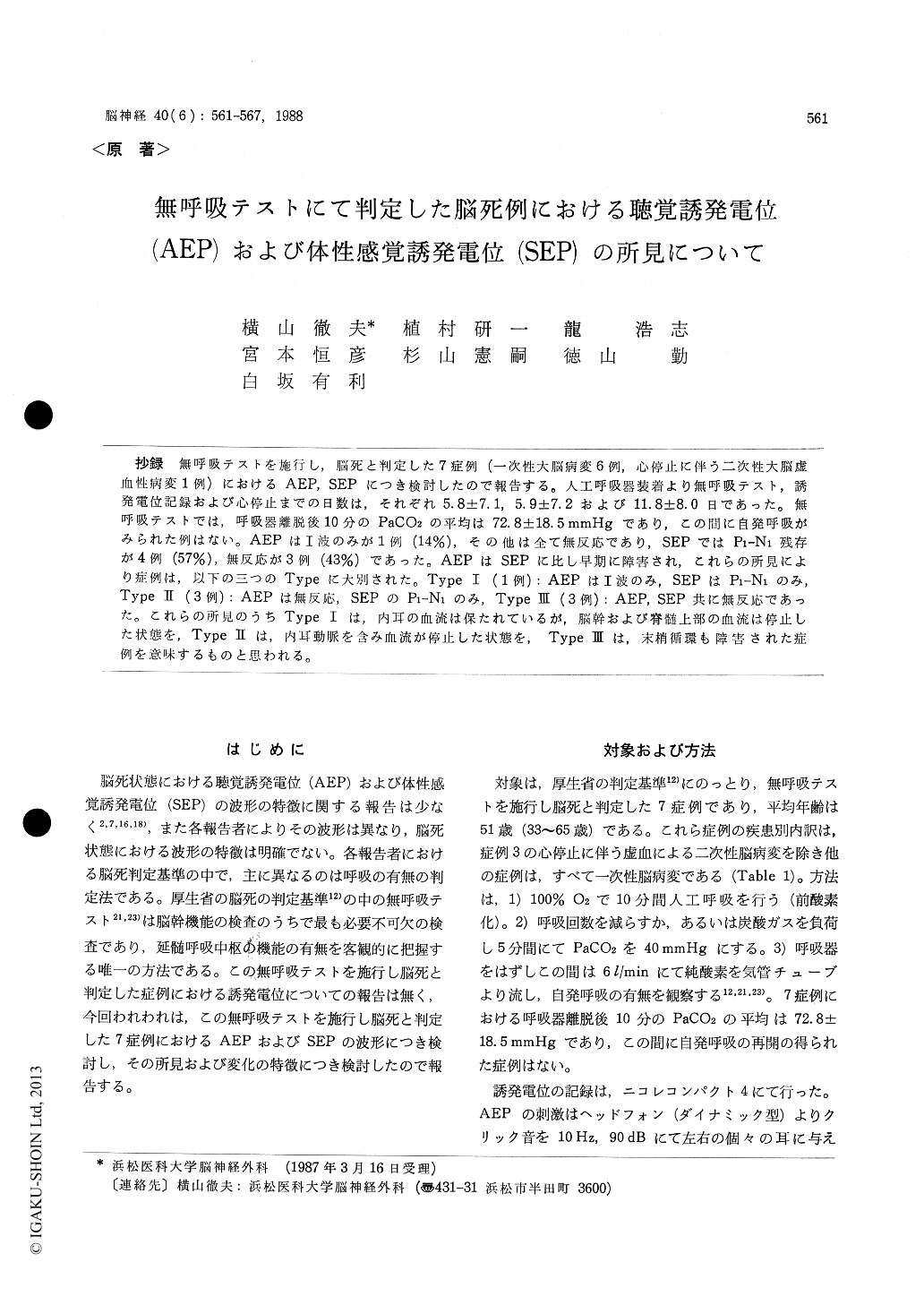
抄録 無呼吸テストを施行し,脳死と判定した7症例(一次性大脳病変6例,心停止に伴う二次性大脳虚血性病変1例)におけるAEP,SEPにつき検討したので報告する。人工呼吸器装着より無呼吸テスト,誘発電位記録および心停止までの日数は,それぞれ5.8±7.1,5.9±7.2および11.8±8.0日であった。無呼吸テストでは,呼吸器離脱後10分のPaCO2の平均は72.8±18.5mmHgであり,この間に自発呼吸がみられた例はない。AEPはI波のみが1例(14%),その他は全て無反応であり,SEPではP1—N1残存が4例(57%),無反応が3例(43%)であった。AEPはSEPに比し早期に障害され,これらの所見により症例は,以下の三つのTypeに大別された。Type I (1例):AEPはI波のみ,SEPはP1—N1のみ,Type II (3例):AEPは無反応,SEPのP1—N1のみ,Type III (3例):AEP,SEP共に無反応であった。これらの所見のうちType Iは,内耳の血流は保たれているが,脳幹および脊髄上部の血流は停止した状態を,Type IIは,内耳動脈を含み血流が停止した状態を,Type IIIは,末梢循環も障害された症例を意味するものと思われる。
The findings of AEP and SEP in the cases with brain death confirmed by the apnea test had not been reported. We studied the features and the characteristic changes of those evoked potentials in 7 cases of brain death.
The etiology of brain death in those cases were the primary intracranial lesions in six and the brain ischemia secondary to cardiac arrest in the others. The apnea test and the recordings of AEP and SEP were performed in the same day in most cases. The mean intervals from the application of the respirator to the apnea test and to cardiacarrest were 5.8±7.1 days and 5.9±7.2 days, re-spectively. Cardiac arrest occured with mean of 11.8±8.0 days after the application of the respi-rator. AEP showed absent responses in six cases (86%) and wave I only in the other (14%). SEP showed P 1-N 1 in four cases (57%) and no re-sponses in three (43%). The components of AEP were disturbed earier than those of SEP and cases were classified into three types according to those findings. Type I (one case, 13%) : wave I only in AEP and P 1-N 1 in SEP. Type II (three cases, 28%) : no wave in AEP and P 1-N 1 in SEP. Type III (three cases, 28%) : no wave in AEP and SEP.
AEP and SEP seem to reveal the process of brain death and those findings seemed to suggest the blood circulation such as ; Type I: represents no blood circulation in the brain stem and the upper spinal cord but the circulation in the audi-tory nerve was still preserved, Type II : the circu-lation in the auditory nerve was disturbed but the peripheral blood circulation was kept intact, Type III : the peripheral blood circulation was collapsed.
Copyright © 1988, Igaku-Shoin Ltd. All rights reserved.