Japanese
English
- 有料閲覧
PPV購入案内
1,320円 (1,200円+税10%) こちらは、367ページから373ページの文献です。購入には医書.jp本会員登録が必要です。
会員登録完了後に改めて上記「購入サイトへ」を選択してください。
または「購入サイトへ」選択後に「購入ログイン」、「新規会員登録」の順に進んでください。
会員登録について詳しくはをご確認ください。
- Abstract 文献概要
- 1ページ目 Look Inside
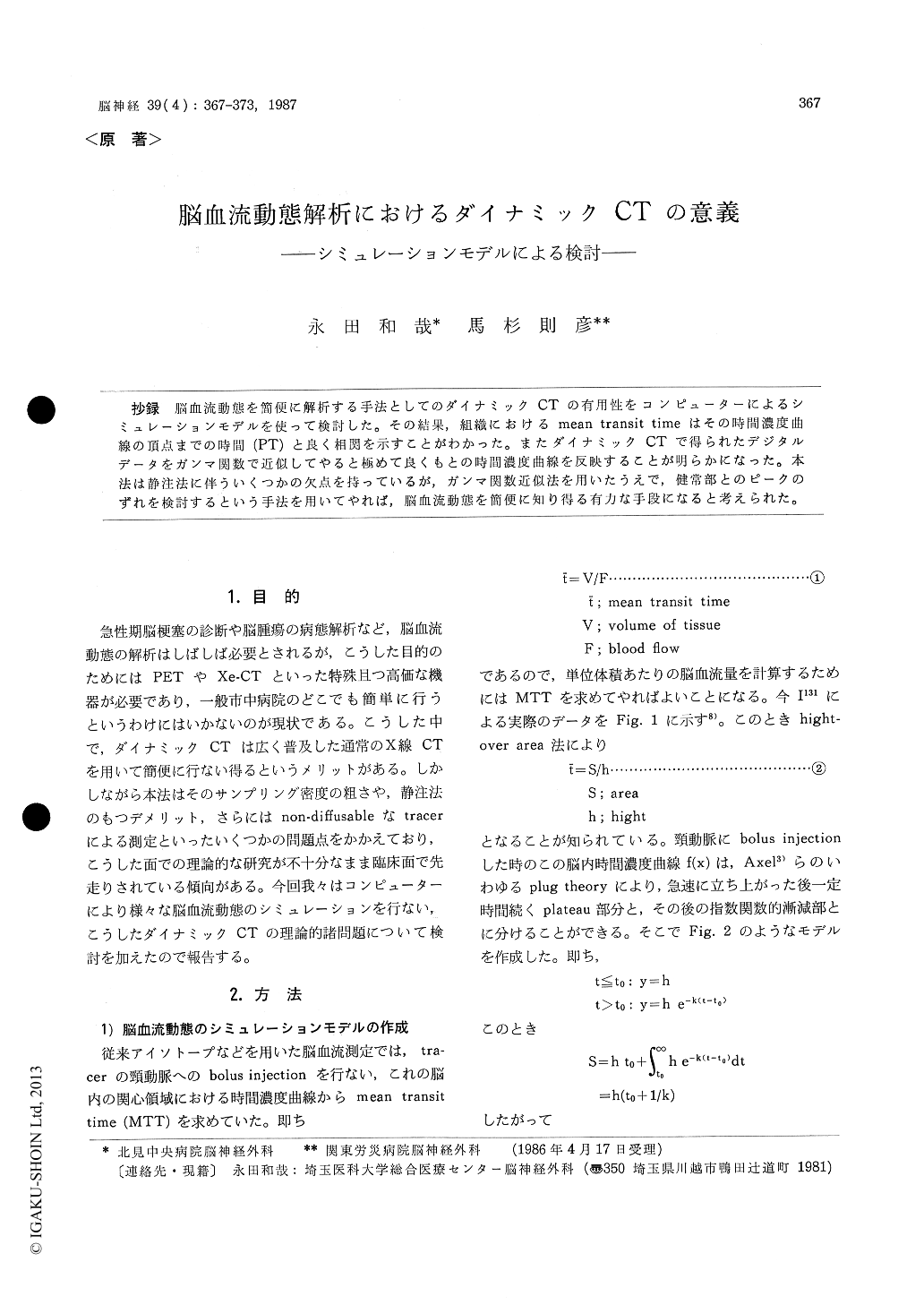
抄録 脳血流動態を簡便に解析する手法としてのダイナミックCTの有用性をコンピューターによるシミュレーションモデルを使って検討した。その結果,組織におけるmean transit timeはその時間濃度曲線の頂点までの時間(PT)と良く相関を示すことがわかった。またダイナミックCTで得られたデジタルデータをガンマ関数で近似してやると極めて良くもとの時間濃度曲線を反映することが明らかになった。本法は静注法に伴ういくつかの欠点を持っているが,ガンマ関数近似法を用いたうえで,健常部とのピークのずれを検討するという手法を用いてやれば,脳血流動態を簡便に知り得る有力な手段になると考えられた。
Abstract It is generally accepted that dynamic CT is one of the best way to evaluate cerebral hemo-dynamics. Employing our original computer simu-lation method, the present study was undergone to examine the theoretical background of dynamic CT. When a single bolus injection of non-diffu-sable indicator is intravenously performed, the time density curve of a cerebral tissue consists of the following two components : the time den-sity curve of a carotid artery (g (x)) and the dis-persion curve through the cerebral tissue (f (x)). A mean transit time (MTT) of the latter curve can be mathematically calculated by height-over area method. The concept gave us an interesting idea that a computer simulation could produce the time density curve implying an MTT. Convo-lution technique was applied to synthesize it from f (x) and g (x). The latter curve (g (x)) is influen-ced by several conditions such as a dispersion through a lung, a cardiac output and systemic arterial pressure. Therefore, it is not essential to measure the definite parameter from the time density curve obtained by dynamic CT. Dynamic CT should be considered as a qualitative method rather than a quantitative one. Several parameters were given by the analysis of a simulated curve. A time to peak (PT), above all, was most linerly correlated to MTT. A prolongation of PT in the insulted area, which means a prolongation of MTT, leads to a decrease of cerebral blood flow. In addition, we examined if Gamma variate fitting curve could apply a substitute for an original time density curve. The computer simulation meth-od revealed a high resemblance between them. We therefore concluded that dynamic CT com-bined with the measurement of PT on the fitted Gamma curve could be a simple and useful technique for an analysis of cerebral hemodynamics.
Copyright © 1987, Igaku-Shoin Ltd. All rights reserved.