Japanese
English
- 有料閲覧
PPV購入案内
1,320円 (1,200円+税10%) こちらは、877ページから884ページの文献です。購入には医書.jp本会員登録が必要です。
会員登録完了後に改めて上記「購入サイトへ」を選択してください。
または「購入サイトへ」選択後に「購入ログイン」、「新規会員登録」の順に進んでください。
会員登録について詳しくはをご確認ください。
- Abstract 文献概要
- 1ページ目 Look Inside
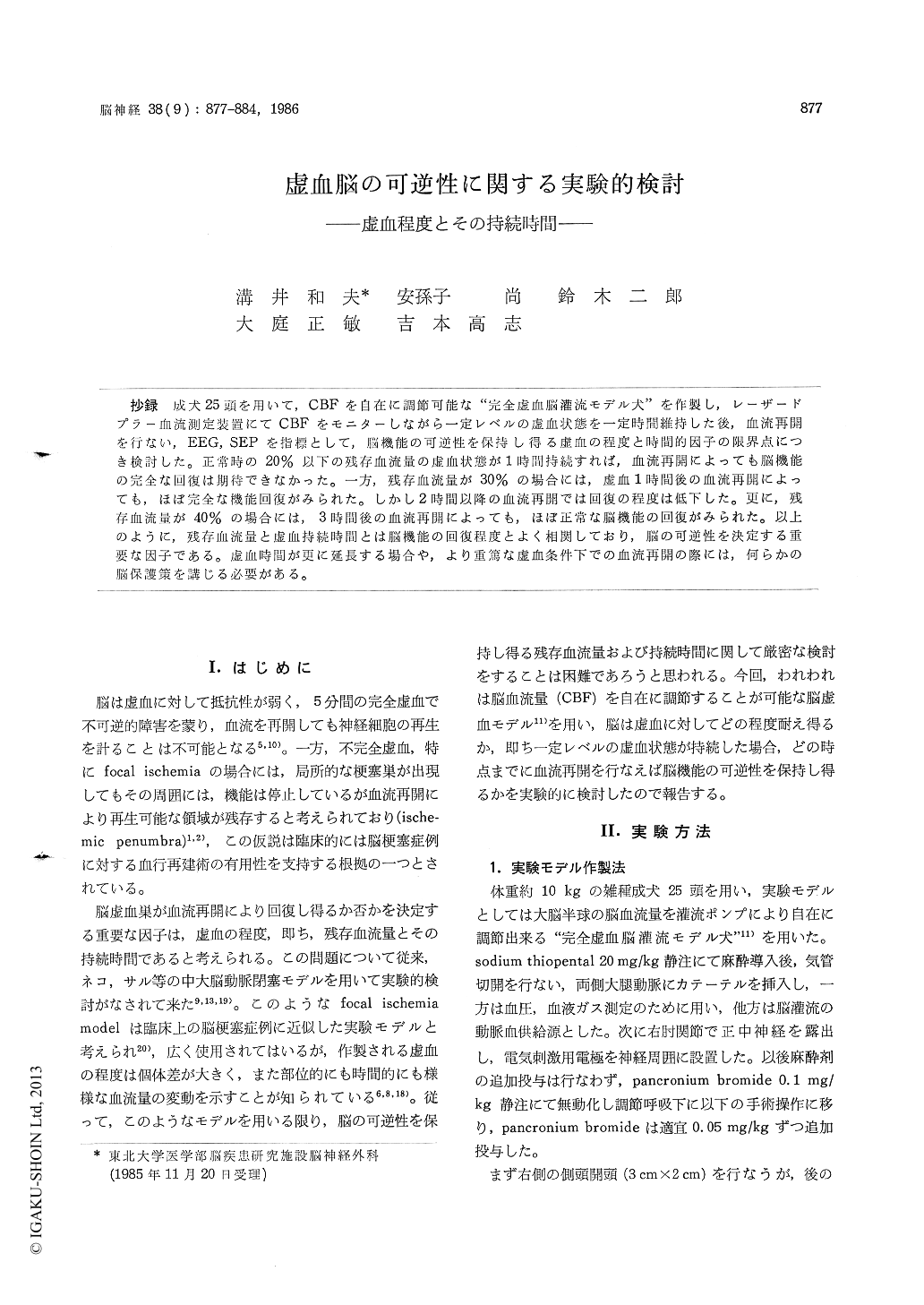
抄録 成犬25頭を用いて,CBFを自在に調節可能な"完全虚血脳灌流モデル犬"を作製し,レーザードプラー血流測定装置にてCBFをモニターしながら一定レベルの虚血状態を一定時間維持した後,血流再開を行ない,EEG,SEPを指標として,脳機能の可逆性を保持し得る虚血の程度と時間的因子の限界点につき検討した。正常時の20%以下の残存血流量の虚血状態が1時間持続すれば,血流再開によっても脳機能の完全な回復は期待できなかった。一方,残存血流量が30%の場合には,虚血1時間後の血流再開によっても,ほぼ完全な機能回復がみられた。しかし2時間以降の血流再開では回復の程度は低下した。更に,残存血流量が40%の場合には,3時間後の血流再開によっても,ほぼ正常な脳機能の回復がみられた。以上のように,残存血流量と虚血持続時閥とは脳機能の回復程度とよく相関しており,脳の可逆性を決定する重要な因子である。虚血時間が更に延長する場合や,より重篤な虚血条件下での血流再開の際には,何らかの脳保護策を講じる必要がある。
This experimental study was designed to esti-mate the flow thresholds and the time thresholds for reversibility of cerebral ischemia.
We used a "canine model of completely ischemic brain regulated with a perfusion method", in which the cerebral blood flow (CBF) could be controlled. The residual blood flow was reduced to 10%, 20%, 30% or 40% of normal CBF, and the recirculation was started after 1, 2, 3 or 4 hours of ischemia. CBF was measured by a laser doppler flow meter. EEG and somatosensory evoked potential (SEP) was monitored and used as a parameter expressing the brain function.
In the 10% and 20% ischemia group, functional recovery could not be obtained even if reperfusion was started at 1 hour after the onset of ischemia. On the other hand, in the 30% ischemia group, nearly complete recovery of EEG and SEP could be seen when reperfusion was done at 1 hour from the onset of ischemia. But recirculation after 2 hours of ischemia did not lead to significant functional recovery. In the 40% ischemia group, reperfusion within 3 hours of ischemia allowed full recovery of ischemic brain. On the contrary, reperfusion after 4 hours of ischemia showed a gradual deterioration of EEG and SEP. According-ly, it was clearly demonstrated that the reversi-bility of ischemic brain was critically correlated to severity and duration of cerebral ischemia.
If these results can be applied to human brain, acute cerebral revascularization for ischemic stroke should be attempted when critical ischemic flow and time thresholds have not been crossed, namely, in less than 1 hour and 3 hours of insult when residual blood flow is reduced to 30% and 40% of the normal status, respectively. In clinical situation, this "critical time" may be too short for acute revascularization to be acomplished. Various available forms of cerebral protective measures should be applied pre-operatively in order to prolong the viability of cerebral ischemic tissue.
Copyright © 1986, Igaku-Shoin Ltd. All rights reserved.