Japanese
English
- 有料閲覧
PPV購入案内
1,320円 (1,200円+税10%) こちらは、361ページから366ページの文献です。購入には医書.jp本会員登録が必要です。
会員登録完了後に改めて上記「購入サイトへ」を選択してください。
または「購入サイトへ」選択後に「購入ログイン」、「新規会員登録」の順に進んでください。
会員登録について詳しくはをご確認ください。
- Abstract 文献概要
- 1ページ目 Look Inside
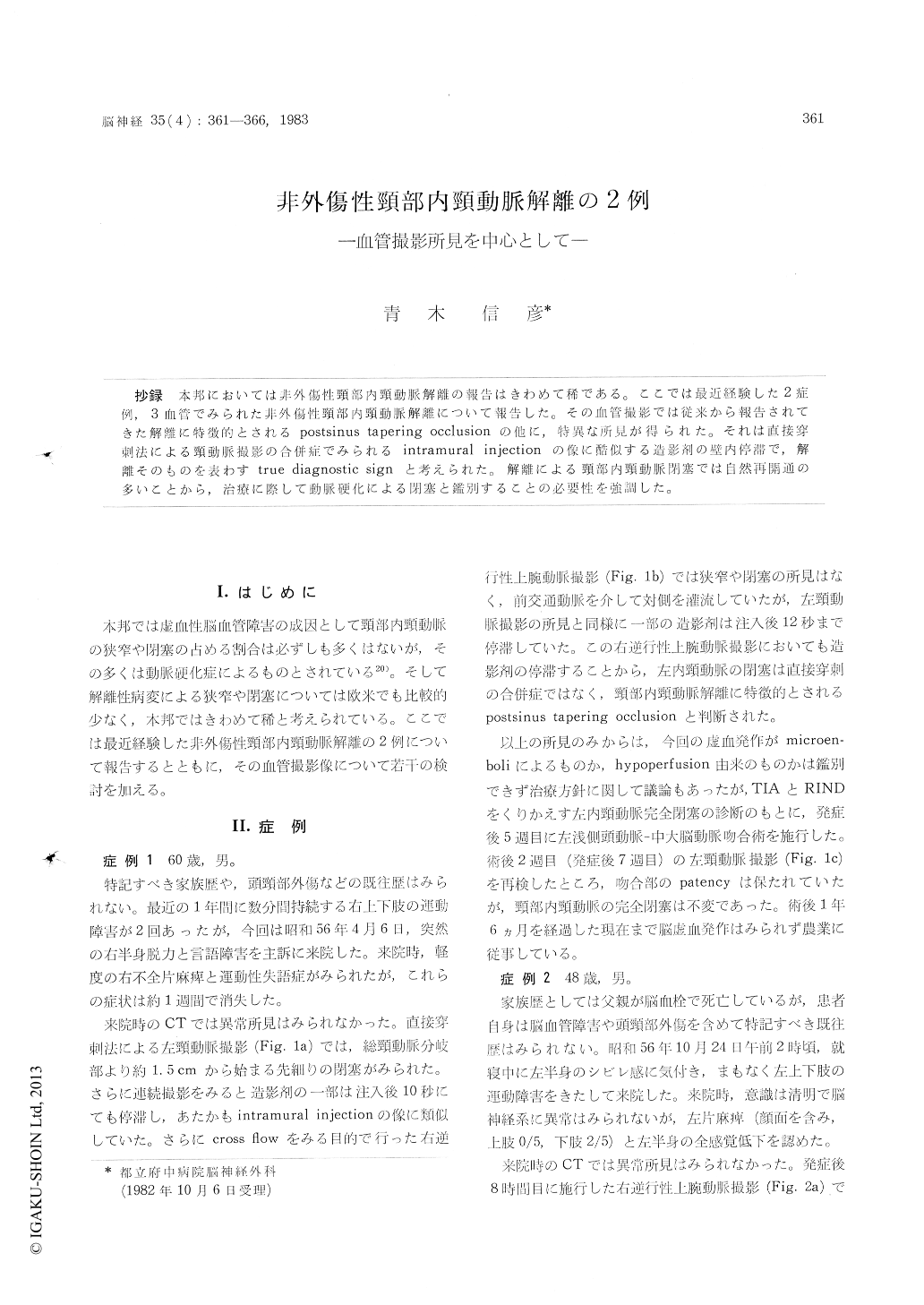
抄録 本邦においては非外傷性頸部内頸動脈解離の報告はきわめて稀である。ここでは最近経験した2症例,3血管でみられた非外傷性頸部内頸動脈解離について報告した。その血管撮影では従来から報告されてきた解離に特徴的とされるpostsinus tapering occlusionの他に,特異な所見が得られた。それは直接穿刺法による頸動脈撮影の合併症でみられるintramural injectionの像に酷似する造影剤の壁内停滞で,解離そのものを表わすtrue diagnostic signと考えられた。解離による頸部内頸動脈閉塞では自然再開通の多いことから,治療に際して動脈硬化による閉塞と鑑別することの必要性を強調した。
The author has recently experienced two cases of the spontaneous dissection of the cervical inter-nal carotid artery, which had rarely been report-ed in Japan. Angiography showed a distinct feature considered to be a true diagnostic sign of the dissection in addition to the features pre-viously reported.
Case 1 : A sixty-year-old man having two epi-sodes of transient weakness on the right side during the preceding year developed a sudden onset of right hemiparesis and dysphasia. They disappeared in a week. The left carotid angio-graphy (CAG) by the direct puncture method in the hospital demonstrated postsinus tapering occlusion in the arterial phase, and retention of the contrast medium in the venous phase. The latter resembled what could be observed when an intramural injection was given. At the same time, the right retrograde brachial angiography revealedretention of the contrast medium in the venous phase as the left CAG did, though it did not show any obstruction or stenosis. Five weeks later, the patient underwent an operation for STA-MCA anastomosis, and for a year and a half thereafter, he has not shown any recurrence of ishemic attack.
Case 2: A forty-year-old man was seized with a rapid progression of the left motor weakness, and came to the hospital. He was found to have dense hemiparesis and hemihypesthesia on the left side. The right retrograde brachial angio-graphy demonstrated postsinus tapering occlusion in the arterial phase, and retention of the contrast material in the venous phase. As a result of con-servative treatment, his hemiparesis was gradually improved, and he was discharged from the hospital four months later with a minimal deficit. Three months after the onset, the right CAG had shown recanalization of the internal carotid artery with an irregular narrowing in the cavernous portion.
The angiographic findings which have so far been reported as being characteristic of the in-ternal carotid dissection are string sign, postsinus tapering occlusion, dissecting aneurysm and intimal flap. None of these findings except for the intimal flap can, however, be said to indicate the dissec-tion per se. On the other hand, the retention of the contrast medium presumably in the arterial wall, which may be an "intramural pooling sign", can be considered to be an angiographically true diagnostic sign of the carotid dissection, because its appearance is identical to a picture obtained by an intramural injection on a complication of CAG by the direct puncture method.
Copyright © 1983, Igaku-Shoin Ltd. All rights reserved.