Japanese
English
- 有料閲覧
PPV購入案内
1,320円 (1,200円+税10%) こちらは、1041ページから1047ページの文献です。購入には医書.jp本会員登録が必要です。
会員登録完了後に改めて上記「購入サイトへ」を選択してください。
または「購入サイトへ」選択後に「購入ログイン」、「新規会員登録」の順に進んでください。
会員登録について詳しくはをご確認ください。
- Abstract 文献概要
- 1ページ目 Look Inside
I.はじめに
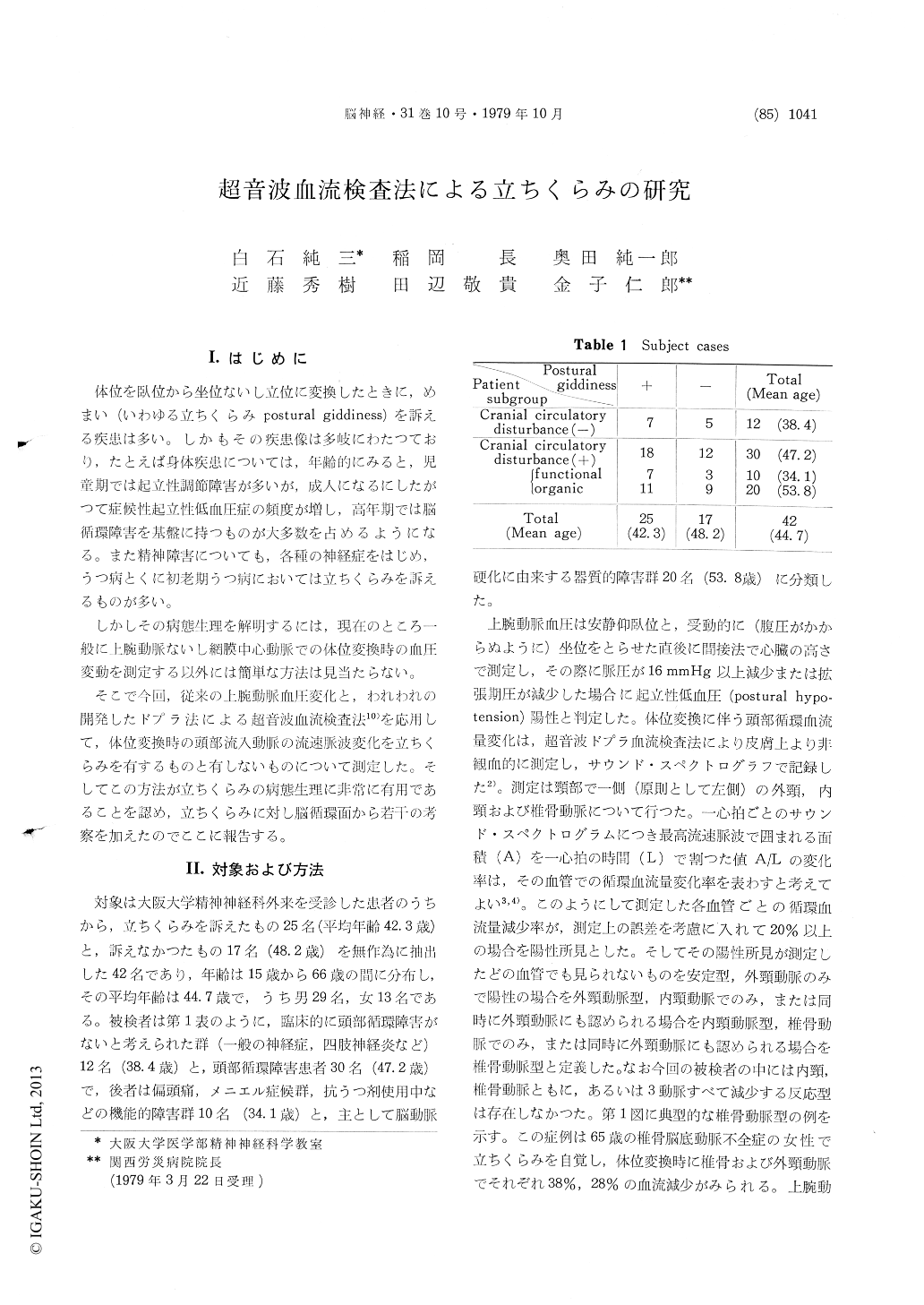
体位を臥位から坐位ないし立位に変換したときに,めまい(いわゆる立ちくらみpostural giddiness)を訴える疾患は多い。しかもその疾患像は多岐にわたつており,たとえば身体疾患については,年齢的にみると,児童期では起立性調節障害が多いが,成人になるにしたがつて症候性起立性低血圧症の頻度が増し,高年期では脳循環障害を基盤に持つものが大多数を占めるようになる。また精神障害についても,各種の神経症をはじめ,うつ病とくに初老期うつ病においては立ちくらみを訴えるものが多い。
しかしその病態生理を解明するには,現在のところ一般に上腕動脈ないし網膜中心動脈での体位変換時の血圧変動を測定する以外には簡単な方法は見当たらない。
Twenty five patients with postural giddiness and seventeen patients without it were studied in this report. They were also divided into the following two categories ; patients without any cranial cir-culatory disturbances (twelve cases) and those who had either functional or organic cranial circulatory disturbances (thirty cases). Blood flow measure-ments in external carotid, internal carotid and vertebral arteries by Doppler ultrasound as well as the blood pressure measurement in brachial artery were made in each patient before and after the postural change from spine to sitting.
The results were as follows.
1) The mode of reaction with respect to blood flow decrease in the cranial arteries by the postural change could be differentiated into four types, i. e. the external carotid type, the internal carotid type, the vertebral type and the steady type.
2) Postural hypotension was more frequently observed in those who had postural giddiness and in patients with cranial circulatory disturbances (0.05 <p <0.1 respectively).
3) In those who showed either the internal carotid type or the vertebral type, which were designated as the abnormal response type in cerebral circulation, the number of patients with postural giddiness was significantly larger than that without postural giddiness (p<0.05). The abnormal response type in cerebral circulation appeared more frequently in patients with cranial circulatory disturbances (p<0.01) and in aged group (0.05<p<0.1). In those who had cranial circulatory disturbances, external carotid flow tended to decrease inde-pendently of blood flow changes in other arteries (0.05<p<0.1).
4) No significant correlation was found between postural hypotension and the mode of reaction incranial arterial blood flow, but it seemed that the former might be related to the decrease of external carotid flow. Patients who had both postural giddiness and the organic cranial circulatory dis-turbances i. e. cerebrovascular diseases tended to show more frequently the abnormal response type in cerebral circulation rather than the postural hypotension.
5) In patients with postural giddiness and without the postural hypotension or the abnormal response in cerebral circulation, those who had organic cranial circulatory disturbances (cerebrovascular diseases) were not found out. The basic illness of all these patients belonged to the category of neurosis.
In consideration of these results, a possible mechanism and the process on postural giddiness were discussed as follows: i) Systemic orthostatic hypotension by the gravitational effect with postural change. ii) Decrease of effective cerebral blood pressure. iii) Regional disturbance of autoregu-lation in the brain. iv) Impairment of cerebral collateral circulation. v) Regional ischemia of the brain. vi) Postural giddiness as a subjective symptom. It was thought that the blood pressure measurement of brachial artery would be useful to assess the process i), and that the Doppler flowmetry on the cranial arteries would evaluate the processes iii) and iv).
Copyright © 1979, Igaku-Shoin Ltd. All rights reserved.