Japanese
English
- 有料閲覧
PPV購入案内
1,320円 (1,200円+税10%) こちらは、855ページから860ページの文献です。購入には医書.jp本会員登録が必要です。
会員登録完了後に改めて上記「購入サイトへ」を選択してください。
または「購入サイトへ」選択後に「購入ログイン」、「新規会員登録」の順に進んでください。
会員登録について詳しくはをご確認ください。
- Abstract 文献概要
- 1ページ目 Look Inside
I.はじめに
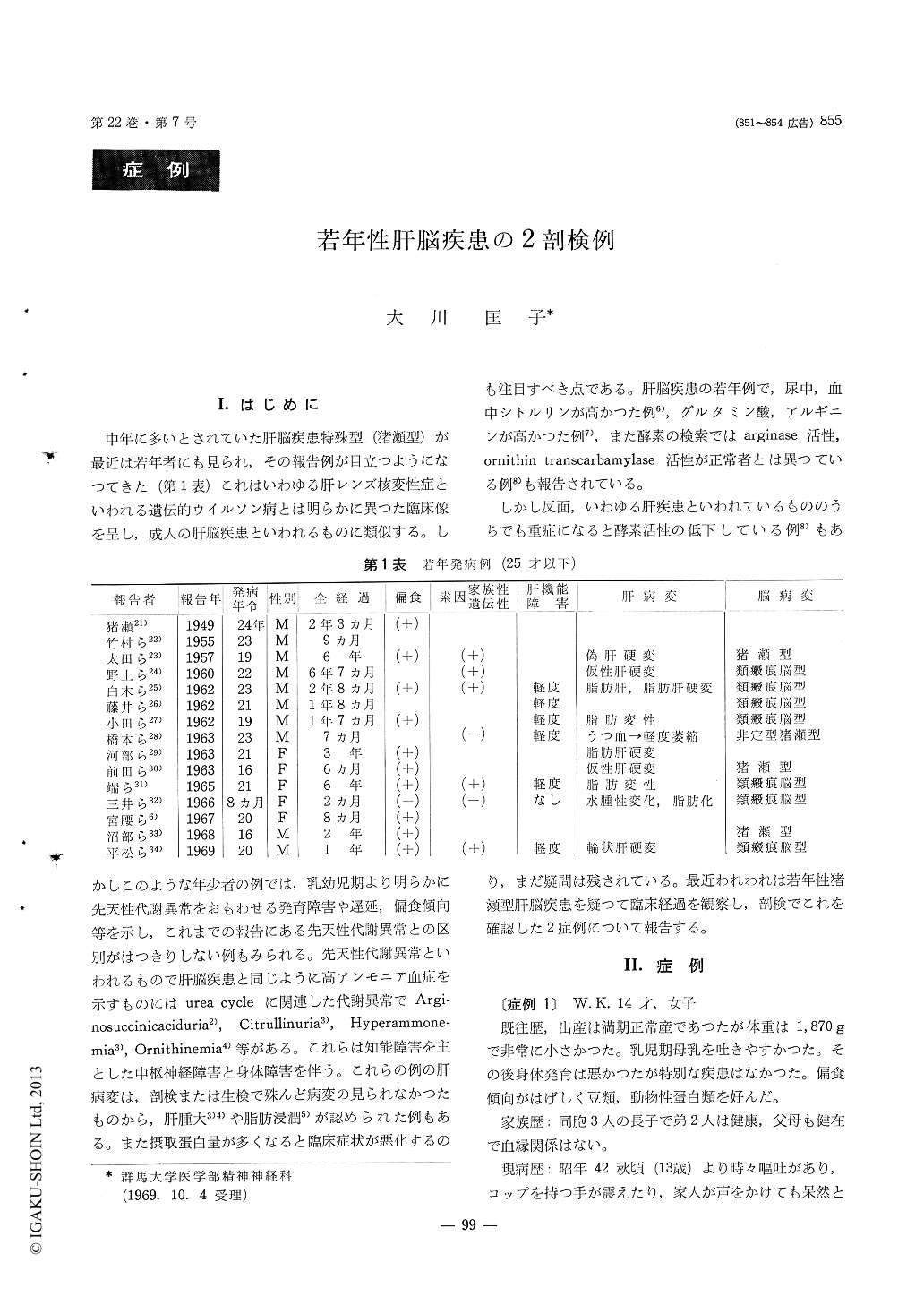
中年に多いとされていた肝脳疾患特殊型(猪瀬型)が最近は若年者にも見られ,その報告例が目立つようになつてきた(第1表)これはいわゆる肝レンズ核変性症といわれる遺伝的ウイルソン病とは明らかに異つた臨床像を呈し,成人の肝脳疾患といわれるものに類似する。しかしこのような年少者の例では,乳幼児期より明らかに先天性代謝異常をおもわせる発育障害や遅延,偏食傾向等を示し,これまでの報告にある先天性代謝異常との区別がはつきりしない例もみられる。先天性代謝異常といわれるもので肝脳疾患と同じように高アンモニァ血症を示すものにはurea cycleに関連した代謝異常でArgi—nosuccinicaciduria2), Citrullinuria3), Hyperammone—mia3), Ornithinemia4)等がある。これらは知能障害を主とした中枢神経障害と身体障害を伴う。これらの例の肝病変は,剖検または生検で殊んど病変の見られなかつたものから,肝腫大3)4)や脂肪浸潤5)が認められた例もある。また摂取蛋白量が多くなると臨床症状が悪化するのも注目すべき点である。肝脳疾患の若年例で,尿中,血中シトルリンが高かつた例6),グルタミン酸,アルギニンが高かつた例7),また酵素の検索ではarginase活性,ornithin transcarbamylase活性が正常者とは異つている例8)も報告されている
しかし反面,いわゆる肝疾患といわれているもののうちでも重症になると酵素活性の低下している例8)もあり,まだ疑問は残されている。最近われわれは若年性猪瀬型肝脳疾患を疑つて臨床経過を観察し,剖検でこれを確認した2症例について報告する。
Since the original report on the special form of hepatocerebral disease by Inose, many cases which had the first attack in the middle age, have been published. However, several cases of young age have been reported recently. From the early infantile stage, these young cases are always associated with a mental retardation, a developmental regression and a disposition of unbalanced diet. These character-istics are common with those of inborn metabolic disorder, such as arginosuccinic aciduria, citrullinem-ia, hyperammonemia or ornithinemia.
In this report, two young cases with suspicion of inborn metabolic disorder were presented. Case 1, female, aged 14, was the first child of healthy, unrelated parent. Two other sibs were unaffected. She was born after uncomplicated pregnancy and delivery with a light weight (1870g). She had vomit-ted frequently during the first few months. She liked peanuts very much. At age 13, her mother noticed the finger tremor of the patient at the table and sometimes she became very irritable. At age 14, she had a sudden attack of epileptic fit with long lethergic state (18 hrs). Since that time, she had suffered from unconciousness episodes with ab-normal behaviors resembling automatism accompan-ied by ataxia, slurred speech and finally lethargic state, especially in the evenening. Three months after the first convulsion, she was hospitalzed be-cause of the repeated disturbance of consciousness.
On admission, physical and neurological examina-tions showed no abnormality except for a very slim (skinny) figure. An EEG revealed triphasic waves. Urinary and plasma amino-acid chromatograms showed an elevated level of citrulline. Blood am-monia was 150 γ/dl. Intermittent vomitting and periods of unconsciousness increased in frequency and in duration gradually. Death occurred 10 months after the onset of her illness. Necropsy revealed fatty degeneration of the liver, cerebral edema and spongy formation in the cortex and basal ganglia associated with Alzheimer's glia type II.
Case 2, female age 24, was the 11th child of he-althy, unrelated parents. She was the product of a normal pregnancy and delivery. Her development was delayed. The family history is quite remarkable. Except one, other 9 sibs were all died at from 3 days to 25 years of age. The sib, age 25, had ob-viously similar clinical history. At age 21, she showed the first episode of unconsciousness. She became restless and was walking around the table without response to any call. Laboratory examinations re-vealed very high blood ammonia level (124-546 γ/dl) and very low cholinesterase activity of serum. The liver function test was normal. An EEG exibited θ activities with triphasic waves and δ ones.
She was also fond of protein diet and it made increase attacks of unconsciousness and weight loss. She died at age 24 of acute pneumonia. Fatty cir-rhosis of the liver and spongy formation in the brain were found at necropsy.
The first case had citrullinemia, the second case had the family disposition and both showed the addiction to protein diet and the delayed development.
These facts seem to suggest some connection be-tween the so called special form of hepatocerebral disease and inborn metabolic disorders described above.
Copyright © 1970, Igaku-Shoin Ltd. All rights reserved.