Japanese
English
- 有料閲覧
PPV購入案内
1,320円 (1,200円+税10%) こちらは、935ページから944ページの文献です。購入には医書.jp本会員登録が必要です。
会員登録完了後に改めて上記「購入サイトへ」を選択してください。
または「購入サイトへ」選択後に「購入ログイン」、「新規会員登録」の順に進んでください。
会員登録について詳しくはをご確認ください。
- Abstract 文献概要
- 1ページ目 Look Inside
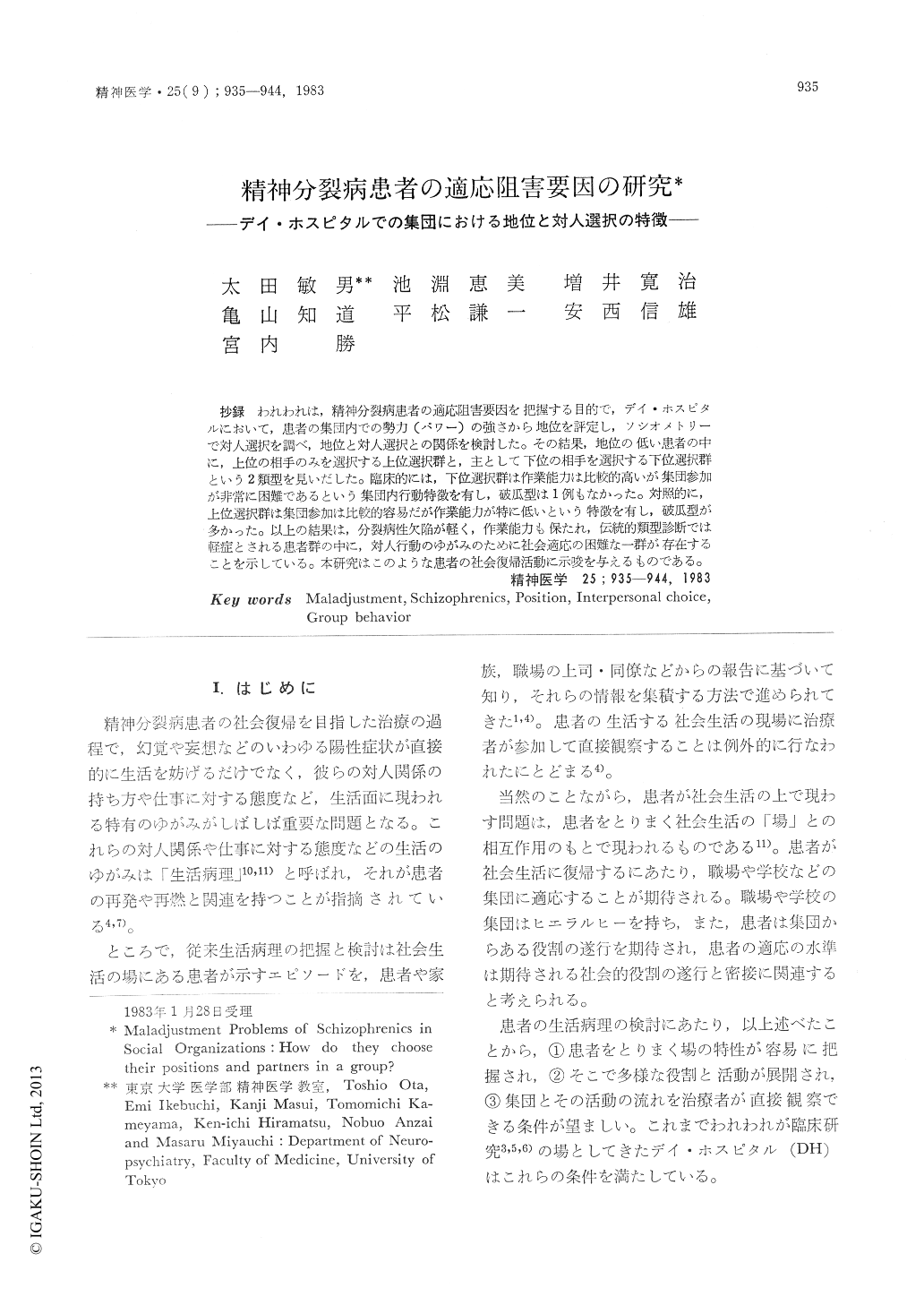
抄録 われわれは,精神分裂病患者の適応阻害要因を把握する目的で,デイ・ホスピタルにおいて,患者の集団内での勢力(パワー)の強さから地位を評定し,ソシオメトリーで対人選択を調べ,地位と対人選択との関係を検討した。その結果,地位の低い患者の中に,上位の相手のみを選択する上位選択群と,主として下位の相手を選択する下位選択群という2類型を見いだした。臨床的には,下位選択群は作業能力は比較的高いが集団参加が非常に困難であるという集団内行動特徴を有し,破瓜型は1例もなかった。対照的に,上位選択群は集団参加は比較的容易だが作業能力が特に低いという特徴を有し,破瓜型が多かった。以上の結果は,分裂病性欠陥が軽く,作業能力も保たれ,伝統的類型診断では軽症とされる患者群の中に,対人行動のゆがみのために社会適応の困難な一群が存在することを示している。本研究はこのような患者の社会復帰活動に示唆を与えるものである。
The study was aimed to make advance for the treatments for schizophrenics by discovering the inhibitory factors for their social adjustment through elucidation of their group behavior characteristics. The authors investigated the relationship between the patients' social status evaluated by their "social power" in the group and their interpersonal choice patterns rated by sociometry. The special objectives of this study were to determine : ( 1 ) whether there was any typology in interpersonal choices among group members indicated by the social status in the group, and ( 2 ) what kind of maladjustment was related to the specific type of interpersonal choices.
The subjects were twenty-four schizophrenic patients (ICD-9 code 295.0-295.9) being treated in the Day Hospital attached to the Neuropsychiatric Department of University of Tokyo Hospital. They participated in the preparation activities made over two months for one-day trip in the autumn of 1980. Social status in the group was rated by means of all the staff members' consensus evaluation. Each subject was given a sociometric questionnaire. These two kinds of data were recorded before and after the two months' preparation period for the trip. A reliable record on each member's group behavior was achievedthrough clinical observations.
Sociometrically, there was a remarkable tendency for the patients to choose the upper half of members. The tendency was especially remarkable for the upper half of patients, who chose few in the lower half. The lower half of patients, however, chose a number of members in the lower half. The two months' preparation period had almost no influence on the tendency described above.
Based upon these findings, the authors tried to divide the lower half of patients into the following two categories : the "high-choosing lows" category and the "low-choosing lows" category. "High-choosing lows" were defined as the lower-half patients who chose the upper-half members only. "Low-choosing lows" were defined as the lower-half patients who chose more than half members from the lower half and did not choose the group leaders.
Group behavior characteristics of "low-choosing lows" contrasted well with those of "high-choosing lows". "Low-choosing lows" were characterized by ( 1 ) the difficulty in their participation in the group activities, ( 2 ) inability to hold an inferior position when getting along with others, ( 3 ) marked manifestation of ambivalence for ambition and anxiety in taking a post or a task in the group, and ( 4 ) poor performance deficit. "High-choosing lows" were characterized by ( 1 ) less difficulty in their participation in the group activities, ( 2 ) tendency to be dependent on certain persons in the group activities, ( 3 ) little hesitation in taking a post or a task in the group (they refused the post without hesitation when they did not want to accept it), and ( 4) a remarkable performance deficit. In terms of social adjustment, "low-choosing lows" were featured by their characteristic mode of participation in group activities, while "high-choosing lows" were featured by their remarkable performance deficit.
In "low-choosing lows", there were no hebephrenics who had been considered to be associated with marked performance deficit, while three out of five in "high-choosing lows" were hebephrenics. Despite their ability to perform a task, "low-choosing lows" showed remarkably poor social adjustment.
Our results will contribute to clarifying the maladjustment problems of schizophrenics living in modern social organizations.
Copyright © 1983, Igaku-Shoin Ltd. All rights reserved.