Japanese
English
- 有料閲覧
PPV購入案内
1,320円 (1,200円+税10%) こちらは、393ページから400ページの文献です。購入には医書.jp本会員登録が必要です。
会員登録完了後に改めて上記「購入サイトへ」を選択してください。
または「購入サイトへ」選択後に「購入ログイン」、「新規会員登録」の順に進んでください。
会員登録について詳しくはをご確認ください。
- Abstract 文献概要
- 1ページ目 Look Inside
- 参考文献 Reference
抄録
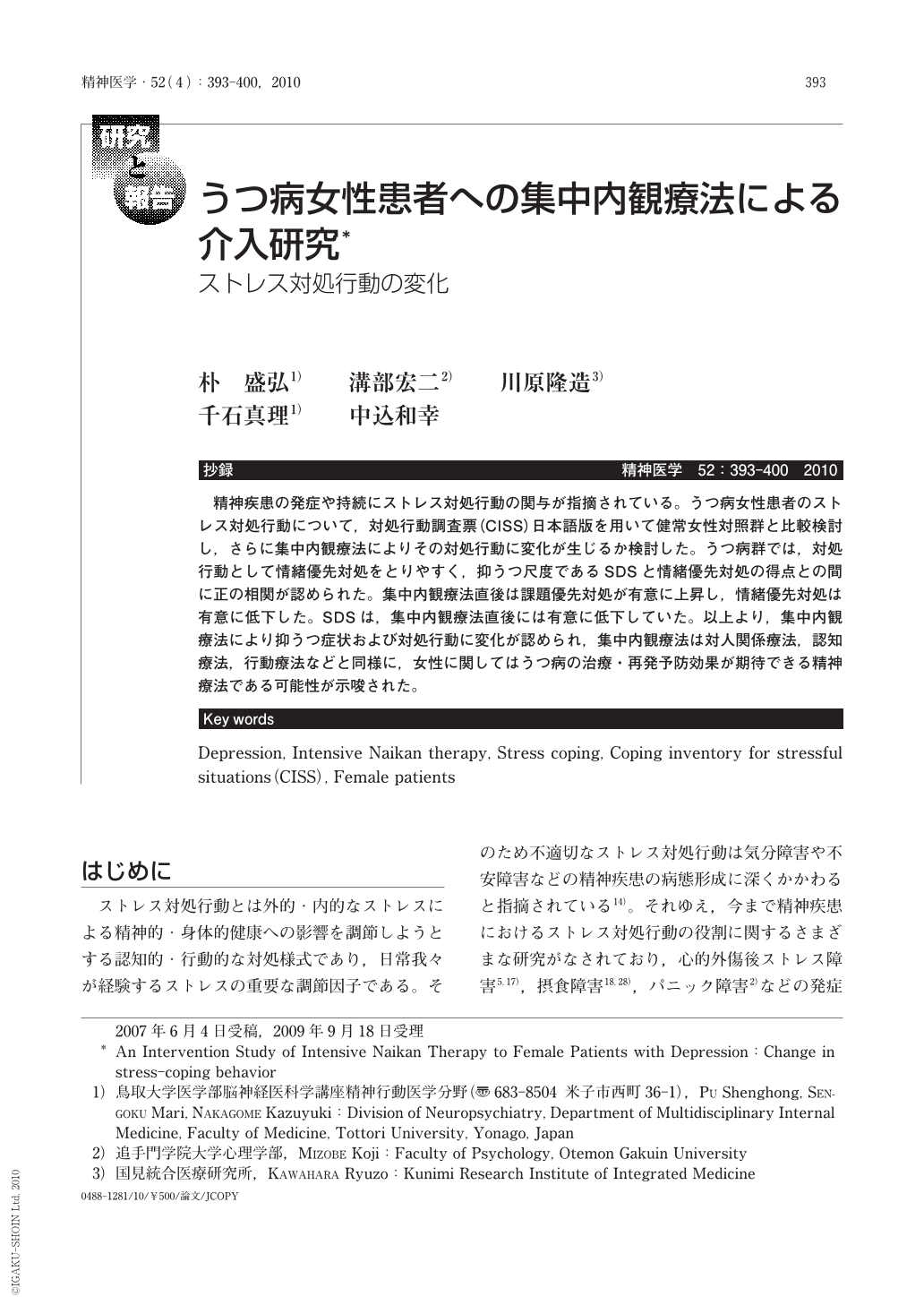
精神疾患の発症や持続にストレス対処行動の関与が指摘されている。うつ病女性患者のストレス対処行動について,対処行動調査票(CISS)日本語版を用いて健常女性対照群と比較検討し,さらに集中内観療法によりその対処行動に変化が生じるか検討した。うつ病群では,対処行動として情緒優先対処をとりやすく,抑うつ尺度であるSDSと情緒優先対処の得点との間に正の相関が認められた。集中内観療法直後は課題優先対処が有意に上昇し,情緒優先対処は有意に低下した。SDSは,集中内観療法直後には有意に低下していた。以上より,集中内観療法により抑うつ症状および対処行動に変化が認められ,集中内観療法は対人関係療法,認知療法,行動療法などと同様に,女性に関してはうつ病の治療・再発予防効果が期待できる精神療法である可能性が示唆された。
It has been discovered that stress-coping behavior is relative to the onset and treatment responses of mental illnesses. We compared the stress-coping behavior of female subjects with and without depression (i.e., clinical and control, respectively) using the Japanese edition of the Coping Inventory for Stressful Situations (CISS). Furthermore, we examined by whether intensive Naikan therapy would lead to any change in the coping style of female subjects with depression. The results are as follows:In contrast to the control subjects, the clinical subjects, that is, the patients with depression showed a tendency to adopt an emotion-oriented coping style, which was positively and significantly correlated with the Self-rating Depression Scale (SDS) scores;The scores of task-oriented coping increased, while those of emotion-oriented coping decreased after intensive Naikan therapy;SDS scores decreased after intensive Naikan therapy. Overall, the results indicate that intensive Naikan therapy may bring about an improvement in female stress-coping behavior as well as depressive symptoms. They also indicate that the treatment/protective efficacies can be expected to be as effective for the treatment and prevention of possible recurrence of depression, as other well-known psychosocial treatment methods, such as interpersonal therapy, cognitive therapy, and behavioral therapy.
Copyright © 2010, Igaku-Shoin Ltd. All rights reserved.