Japanese
English
- 有料閲覧
PPV購入案内
1,320円 (1,200円+税10%) こちらは、65ページから69ページの文献です。購入には医書.jp本会員登録が必要です。
会員登録完了後に改めて上記「購入サイトへ」を選択してください。
または「購入サイトへ」選択後に「購入ログイン」、「新規会員登録」の順に進んでください。
会員登録について詳しくはをご確認ください。
- Abstract 文献概要
- 1ページ目 Look Inside
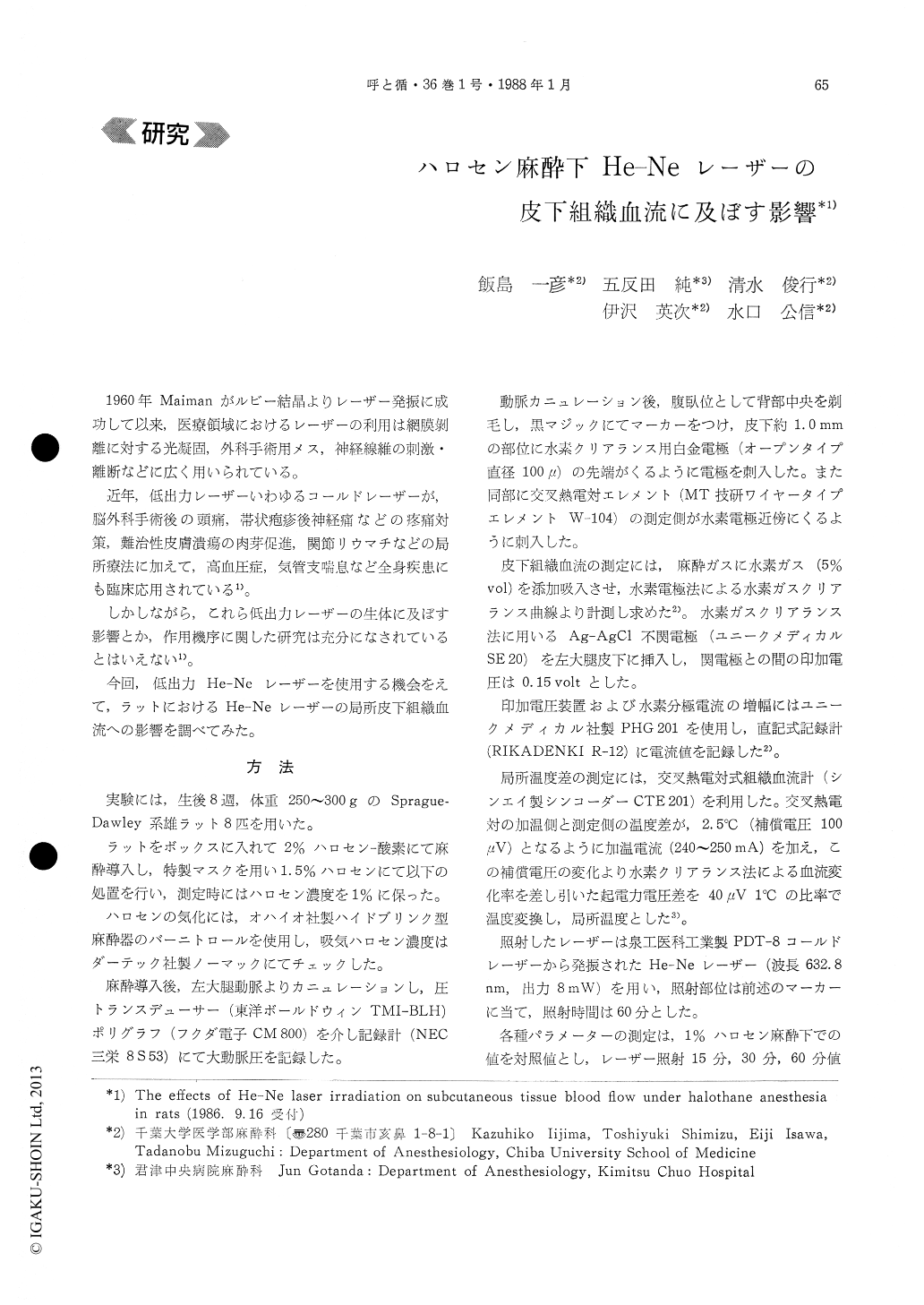
1960年Maimanがルビー結晶よりレーザー発振に成功して以来,医療領域におけるレーザーの利用は網膜剥離に対する光凝固,外科手術用メス,神経線維の刺激・離断などに広く用いられている。
近年,低出力レーザーいわゆるコールドレーザーが,脳外科手術後の頭痛,帯状疱疹後神経痛などの疼痛対策,難治性皮膚潰瘍の肉芽促進,関節リウマチなどの局所療法に加えて,高血圧症,気管支喘息など全身疾患にも臨床応用されている1)。
This study was designed to investigate the effects of He-Ne laser on subcutaneous tissue blood flow in rats.
The animals were anesthetized with 1% halothan under spontaneous respiration. Subcutaneous tissue blood flow and regional temperature were measured using hydrogen clearance method and thermoelec-trical method at the dorsal skin of the rat.
Subcutaneous tissue blood flow was 50.3±18.6 ml/ 100g/min prior to the irradiation of the laser and it decreased to 42.4±15.2 and to 39.3±13.6 at 15 minutes and 30 minutes after the irradiation of the laser, respectively. The blood flow partially re-covered to 43.1±18.5 following 60 minutes of the irradiation.
The regional temperature increased 1.5±0.25℃ and 1.10±0.93℃ compared to the control value after 15 minutes' and 30 minutes' irradiation, respec-tively. The temperature returned to the control at the end of 60 minutes' irradiation.
These results indicate that the blood flow decreased despite the increased regional temperature with the irradiation, suggesting that the irradiation could inhibit the vasodilation effect of halothane in the area.
Copyright © 1988, Igaku-Shoin Ltd. All rights reserved.