Japanese
English
- 有料閲覧
PPV購入案内
1,320円 (1,200円+税10%) こちらは、775ページから777ページの文献です。購入には医書.jp本会員登録が必要です。
会員登録完了後に改めて上記「購入サイトへ」を選択してください。
または「購入サイトへ」選択後に「購入ログイン」、「新規会員登録」の順に進んでください。
会員登録について詳しくはをご確認ください。
- Abstract 文献概要
- 1ページ目 Look Inside
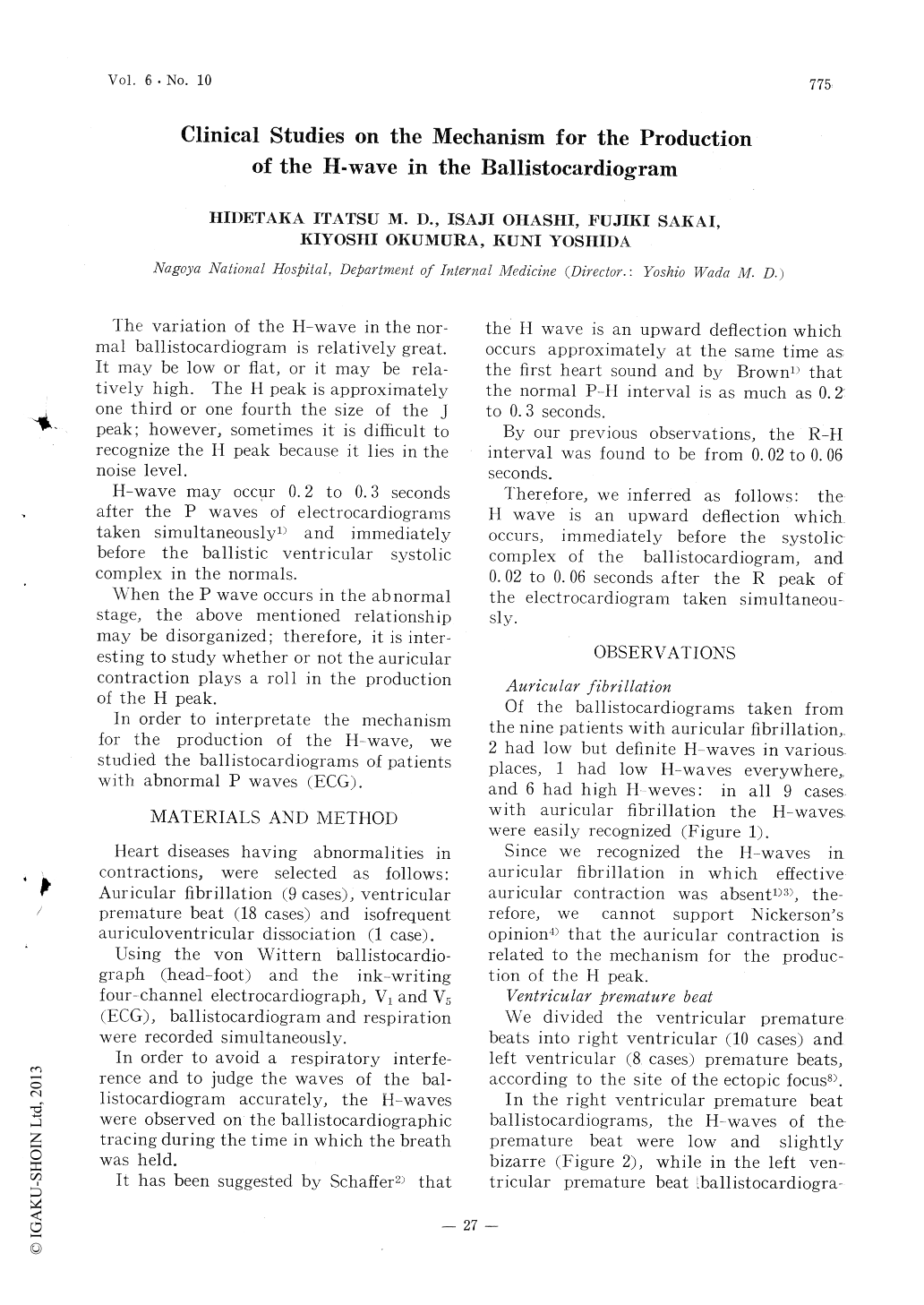
It is interesting and important for the analysis of the ballistic wave to determine whether or not the H-wave is produced by auricular contraction.
Nickerson4) has reported that the produ—ction of the H-wave may be relateed to auricular contraction.
Hamilton6) has described that the H-wave is initiated by the apex thrust which oc—curs during isometric contraction.
Brown1) said shat the apex thrust and the right auricular systole play, a role in the production of the H peak, and it has been suggested by Schaffer2) that some of the factors which are thought to be res—ponsible for the H-wave are: auricular contraction, apical thrust, and downward displacement of blood in the inferior vena cava.
Using a high-frequency table, Shimizu and Akita7) have reported as follows: the H-wave consists of two upward deflections. which are approximately the same in magnitude but the initial deflection is not as sharp as the 2nd deflection.
The initial deflection may be due to the abrupt deceleration of the inflowing blood and the occulsion of the semilunar valve, while the 2nd deflection may be caused by the apex thrust which occurs during isometric contraction.
We conclude that the H-wave may not be due to auricular contraction but to the apical trust during ventricular contraction, since it was possible for us to obsecve the H wave in the auricular fibrillation in which effective auricular contraction is absent, and in the ventricular premature beat and the isofrequent auriculo-ventri cular dissociaiion, in which the preceeding auricular contractions are absent.
Copyright © 1958, Igaku-Shoin Ltd. All rights reserved.