Japanese
English
- 有料閲覧
PPV購入案内
1,320円 (1,200円+税10%) こちらは、34ページから46ページの文献です。購入には医書.jp本会員登録が必要です。
会員登録完了後に改めて上記「購入サイトへ」を選択してください。
または「購入サイトへ」選択後に「購入ログイン」、「新規会員登録」の順に進んでください。
会員登録について詳しくはをご確認ください。
- Abstract 文献概要
- 1ページ目 Look Inside
- 参考文献 Reference
- サイト内被引用 Cited by
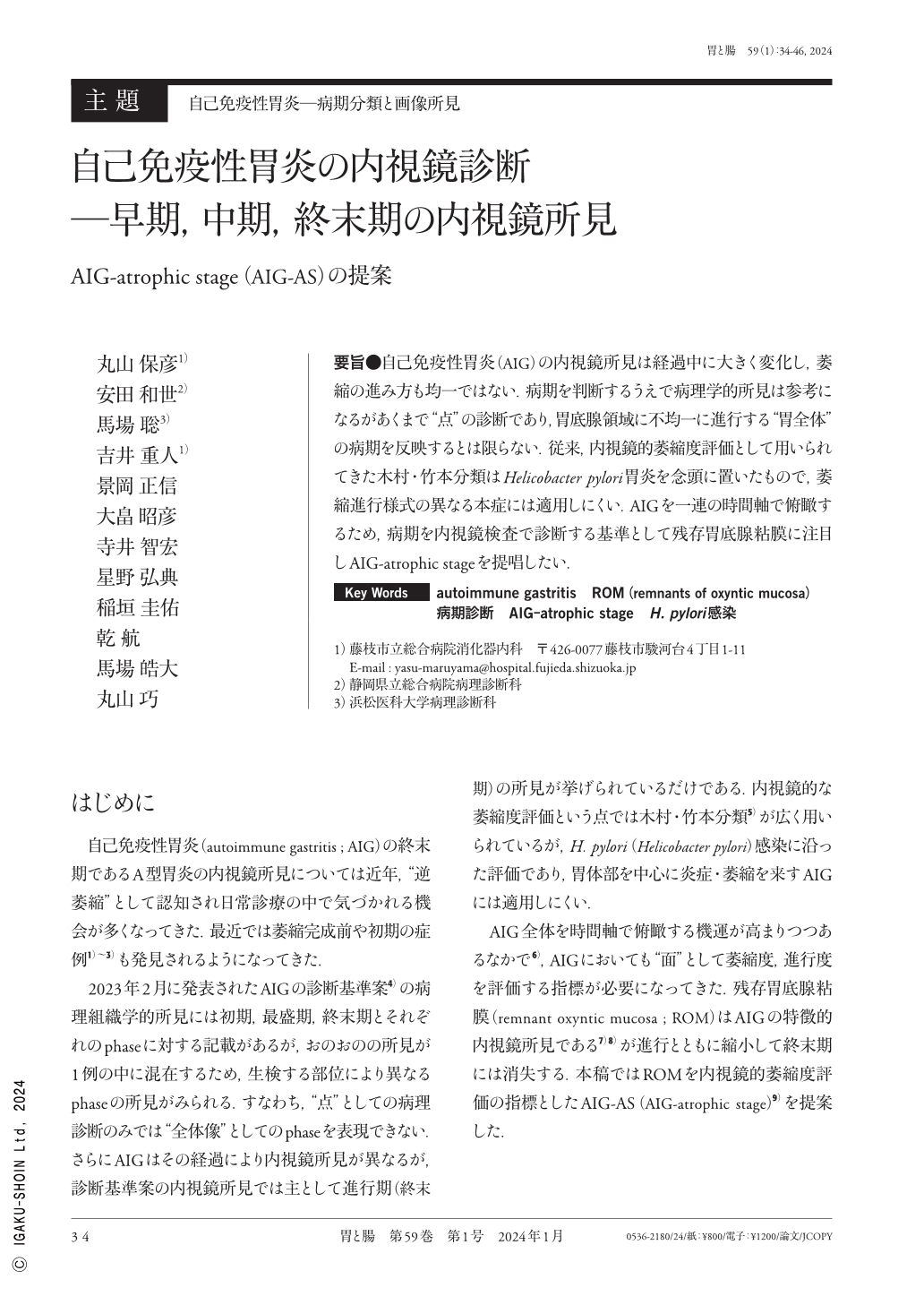
要旨●自己免疫性胃炎(AIG)の内視鏡所見は経過中に大きく変化し,萎縮の進み方も均一ではない.病期を判断するうえで病理学的所見は参考になるがあくまで“点”の診断であり,胃底腺領域に不均一に進行する“胃全体”の病期を反映するとは限らない.従来,内視鏡的萎縮度評価として用いられてきた木村・竹本分類はHelicobacter pylori胃炎を念頭に置いたもので,萎縮進行様式の異なる本症には適用しにくい.AIGを一連の時間軸で俯瞰するため,病期を内視鏡検査で診断する基準として残存胃底腺粘膜に注目しAIG-atrophic stageを提唱したい.
Endoscopic findings in AIG(autoimmune gastritis)change diversely and the accompanying atrophic progression varies during the course of illness. Pathological findings are helpful in determining the disease stage ; however, they are only “point” diagnoses and do not necessarily reflect the disease stage of the entire stomach, which progresses unevenly, particularly in the oxyntic mucosa. The Kimura−Takemoto classification, which is used to evaluate the degree of atrophy, is based on Helicobacter pylori gastritis and is unsuitable for the varying atrophic progression in AIG. To encapsulate AIG disease progression in a time scale, we propose the AIG atrophic stage, which focuses on the remnant oxyntic mucosa as an indicator for determining the disease stage by endoscopy.
Copyright © 2024, Igaku-Shoin Ltd. All rights reserved.