Japanese
English
- 有料閲覧
PPV購入案内
1,320円 (1,200円+税10%) こちらは、781ページから787ページの文献です。購入には医書.jp本会員登録が必要です。
会員登録完了後に改めて上記「購入サイトへ」を選択してください。
または「購入サイトへ」選択後に「購入ログイン」、「新規会員登録」の順に進んでください。
会員登録について詳しくはをご確認ください。
- Abstract 文献概要
- 1ページ目 Look Inside
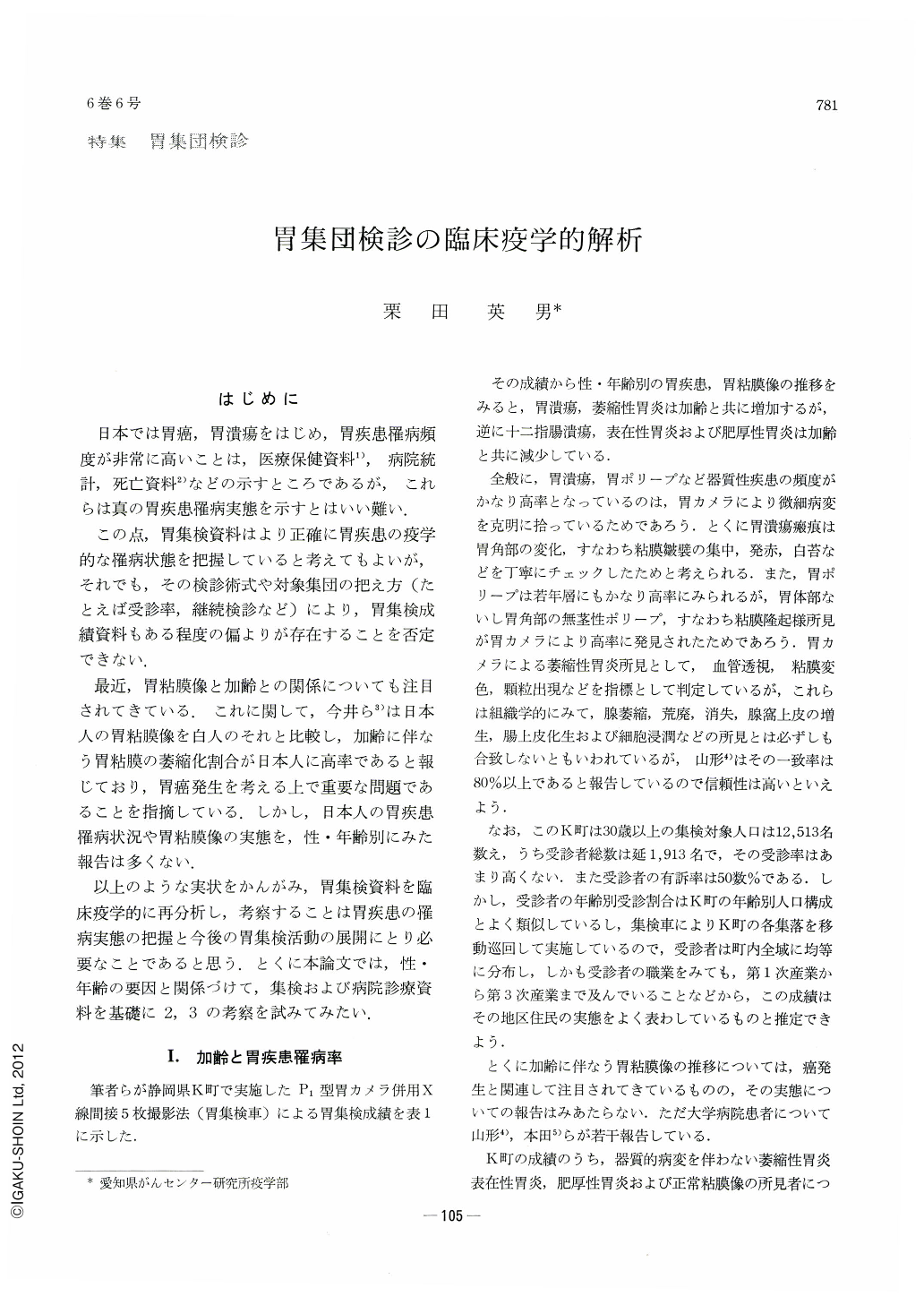
はじめに
日本では胃癌,胃潰瘍をはじめ,胃疾患罹病頻度が非常に高いことは,医療保健資料1),病院統計,死亡資料2)などの示すところであるが,これらは真の胃疾患罹病実態を示すとはいい難い.
この点,胃集検資料はより正確に胃疾患の疫学的な罹病状態を把握していると考えてもよいが,それでも,その検診術式や対象集団の把え方(たとえば受診率,継続検診など)により,胃集検成績資料もある程度の偏よりが存在することを否定できない.
最近,胃粘膜像と加齢との関係についても注目されてきている.これに関して,今井ら3)は日本人の胃粘膜像を白人のそれと比較し,加齢に伴なう胃粘膜の萎縮化割合が日本人に高率であると報じており,胃癌発生を考える上で重要な問題であることを指摘している.しかし,日本人の胃疾患罹病状況や胃粘膜像の実態を,性・年齢別にみた報告は多くない.
以上のような実状をかんがみ,胃集検資料を臨床疫学的に再分析し,考察することは胃疾患の罹病実態の把握と今後の胃集検活動の展開にとり必要なことであると思う.とくに本論文では,性・年齢の要因と関係づけて,集検および病院診療資料を基礎に2,3の考察を試みてみたい.
Epidemiological analysis of the results of gastric mass screening survey is important not only for its development in the years ahead but also for accurate assessment of the present percentage of gastric diseases detected thereby.
Gastric mass survey, far more accurate than other mass screening procedures for other organs hitherto employed, calls for higher levels of diagnostic techniques, and discovery rate of early gastric cancer as well as other benign lesions of the stomach is steadily increasing in accordance with the progress in technical standard. It has also been clarified that, owing to the co-employment of gastrocamera remodeled for screening purpose, the changes seen in the gastric mucosa of the Japanese as they get older, especially the rate of atrophic changes increases markedly as the years go by.
Comparison of clinical pictures of gastric cancer detected at mass screening survey with those found in hospitals shows that in the former gastric lesions are predominantly found in the lower corpus and the pylorus, cancer in the upper segments of the stomach being very rare. Discrepancy is also seen in its gross forms, for gastric cancers detected at mass screening survey are mostly of protruding types (in early cancer they are of type Ⅰ and Ⅱa, while in advanced one they are of type Ⅰ and Ⅱ according to Borrmann). This fact is considered as the results of difference in diagnostic techniques and of biological factors on the host side.
Despite the well-known fact that stomach cancer is more prevalent among low socioeconomic classes than in high ones, it has been found in this investigation that most of patients with early stomach cancer found in the mass surveys belong to higher socioeconomic and intelligent classes. It has also be seen that presonality examinations have revealed nearly 40 per cent of them to have nervous tendencies. This fact seems to show that gastric mass survey is as yet not popularized enough, not universally accepted in the whole strata of Japanese society.
Copyright © 1971, Igaku-Shoin Ltd. All rights reserved.