Japanese
English
- 有料閲覧
PPV購入案内
2,200円 (2,000円+税10%) こちらは、993ページから999ページの文献です。購入には医書.jp本会員登録が必要です。
会員登録完了後に改めて上記「購入サイトへ」を選択してください。
または「購入サイトへ」選択後に「購入ログイン」、「新規会員登録」の順に進んでください。
会員登録について詳しくはをご確認ください。
- Abstract 文献概要
- 1ページ目 Look Inside
- 参考文献 Reference
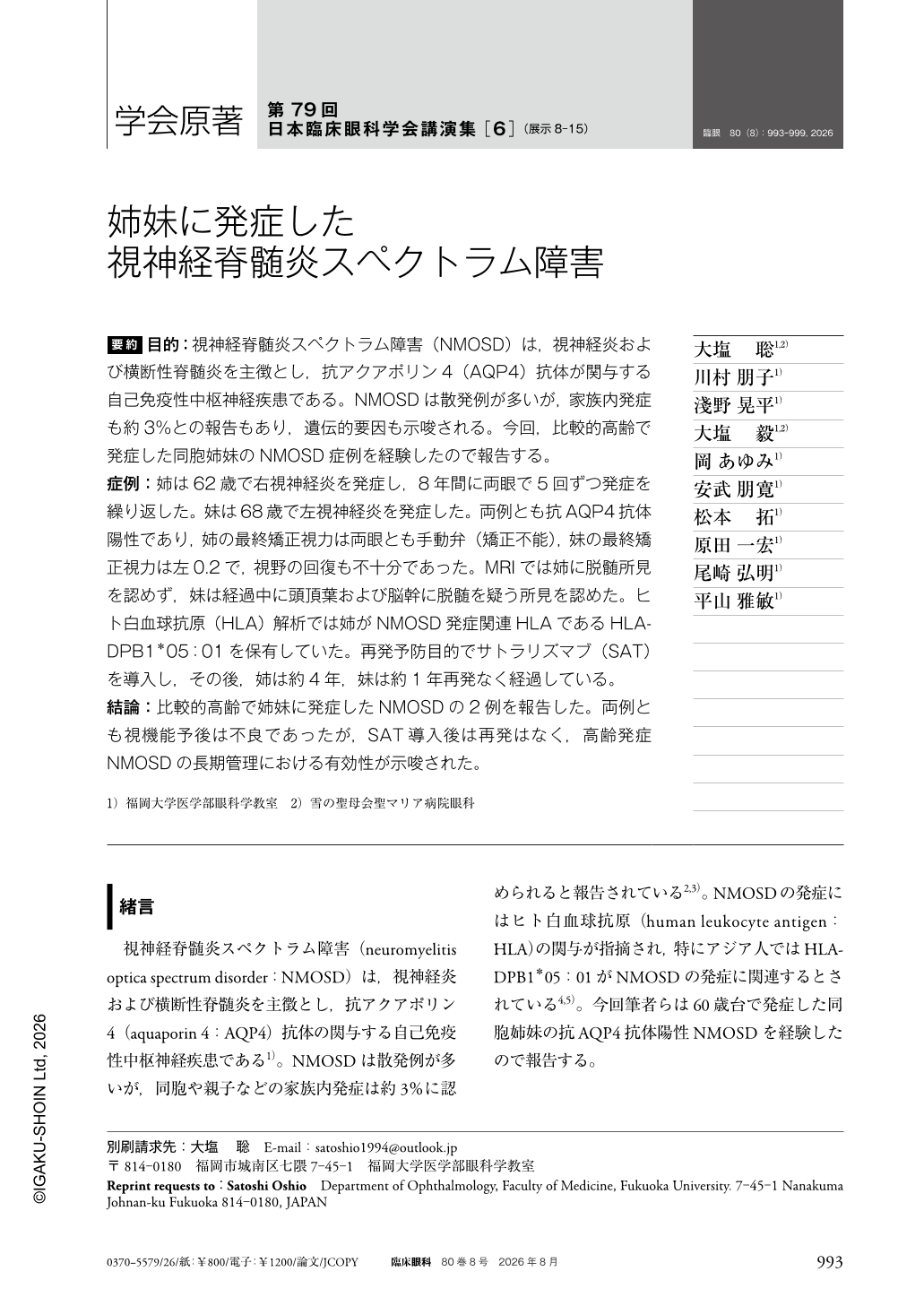
要約 目的:視神経脊髄炎スペクトラム障害(NMOSD)は,視神経炎および横断性脊髄炎を主徴とし,抗アクアポリン4(AQP4)抗体が関与する自己免疫性中枢神経疾患である。NMOSDは散発例が多いが,家族内発症も約3%との報告もあり,遺伝的要因も示唆される。今回,比較的高齢で発症した同胞姉妹のNMOSD症例を経験したので報告する。
症例:姉は62歳で右視神経炎を発症し,8年間に両眼で5回ずつ発症を繰り返した。妹は68歳で左視神経炎を発症した。両例とも抗AQP4抗体陽性であり,姉の最終矯正視力は両眼とも手動弁(矯正不能),妹の最終矯正視力は左0.2で,視野の回復も不十分であった。MRIでは姉に脱髄所見を認めず,妹は経過中に頭頂葉および脳幹に脱髄を疑う所見を認めた。ヒト白血球抗原(HLA)解析では姉がNMOSD発症関連HLAであるHLA-DPB1*05:01を保有していた。再発予防目的でサトラリズマブ(SAT)を導入し,その後,姉は約4年,妹は約1年再発なく経過している。
結論:比較的高齢で姉妹に発症したNMOSDの2例を報告した。両例とも視機能予後は不良であったが,SAT導入後は再発はなく,高齢発症NMOSDの長期管理における有効性が示唆された。
Abstract Purpose:Neuromyelitis Optica Spectrum Disorder(NMOSD) is an autoimmune central nervous system disease characterized by optic neuritis and transverse myelitis, involving anti-aquaporin-4(AQP4) antibodies. While NMOSD is predominantly sporadic, familial cases account for approximately 3% of reports, suggesting a genetic component. We report on two sibling sisters with NMOSD who presented at a relatively advanced age.
Cases:The older sister developed right optic neuritis at age 62, and over the next eight years, she experienced five recurrences in each eye. The younger sister developed left optic neuritis at age 68. Both cases tested positive for anti-AQP4 antibodies. The sisters final visual acuity was hand motion in both eyes for the older sister, and the younger sister had left eye vision of 0.2, with incomplete visual field recovery. MRI showed no demyelinating lesions in the older sister, while the younger sister demonstrated findings suggestive of demyelination in the parietal lobe and brain stem during the course of the disease. Human leukocyte antigen(HLA) analysis revealed that the older sister carried HLA-DPB1*05:01, an HLA associated with NMOSD onset. Satralizumab(SAT) was initiated for relapse prevention. Subsequently, the older sister remained relapse-free for approximately 4 years, and the younger sister for approximately 1 year.
Conclusion:We report two cases of NMOSD occurring in relatively older sisters. Although visual function prognosis was poor in both cases, no relapses have been observed since SAT initiation, suggesting its efficacy in the long-term management of NMOSD with late-onset.
Copyright © 2026, Igaku-Shoin Ltd. All rights reserved.