Japanese
English
- 有料閲覧
PPV購入案内
1,320円 (1,200円+税10%) こちらは、797ページから802ページの文献です。購入には医書.jp本会員登録が必要です。
会員登録完了後に改めて上記「購入サイトへ」を選択してください。
または「購入サイトへ」選択後に「購入ログイン」、「新規会員登録」の順に進んでください。
会員登録について詳しくはをご確認ください。
- Abstract 文献概要
- 1ページ目 Look Inside
- 参考文献 Reference
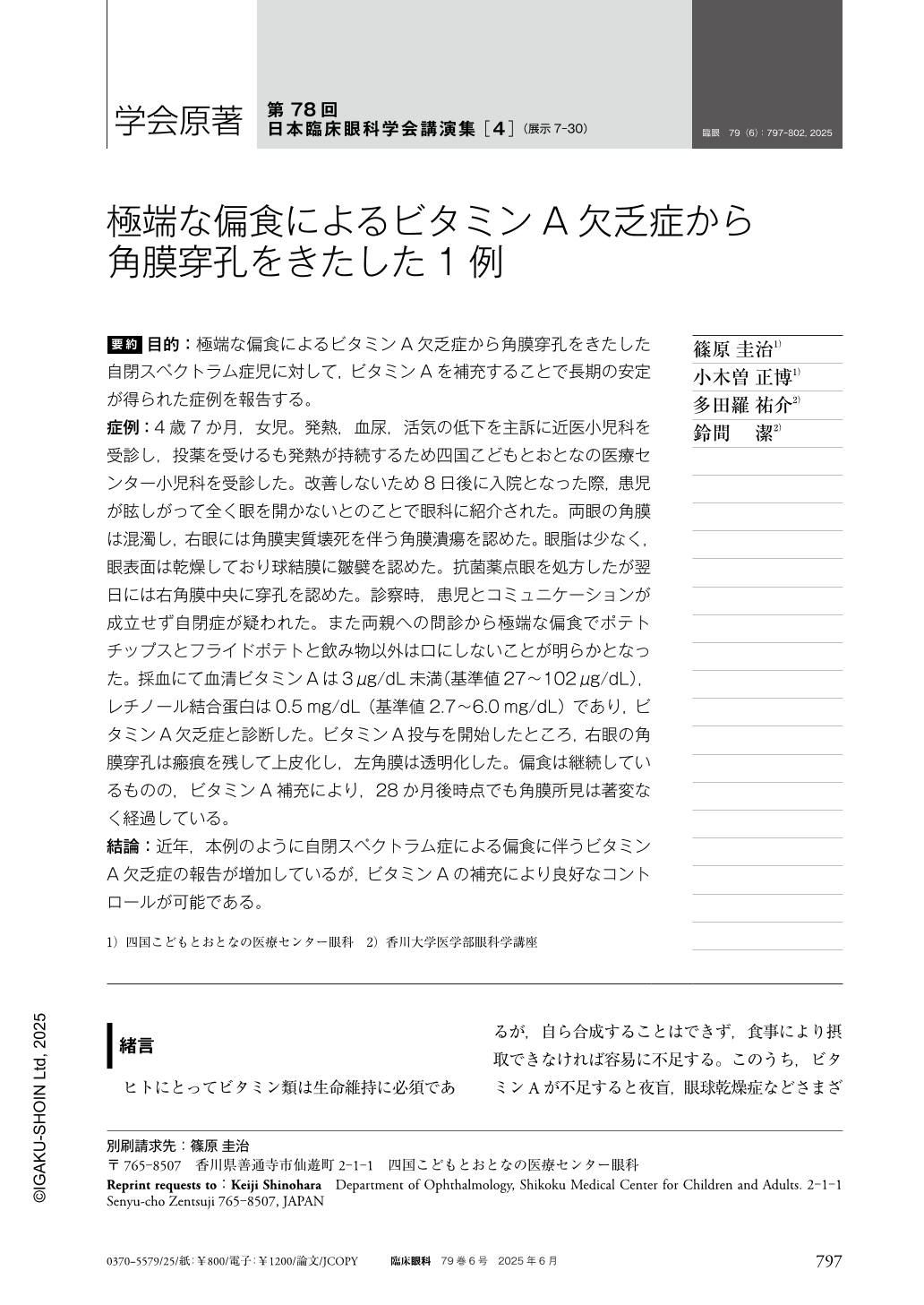
要約 目的:極端な偏食によるビタミンA欠乏症から角膜穿孔をきたした自閉スペクトラム症児に対して,ビタミンAを補充することで長期の安定が得られた症例を報告する。
症例:4歳7か月,女児。発熱,血尿,活気の低下を主訴に近医小児科を受診し,投薬を受けるも発熱が持続するため四国こどもとおとなの医療センター小児科を受診した。改善しないため8日後に入院となった際,患児が眩しがって全く眼を開かないとのことで眼科に紹介された。両眼の角膜は混濁し,右眼には角膜実質壊死を伴う角膜潰瘍を認めた。眼脂は少なく,眼表面は乾燥しており球結膜に皺襞を認めた。抗菌薬点眼を処方したが翌日には右角膜中央に穿孔を認めた。診察時,患児とコミュニケーションが成立せず自閉症が疑われた。また両親への問診から極端な偏食でポテトチップスとフライドポテトと飲み物以外は口にしないことが明らかとなった。採血にて血清ビタミンAは3μg/dL未満(基準値27〜102μg/dL),レチノール結合蛋白は0.5mg/dL(基準値2.7〜6.0mg/dL)であり,ビタミンA欠乏症と診断した。ビタミンA投与を開始したところ,右眼の角膜穿孔は瘢痕を残して上皮化し,左角膜は透明化した。偏食は継続しているものの,ビタミンA補充により,28か月後時点でも角膜所見は著変なく経過している。
結論:近年,本例のように自閉スペクトラム症による偏食に伴うビタミンA欠乏症の報告が増加しているが,ビタミンAの補充により良好なコントロールが可能である。
Abstract Purpose:To report a case of a child with autism spectrum disorder and extreme selective eating, who developed corneal perforation due to vitamin A deficiency and achieved long-term stability following vitamin A supplementation.
Case:A 4-year and 7-month-old girl initially visited a local pediatric clinic complaining of fever, hematuria, and decreased vitality. Despite initial treatment, her fever persisted and she was referred to our hospital's pediatric department. She was admitted eight days later due to the lack of improvement, and on the day of admission, she was referred to the ophthalmology department for photophobia and her inability to open her eyes. Ophthalmological examination revealed bilateral corneal clouding with a corneal ulcer and stromal necrosis in the right eye. The ocular discharge was minimal, and the ocular surface was dry, with Bitot's spots visible on the bulbar conjunctiva. Antibacterial eye drops were prescribed;however, central corneal perforation in the right eye was detected the following day. During the examination, communication with the patient was challenging, which raised the suspicion of autism spectrum disorder. Parental interviews revealed that the child had extremely selective eating habits, consuming only potato chips, french fries, and specific beverages while refusing all other foods. Blood tests revealed a serum vitamin A level of less than 3 μg/dL(reference range:27-102 μg/dL)and a retinol-binding protein level of 0.5 mg/dL(reference range:2.7-6.0 mg/dL), leading to a diagnosis of vitamin A deficiency. Vitamin A supplementation was initiated, which resulted in epithelialization of the right corneal perforation with residual scarring and restoration of transparency in the left cornea. Despite continued selective eating habits, the patient's corneal findings remained stable for 28 months since starting vitamin A therapy.
Conclusion:Recent reports have highlighted the increasing prevalence of vitamin A deficiency in children with autism spectrum disorder owing to selective eating habits. This case demonstrates that vitamin A supplementation can effectively stabilize ocular manifestations resulting from severe vitamin A deficiency, even when dietary challenges persist.
Copyright © 2025, Igaku-Shoin Ltd. All rights reserved.