Japanese
English
- 有料閲覧
PPV購入案内
2,200円 (2,000円+税10%) こちらは、872ページから878ページの文献です。購入には医書.jp本会員登録が必要です。
会員登録完了後に改めて上記「購入サイトへ」を選択してください。
または「購入サイトへ」選択後に「購入ログイン」、「新規会員登録」の順に進んでください。
会員登録について詳しくはをご確認ください。
- Abstract 文献概要
- 1ページ目 Look Inside
- 参考文献 Reference
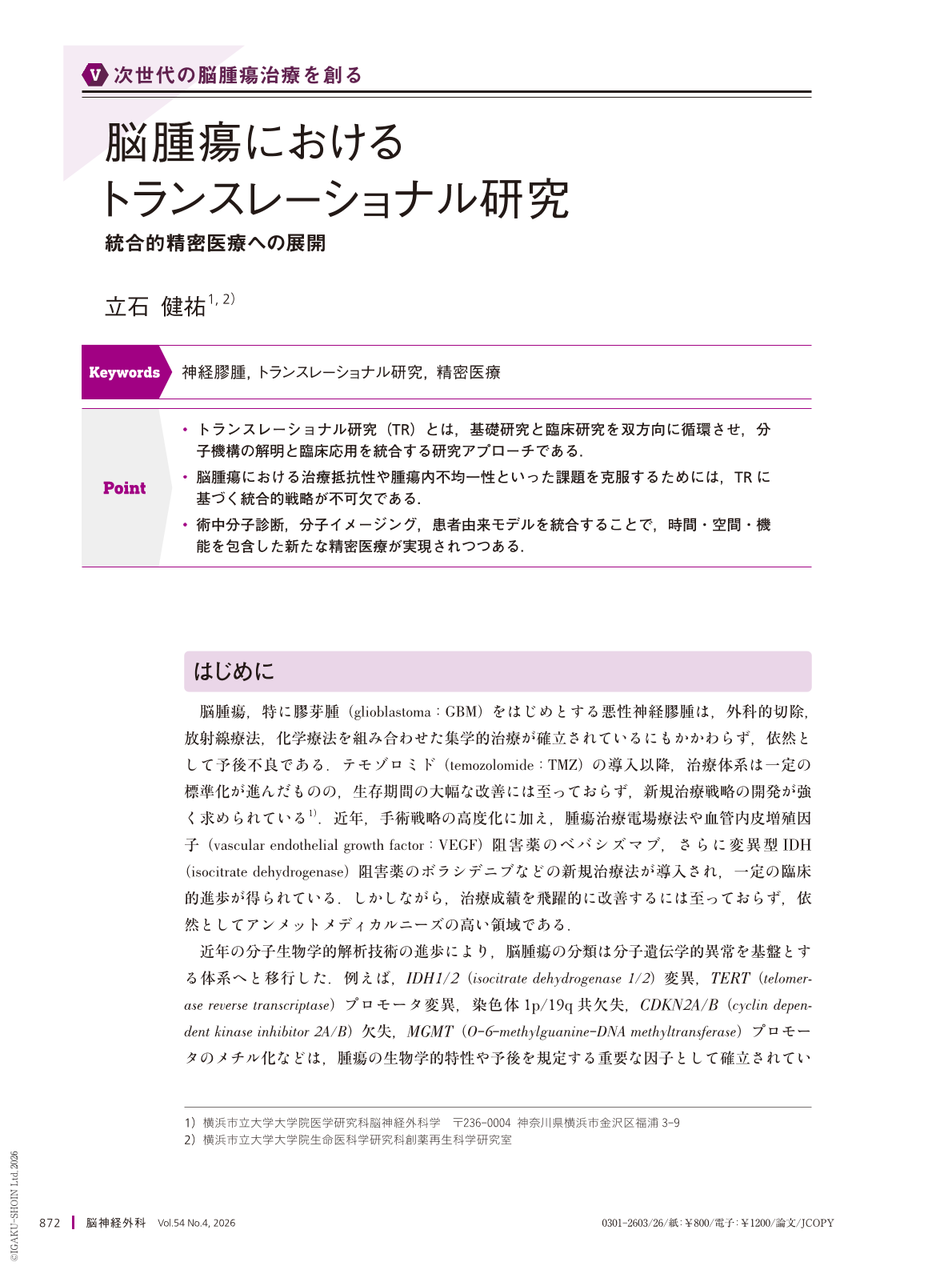
Point
・トランスレーショナル研究(TR)とは,基礎研究と臨床研究を双方向に循環させ,分子機構の解明と臨床応用を統合する研究アプローチである.
・脳腫瘍における治療抵抗性や腫瘍内不均一性といった課題を克服するためには,TRに基づく統合的戦略が不可欠である.
・術中分子診断,分子イメージング,患者由来モデルを統合することで,時間・空間・機能を包含した新たな精密医療が実現されつつある.
Translational research on malignant brain tumors provide a bidirectional framework that links basic science with clinical practice to advance precision medicine. Despite progress in surgery, radiotherapy, chemotherapy, and molecular classification, outcomes remain poor, particularly for diffuse high-grade gliomas, because of treatment resistance, intratumoral heterogeneity, and the limited clinical implementation of molecular insights. Recent advances have highlighted the value of integrating intraoperative molecular diagnostics, molecular imaging, and patient-derived models into a unified translational platform. Rapid intraoperative assessment of key molecular alterations can support real-time surgical and therapeutic decision-making. Molecular imaging, including amino acid and hypoxia PET, enables the noninvasive evaluation of tumor biology and spatial heterogeneity. Patient-derived xenograft models and primary cultured cells retain tumor-specific molecular and phenotypic characteristics, enabling functional analyses of drug sensitivity, resistance mechanisms, and potential therapeutic strategies. Together, these approaches establish a multidimensional precision-medicine framework that integrates temporal, spatial, and functional information. Continued progress will require progress close collaboration across medicine, basic science, and data science, supported by systems that efficiently translate research findings back into clinical care. This integrated strategy is poised to accelerate the development of more effective personalized therapies for malignant brain tumors.
Copyright © 2026, Igaku-Shoin Ltd. All rights reserved.