Japanese
English
- 有料閲覧
PPV購入案内
1,320円 (1,200円+税10%) こちらは、302ページから311ページの文献です。購入には医書.jp本会員登録が必要です。
会員登録完了後に改めて上記「購入サイトへ」を選択してください。
または「購入サイトへ」選択後に「購入ログイン」、「新規会員登録」の順に進んでください。
会員登録について詳しくはをご確認ください。
- Abstract 文献概要
- 1ページ目 Look Inside
- 参考文献 Reference
Point
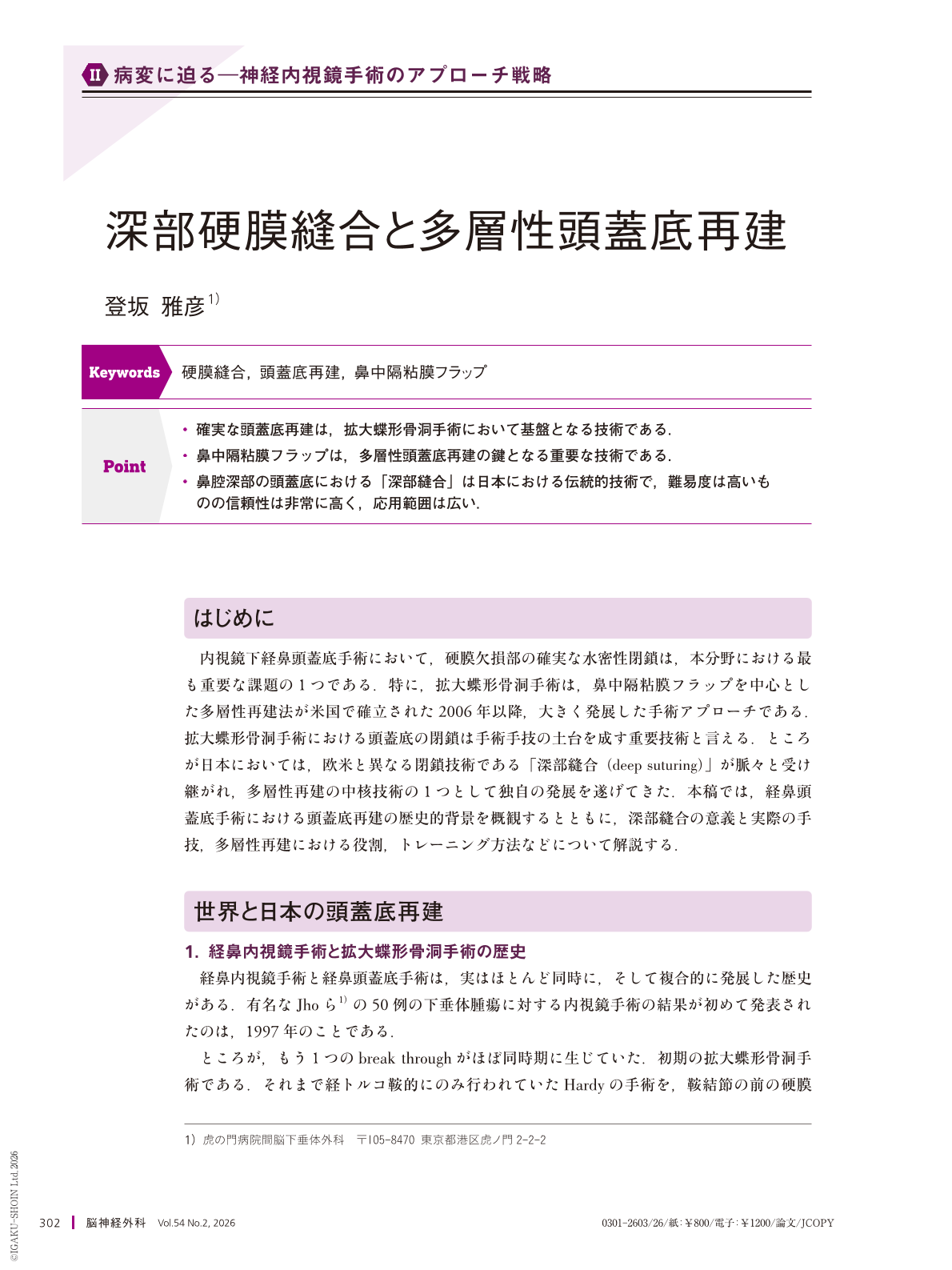
・確実な頭蓋底再建は,拡大蝶形骨洞手術において基盤となる技術である.
・鼻中隔粘膜フラップは,多層性頭蓋底再建の鍵となる重要な技術である.
・鼻腔深部の頭蓋底における「深部縫合」は日本における伝統的技術で,難易度は高いものの信頼性は非常に高く,応用範囲は広い.
*本論文中、[Video]マークのある図につきましては、関連する動画を見ることができます(公開期間:2029年4月まで)。
This review described the principles and techniques of dural suturing and multilayer skull base reconstruction in extended endoscopic endonasal surgery, with an emphasis on the Japanese tradition of deep suturing. Secure watertight reconstruction is a fundamental requirement in extended transsphenoidal and endonasal skull base surgery because persistent cerebrospinal fluid (CSF) leakage can result in life-threatening meningitis. Since its introduction in 2007, multilayer reconstruction using various materials combined with a pedicled nasoseptal flap has become the standard approach. In contrast, Japanese surgeons had long emphasized direct dural closure using deep suturing techniques, even before the widespread adoption of endoscopy. This culture of suturing has been incorporated into modern endoscopic surgery and remains a key component of skull base reconstruction in Japan. Deep suturing provides reliable fixation of patch materials, contributes to both major and minor CSF leak control, and may reduce the dependence on large vascularized flaps in selected cases. This review described the fundamental techniques of deep suturing, including needle handling, control of the needle holding angle, knot-sliding methods, and suturing in multilayer reconstruction strategies. It also discussed the management of CSF pulsation and training methods. Although technically demanding, deep suturing is a highly reliable and versatile technique that continues to play a critical role in endoscopic skull base surgery.
Copyright © 2026, Igaku-Shoin Ltd. All rights reserved.