Japanese
English
- 有料閲覧
PPV購入案内
1,320円 (1,200円+税10%) こちらは、586ページから594ページの文献です。購入には医書.jp本会員登録が必要です。
会員登録完了後に改めて上記「購入サイトへ」を選択してください。
または「購入サイトへ」選択後に「購入ログイン」、「新規会員登録」の順に進んでください。
会員登録について詳しくはをご確認ください。
- Abstract 文献概要
- 1ページ目 Look Inside
- 参考文献 Reference
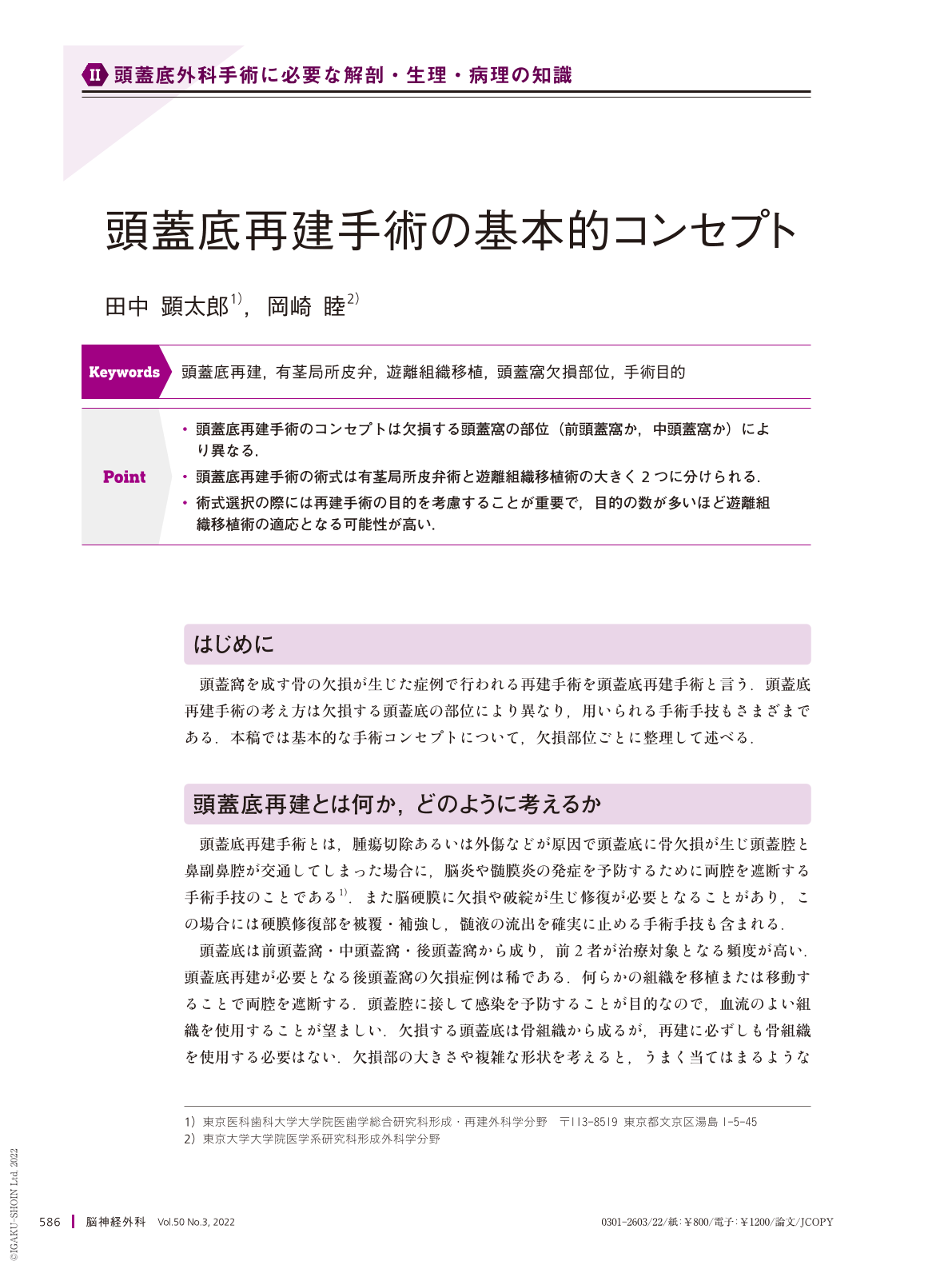
Point
・頭蓋底再建手術のコンセプトは欠損する頭蓋窩の部位(前頭蓋窩か,中頭蓋窩か)により異なる.
・頭蓋底再建手術の術式は有茎局所皮弁術と遊離組織移植術の大きく2つに分けられる.
・術式選択の際には再建手術の目的を考慮することが重要で,目的の数が多いほど遊離組織移植術の適応となる可能性が高い.
In most cases of anterior cranial fossa defects, the cranial cavity and the nasal cavity are connected, and it is necessary to reconstruct the skull base in a narrow sense to separate both cavities. If the surgical purpose is only separation, reconstruction with a pedicled local flap is often possible. As other surgical purposes such as the reconstruction of surrounding tissues are added, the transplanted tissue volume becomes insufficient, and free tissue transfer is required. In the case of a defect in the middle cranial fossa, the cranial cavity is not always connected with the nasal cavity because it is far from the nasal cavity and oral cavity. In this case, it is skull base reconstruction in a broad sense whose purpose is other than separation. There are many factors such as facial soft tissue augmentation and facial nerve reconstruction as the surgical purpose, and the more the purposes, the more likely it is that free tissue transfer will be required. In patients with anterior and middle cranial fossa defects, both cavities are connected and the resected tissue volume is large, so free tissue transfer is selected in most cases, except for a few benign diseases.
Copyright © 2022, Igaku-Shoin Ltd. All rights reserved.