Japanese
English
- 有料閲覧
- Abstract 文献概要
- 1ページ目 Look Inside
- 参考文献 Reference
要旨
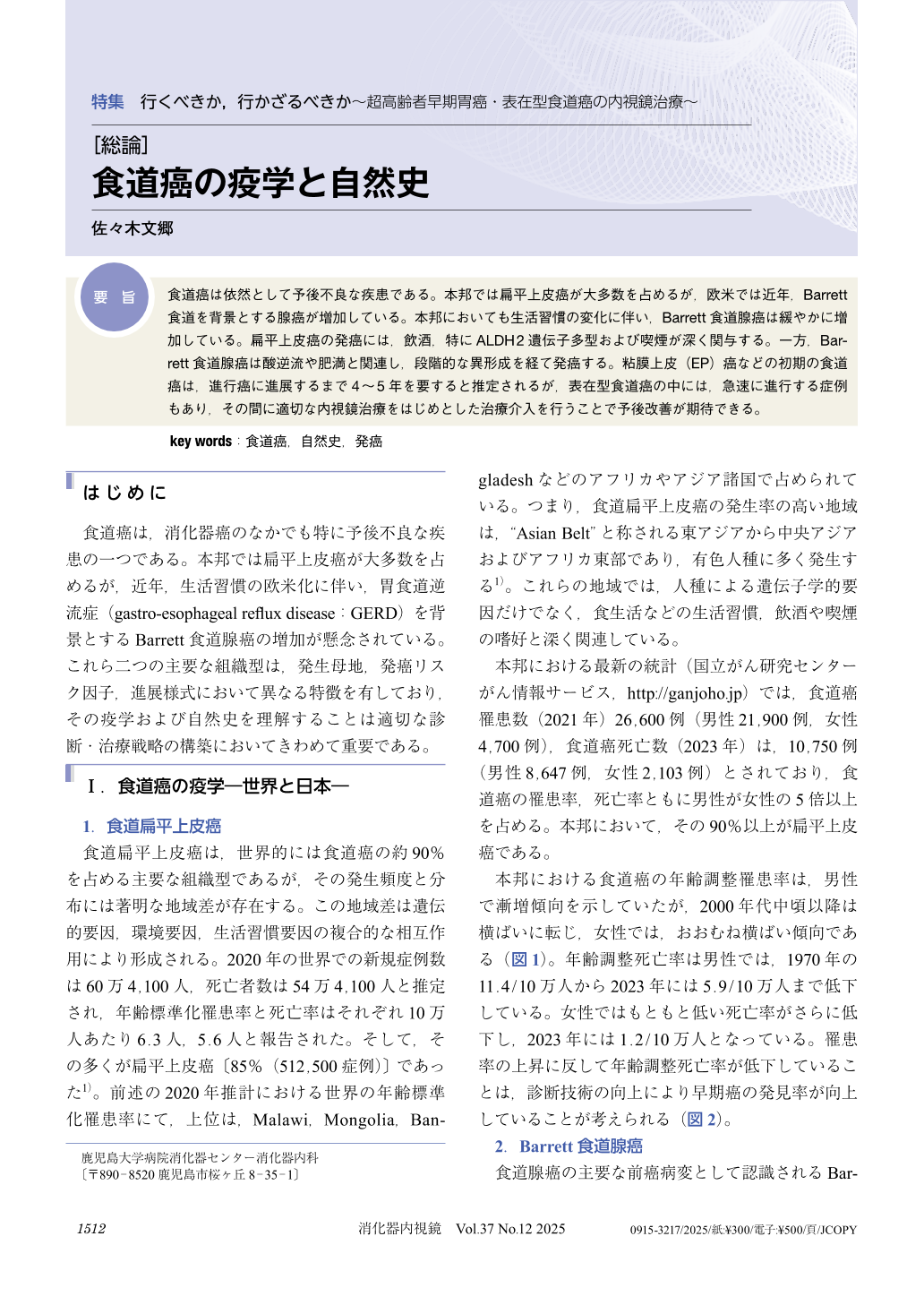
食道癌は依然として予後不良な疾患である。本邦では扁平上皮癌が大多数を占めるが,欧米では近年,Barrett食道を背景とする腺癌が増加している。本邦においても生活習慣の変化に伴い,Barrett食道腺癌は緩やかに増加している。扁平上皮癌の発癌には,飲酒,特にALDH2遺伝子多型および喫煙が深く関与する。一方,Barrett食道腺癌は酸逆流や肥満と関連し,段階的な異形成を経て発癌する。粘膜上皮(EP)癌などの初期の食道癌は,進行癌に進展するまで4〜5年を要すると推定されるが,表在型食道癌の中には,急速に進行する症例もあり,その間に適切な内視鏡治療をはじめとした治療介入を行うことで予後改善が期待できる。
Esophageal cancer remains a disease with a poor prognosis, and understanding its epidemiology and natural history is essential for developing diagnostic and therapeutic strategies. In Japan, most cases are squamous cell carcinoma (SCC), whereas in Western countries, the incidence of Barrett’s esophageal adenocarcinoma has recently increased. In Japan as well, Barrett’s esophageal adenocarcinoma is gradually increasing with changes in lifestyle, warranting consideration of appropriate surveillance systems. The development of SCC is strongly associated with smoking, alcohol consumption, and genetic polymorphisms of ALDH2, and carries a high risk of multiple and synchronous cancers. In contrast, Barrett’s esophageal adenocarcinoma is linked to acid reflux and obesity, progressing through a stepwise dysplastic sequence. Esophageal cancers with submucosal invasion tend to develop early lymph node metastasis, emphasizing the importance of prompt treatment. Untreated superficial esophageal cancer is estimated to progress to an advanced stage within approximately 4-5 years; however, timely therapeutic intervention, including endoscopic treatment, can significantly improve prognosis.
© tokyo-igakusha.co.jp. All right reserved.