Japanese
English
- 有料閲覧
- Abstract 文献概要
- 1ページ目 Look Inside
- 参考文献 Reference
はじめに
頭頸部の腫瘍切除後再建では,放射線療法・化学療法・再建術後の遊離皮弁の壊死などで必ずしも遊離皮弁が使えるとは限らない。その際に有茎皮弁の大胸筋皮弁が再建材料として非常に有用である。豊富な筋体を有するため,死腔の充填,下顎の再建プレートの被覆など幅広く使用できる。
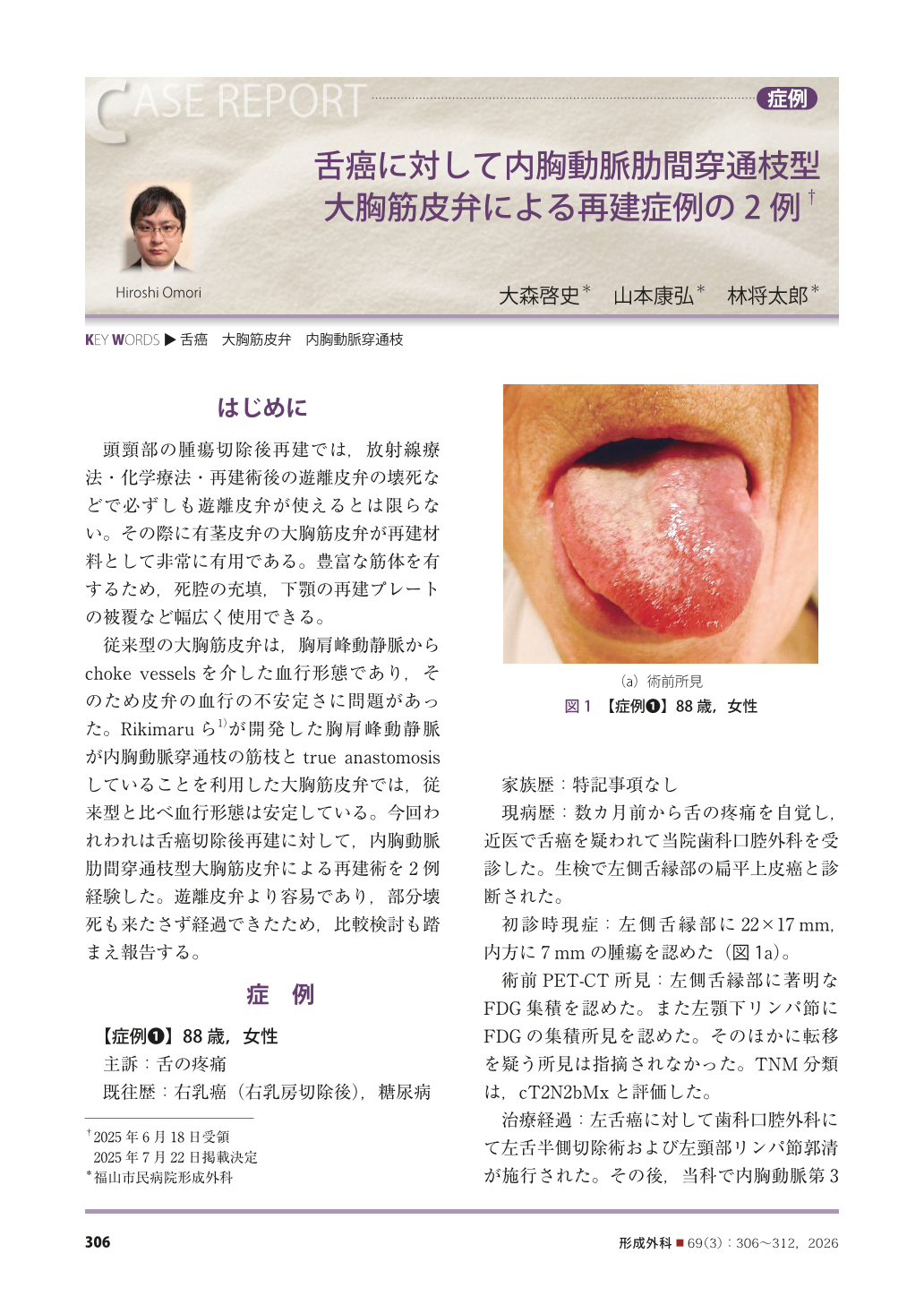
従来型の大胸筋皮弁は,胸肩峰動静脈からchoke vesselsを介した血行形態であり,そのため皮弁の血行の不安定さに問題があった。Rikimaruら 1)が開発した胸肩峰動静脈が内胸動脈穿通枝の筋枝とtrue anastomosisしていることを利用した大胸筋皮弁では,従来型と比べ血行形態は安定している。今回われわれは舌癌切除後再建に対して,内胸動脈肋間穿通枝型大胸筋皮弁による再建術を2例経験した。遊離皮弁より容易であり,部分壊死も来たさず経過できたため,比較検討も踏まえ報告する。
After resection of head and neck cancer, the conventional pectoralis major myocutaneous flap has often been used as a reconstruction material. However, due to issues such as unstable blood flow, its usage has diminished in recent years. We report two cases of tongue cancer reconstruction using a pectoralis major myocutaneous flap that takes advantage of the true anastomosis between the thoracoacromial artery and the perforating branches of the internal thoracic artery. In Case 1, a spindle-shaped flap measuring 12×5cm was created in the vertical direction. In Case 2, a more complex flap was created using a combined flap with an anterior chest flap from the perforating branch of the internal thoracic artery. There was no partial necrosis in any case, and all were fully integrated. Compared to traditional pectoralis major myocutaneous flaps, this method seems to be highly useful.
Copyright© 2026 KOKUSEIDO CO., LTD. All Rights Reserved.