Japanese
English
- 有料閲覧
- Abstract 文献概要
- 1ページ目 Look Inside
- 参考文献 Reference
はじめに
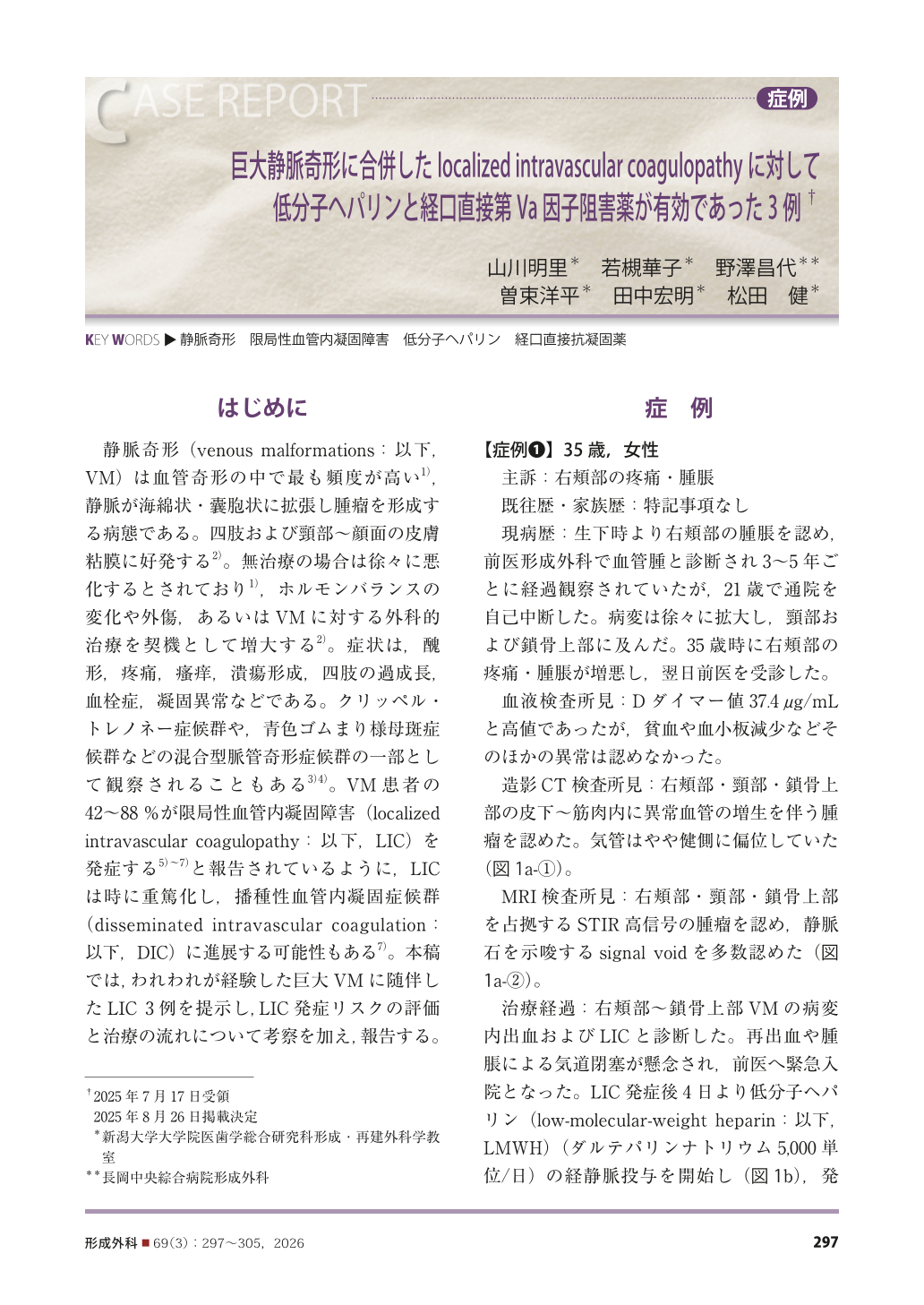
静脈奇形(venous malformations:以下,VM)は血管奇形の中で最も頻度が高い 1),静脈が海綿状・囊胞状に拡張し腫瘤を形成する病態である。四肢および頸部~顔面の皮膚粘膜に好発する 2)。無治療の場合は徐々に悪化するとされており 1),ホルモンバランスの変化や外傷,あるいはVMに対する外科的治療を契機として増大する 2)。症状は,醜形,疼痛,瘙痒,潰瘍形成,四肢の過成長,血栓症,凝固異常などである。クリッペル・トレノネー症候群や,青色ゴムまり様母斑症候群などの混合型脈管奇形症候群の一部として観察されることもある 3)4)。VM患者の42~88 %が限局性血管内凝固障害(localized intravascular coagulopathy:以下,LIC)を発症する 5)~7)と報告されているように,LICは時に重篤化し,播種性血管内凝固症候群(disseminated intravascular coagulation:以下,DIC)に進展する可能性もある 7)。本稿では,われわれが経験した巨大VMに随伴したLIC 3例を提示し,LIC発症リスクの評価と治療の流れについて考察を加え,報告する。
We report on three cases of severe localized intravascular coagulopathy (LIC) observed in young women with extensive, large, and deep venous malformations (VMs). These patients were at high risk for developing LIC. All three cases showed rapid improvement after treatment, which involved an initial course of low-molecular-weight heparin (LMWH) followed by a transition to oral direct factor Xa inhibitors. It is known that sirolimus is effective in reducing lesion size and inhibiting LIC in patients with mutations such as TEK and PIK3CA, which are associated with VM enlargement and coagulation abnormalities. LIC should be actively screened for when planning surgical treatment of VMs in high-risk patients. While LMWH is currently considered the first line treatment for LIC, the confirmed efficacy of DOACs is expected to simplify LIC management. Our treatment strategy of transitioning from LMWH to DOACs for severe LIC was found to be highly effective. Furthermore, it is crucial for high-risk patients to understand the triggers and symptoms that indicate worsening LIC as well as medical conditions they should monitor themselves. Therefore, providing appropriate guidance in the outpatient setting is considered important.
Copyright© 2026 KOKUSEIDO CO., LTD. All Rights Reserved.