Japanese
English
- 有料閲覧
- Abstract 文献概要
- 1ページ目 Look Inside
- 参考文献 Reference
はじめに
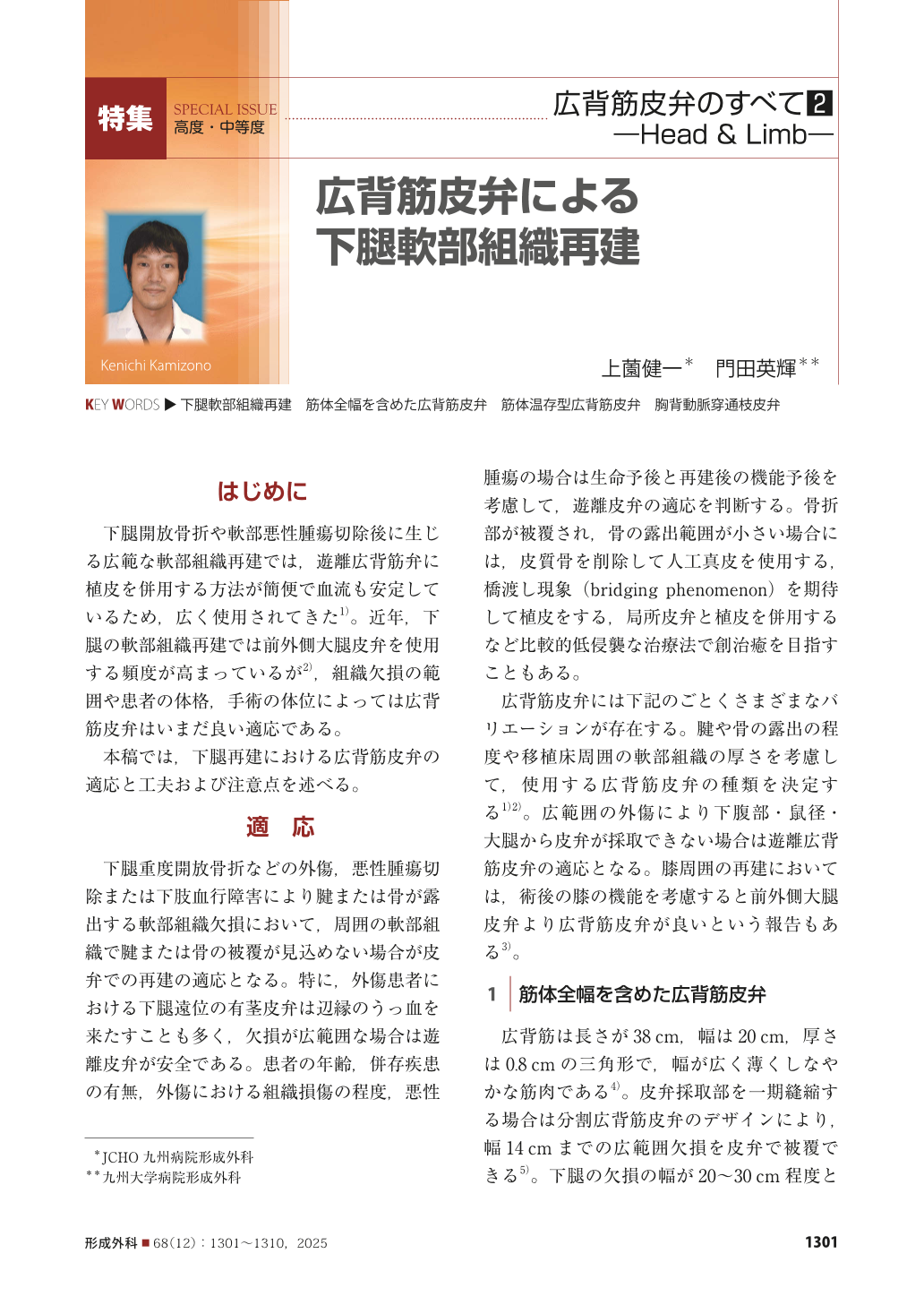
下腿開放骨折や軟部悪性腫瘍切除後に生じる広範な軟部組織再建では,遊離広背筋弁に植皮を併用する方法が簡便で血流も安定しているため,広く使用されてきた 1)。近年,下腿の軟部組織再建では前外側大腿皮弁を使用する頻度が高まっているが 2),組織欠損の範囲や患者の体格,手術の体位によっては広背筋皮弁はいまだ良い適応である。
本稿では,下腿再建における広背筋皮弁の適応と工夫および注意点を述べる。
Soft tissue defect reconstructions after open lower-leg fractures and extensive malignant tumor resection in lower extremities have commonly been reconstructed with a free latissimus dorsi musculocutaneous flap combined with a skin graft, due to this techniqueʼs simplicity and the stable blood flow that it enables. The anterolateral thigh flap has recently gained popularity for lower-leg soft tissue defect reconstruction; however, the latissimus dorsi flap remains a suitable option depending on the extent of the tissue defects, the patientʼs physique, and the surgical positioning. This paper discusses the indications, techniques, and considerations for using the latissimus dorsi flap in lower-leg reconstructions. Use of the broad latissimus dorsi muscle remains a valuable method for limb preservation in cases of severe limb trauma and extensive malignant tumor resections. A muscle-sparing latissimus dorsi flap with an appropriate design allows coverage of wider defect areas. The use of a thoracodorsal artery perforator flap requires careful vessel dissection, but it addresses the latissimus dorsi flapʼs limitations, such as a short pedicle length and limited flap thickness. The latissimus dorsi flap remains a viable option for lower-leg reconstructions with appropriate indications and techniques.
Copyright© 2025 KOKUSEIDO CO., LTD. All Rights Reserved.