Japanese
English
- 有料閲覧
- Abstract 文献概要
- 1ページ目 Look Inside
- 参考文献 Reference
はじめに
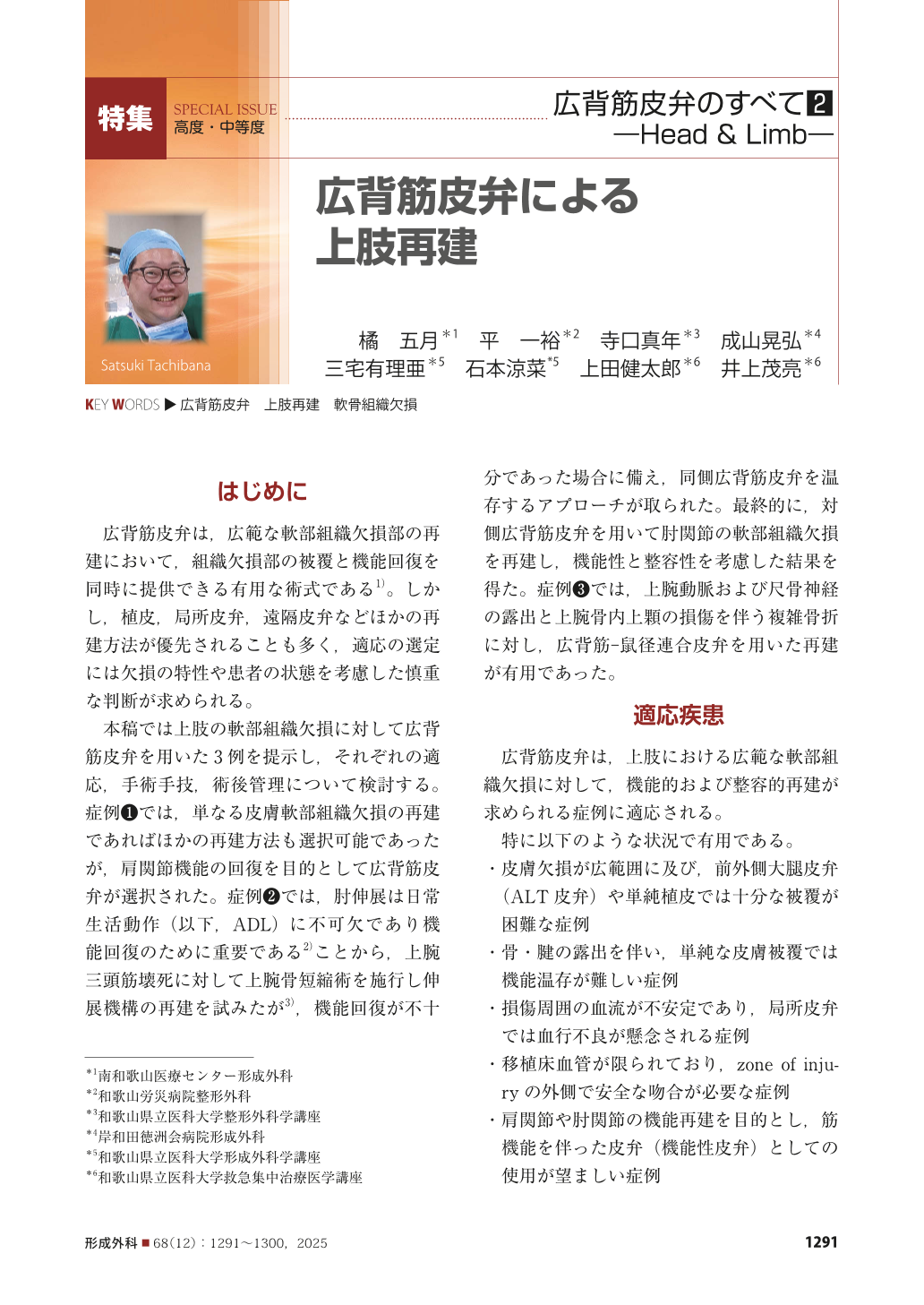
広背筋皮弁は,広範な軟部組織欠損部の再建において,組織欠損部の被覆と機能回復を同時に提供できる有用な術式である 1)。しかし,植皮,局所皮弁,遠隔皮弁などほかの再建方法が優先されることも多く,適応の選定には欠損の特性や患者の状態を考慮した慎重な判断が求められる。
本稿では上肢の軟部組織欠損に対して広背筋皮弁を用いた3例を提示し,それぞれの適応,手術手技,術後管理について検討する。症例❶では,単なる皮膚軟部組織欠損の再建であればほかの再建方法も選択可能であったが,肩関節機能の回復を目的として広背筋皮弁が選択された。症例❷では,肘伸展は日常生活動作(以下,ADL)に不可欠であり機能回復のために重要である 2)ことから,上腕三頭筋壊死に対して上腕骨短縮術を施行し伸展機構の再建を試みたが 3),機能回復が不十分であった場合に備え,同側広背筋皮弁を温存するアプローチが取られた。最終的に,対側広背筋皮弁を用いて肘関節の軟部組織欠損を再建し,機能性と整容性を考慮した結果を得た。症例❸では,上腕動脈および尺骨神経の露出と上腕骨内上顆の損傷を伴う複雑骨折に対し,広背筋-鼠径連合皮弁を用いた再建が有用であった。
Background: The latissimus dorsi (LD) flap remains one of the most reliable options in upper-limb reconstruction, providing both durable coverage and the potential for functional restoration.
Methods: We retrospectively analyzed three cases in which reconstruction was conducted with an LD-based flap: the use of a classic LD musculocutaneous flap, a salvage case after a failed DIEP (deep inferior epigastric perforator) flap, and a complex reconstruction using a conjoined LD-groin flap. We analyzed the patient characteristics, defect profiles, surgical details, outcomes, complications, and functional recovery.
Results: All three patients achieved wound healing and satisfactory functional outcomes. The QuickDASH score of each patient improved after the reconstruction. Secondary procedures including debulking and tendon surgeries contributed to aesthetic and functional refinements. One case required conversion from a failed DIEP flap to an LD flap on postoperative day 1.
Conclusions: LD-based flaps are extremely versatile in upper-limb reconstruction, especially when combined with other flaps. Their stable vascularity, wide coverage, and positional flexibility make them ideal for managing severe injuries or secondary reconstructions.
Copyright© 2025 KOKUSEIDO CO., LTD. All Rights Reserved.