Japanese
English
- 有料閲覧
- Abstract 文献概要
- 1ページ目 Look Inside
- 参考文献 Reference
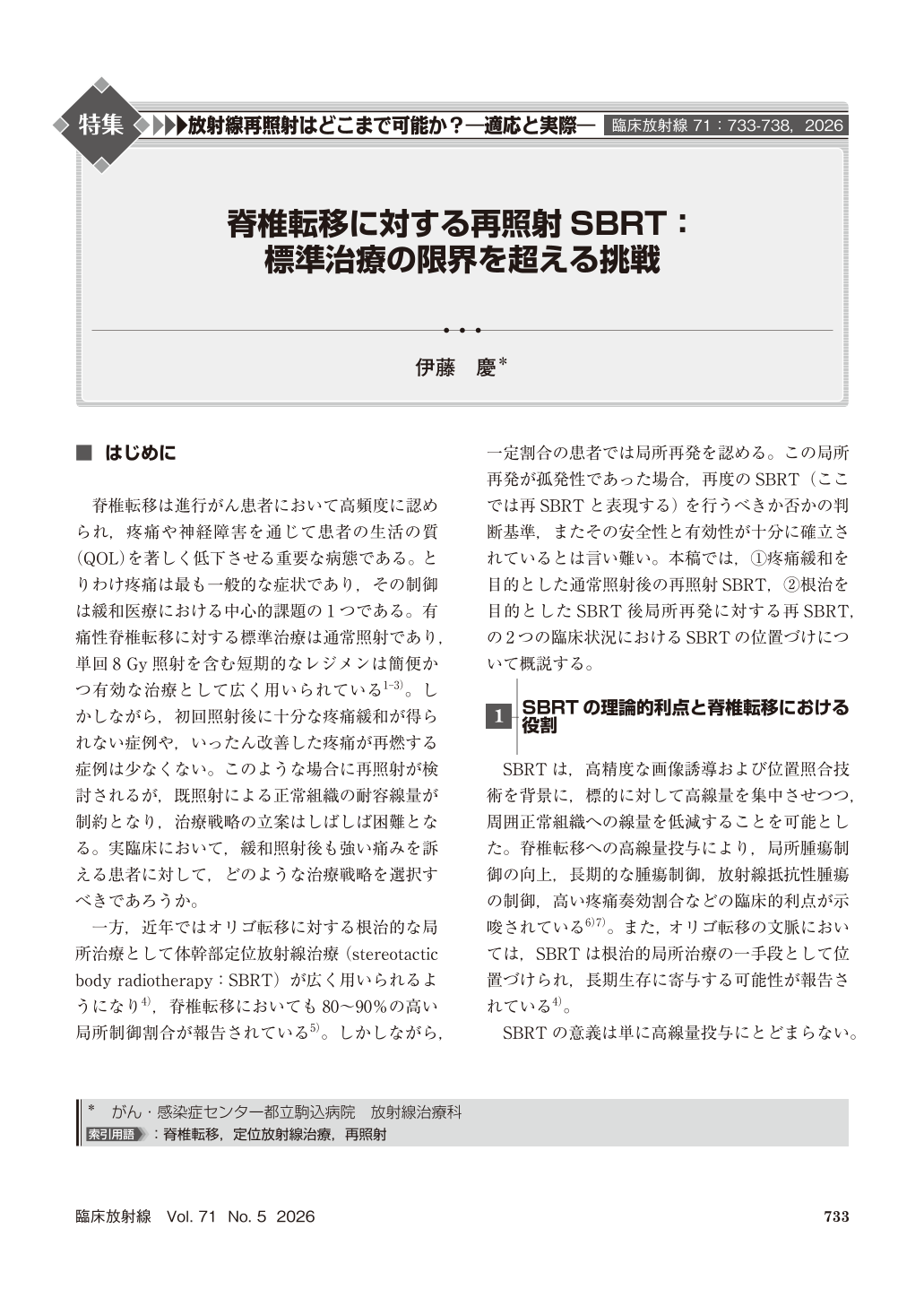
脊椎転移は進行がん患者において高頻度に認められ,疼痛や神経障害を通じて患者の生活の質(QOL)を著しく低下させる重要な病態である。とりわけ疼痛は最も一般的な症状であり,その制御は緩和医療における中心的課題の1つである。有痛性脊椎転移に対する標準治療は通常照射であり,単回8Gy照射を含む短期的なレジメンは簡便かつ有効な治療として広く用いられている1-3)。しかしながら,初回照射後に十分な疼痛緩和が得られない症例や,いったん改善した疼痛が再燃する症例は少なくない。このような場合に再照射が検討されるが,既照射による正常組織の耐容線量が制約となり,治療戦略の立案はしばしば困難となる。実臨床において,緩和照射後も強い痛みを訴える患者に対して,どのような治療戦略を選択すべきであろうか。
Stereotactic body radiotherapy(SBRT)has emerged as a valuable treatment option for spinal metastases requiring re-irradiation. Its steep dose gradient enables effective tumor control while minimizing radiation exposure to critical organs, making it suitable for both conventional radiotherapy failures and local recurrence after prior SBRT. Although favorable local control and acceptable safety have been reported, important challenges remain, including the lack of high-level evidence for pain palliation and the risk of plexopathy after repeat SBRT. SBRT may provide an important treatment option for patients whose needs cannot be adequately addressed by conventional radiotherapy.
Copyright © 2026, KANEHARA SHUPPAN Co.LTD. All rights reserved.