Japanese
English
- 販売していません
- Abstract 文献概要
- 1ページ目 Look Inside
- 参考文献 Reference
はじめに
聖マリアンナ医科大学病院(以下,当院)では2015年4月より,「勤務犬」として動物介在療法(animal-assisted therapy,以下AAT)が導入された.特定機能病院としては本邦初となるAATを現在まで400件以上実施している.勤務犬は2代続けてスタンダードプードルであったが,2023年4月21日からはゴールデンレトリーバーの3代目,ハクが後を引き継いだ.
AATとは医師の指示のもと,病と闘う患者およびその家族の情緒的安定や闘病意欲の向上を促し,自立と適応力を高めることを目的とした治療的介入である.AATを実施するのは特別な訓練を受け,さまざまな条件をクリアした犬とそれを扱うハンドラーである.ハンドラーは患者に関わるすべての医療従事者と連携を図りながら,患者の治療目的に沿ったAATを展開する.そのために患者の状態を病棟スタッフと共有する必要があり,ハンドラーはAATや医療の知識のみならず,コミュニケーション能力も求められる.単にかわいい動物に触れ合うといったようないわゆる「アニマルセラピー」とは一線を画す.個々の患者の治療阻害因子を抽出し,その患者1人に対する目標を設定する.AAT介入後は病棟スタッフと患者の変化を評価し,患者に対する治療や看護に反映させている.
当院におけるこれまでのAAT対象患者の多くは,情緒や闘病意欲の問題が特に大きい小児患者やがん患者であった.しかし,同様の問題は重度障害を後遺したリハビリテーション患者にも認められやすい.不安や抑うつ気分,不能感などはリハビリテーション治療の推進を著しく阻害する.
なお,AAT対象患者はAATの効果を阻害する要素を持ち合わせていないことが前提にある.絶対条件として動物アレルギーではないことが挙げられる.次に犬に対して嫌悪感を抱いておらず,治療や看護の最中に「勤務犬が一緒にいてほしい」という思いを患者がもっていることが重要となる.本症例の患者はこれらの前提条件をすべてクリアしている.今回,歩行障害を呈した頚髄症患者のリハビリテーション治療にAATを組み合わせたことにより,患者のリハビリテーション治療に対する意欲の改善を認めたため,報告する.
本症例報告に際し,患者には趣旨や内容について文書および口頭にて十分な説明を行い,書面にて同意を得た.
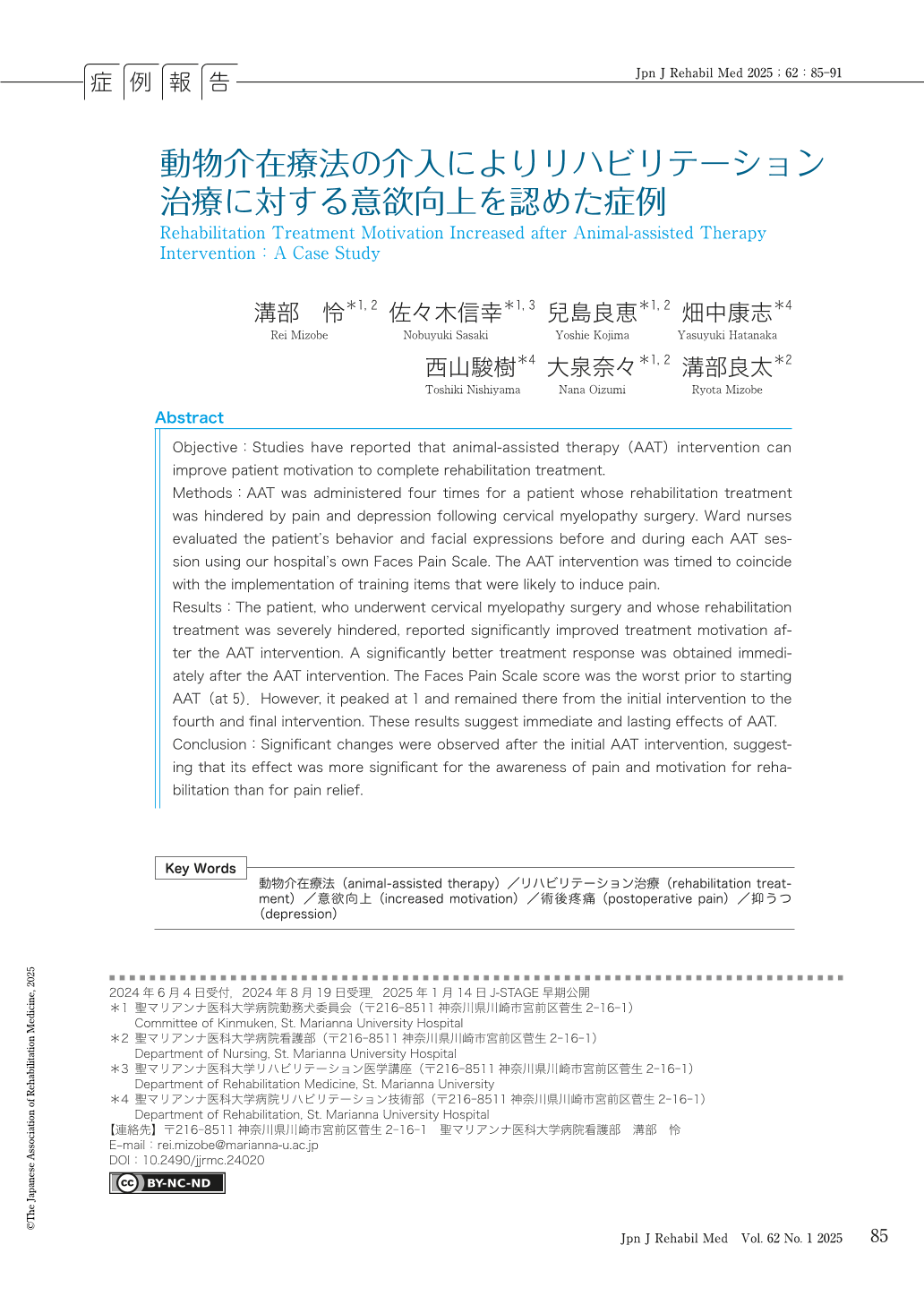
Abstract Objective: Studies have reported that animal-assisted therapy (AAT) intervention can improve patient motivation to complete rehabilitation treatment.
Methods: AAT was administered four times for a patient whose rehabilitation treatment was hindered by pain and depression following cervical myelopathy surgery. Ward nurses evaluated the patient's behavior and facial expressions before and during each AAT session using our hospital's own Faces Pain Scale. The AAT intervention was timed to coincide with the implementation of training items that were likely to induce pain.
Results: The patient, who underwent cervical myelopathy surgery and whose rehabilitation treatment was severely hindered, reported significantly improved treatment motivation after the AAT intervention. A significantly better treatment response was obtained immediately after the AAT intervention. The Faces Pain Scale score was the worst prior to starting AAT (at 5). However, it peaked at 1 and remained there from the initial intervention to the fourth and final intervention. These results suggest immediate and lasting effects of AAT.
Conclusion: Significant changes were observed after the initial AAT intervention, suggesting that its effect was more significant for the awareness of pain and motivation for rehabilitation than for pain relief.
Copyright © 2025, The Japanese Association of Rehabilitation Medicine. All rights reserved.