Japanese
English
- 有料閲覧
- Abstract 文献概要
- 1ページ目 Look Inside
- 参考文献 Reference
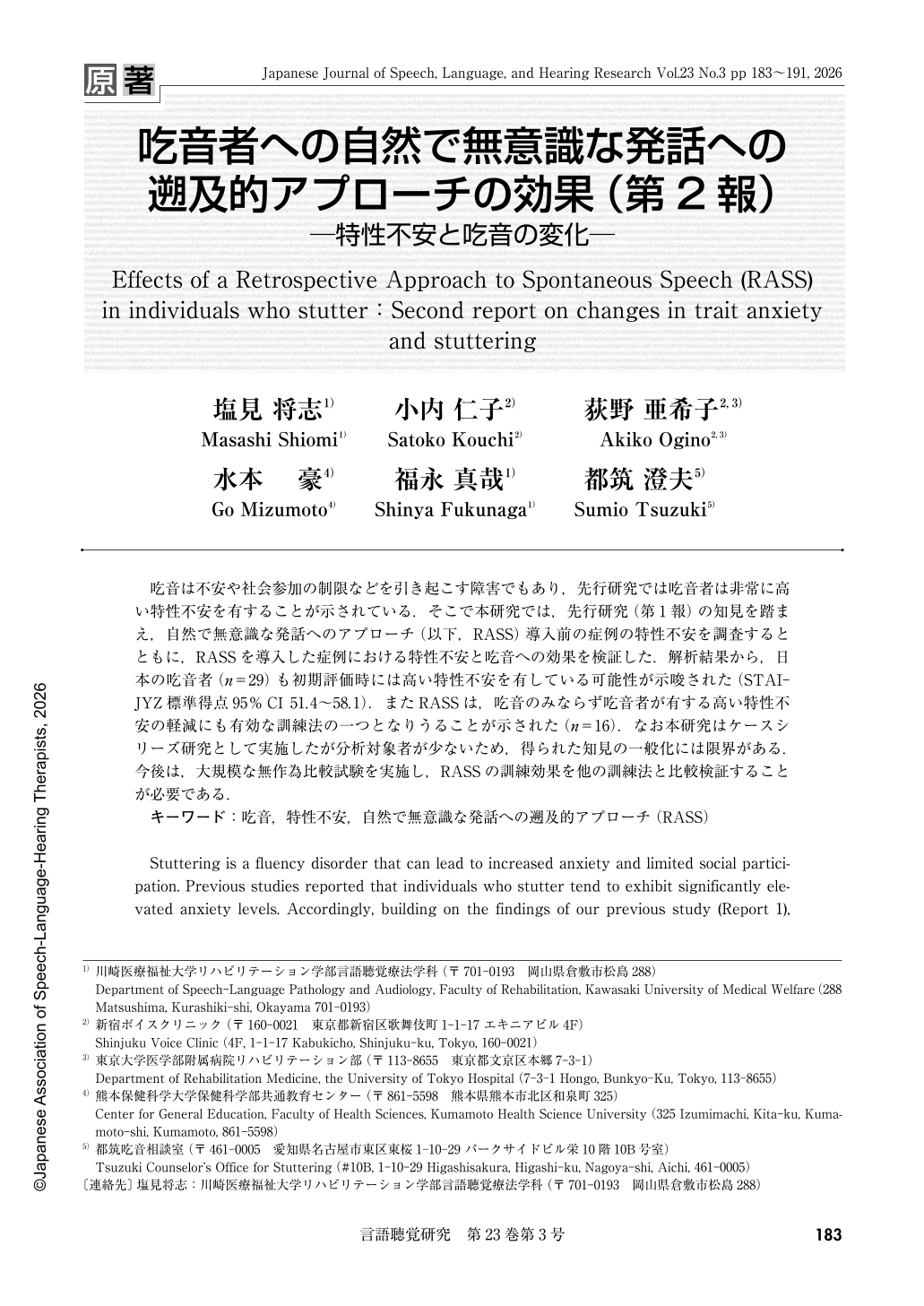
吃音は不安や社会参加の制限などを引き起こす障害でもあり,先行研究では吃音者は非常に高い特性不安を有することが示されている.そこで本研究では,先行研究(第1報)の知見を踏まえ,自然で無意識な発話へのアプローチ(以下,RASS)導入前の症例の特性不安を調査するとともに,RASSを導入した症例における特性不安と吃音への効果を検証した.解析結果から,日本の吃音者(n=29)も初期評価時には高い特性不安を有している可能性が示唆された(STAI-JYZ標準得点95%CI 51.4〜58.1).またRASSは,吃音のみならず吃音者が有する高い特性不安の軽減にも有効な訓練法の一つとなりうることが示された(n=16).なお本研究はケースシリーズ研究として実施したが分析対象者が少ないため,得られた知見の一般化には限界がある.今後は,大規模な無作為比較試験を実施し,RASSの訓練効果を他の訓練法と比較検証することが必要である.
Stuttering is a fluency disorder that can lead to increased anxiety and limited social participation. Previous studies reported that individuals who stutter tend to exhibit significantly elevated anxiety levels. Accordingly, building on the findings of our previous study (Report 1), the present study investigated trait anxiety in patients prior to the introduction of Retrospective Approach to Spontaneous Speech (RASS) and examined the effects of RASS on trait anxiety and stuttering in patients who underwent RASS. The analysis suggested that Japanese clients who stutter (n=29) also showed high trait anxiety during the initial assessment (STAI-JYZ standardized score ; 95%CI : 51.4〜58.1). Furthermore, RASS was found to be potentially effective in reducing both stuttering severity and trait anxiety (n=16). However, because this study was conducted as a case series with a small number of participants, the generalizability of the findings remains limited. Future investigations should involve large-scale randomized controlled trials to compare the therapeutic efficacy of RASS with that of other intervention methods.
Copyright © 2026, Japanese Association of Speech-Language-Hearing Therapists. All rights reserved.