Japanese
English
- 有料閲覧
- Abstract 文献概要
- 1ページ目 Look Inside
- 参考文献 Reference
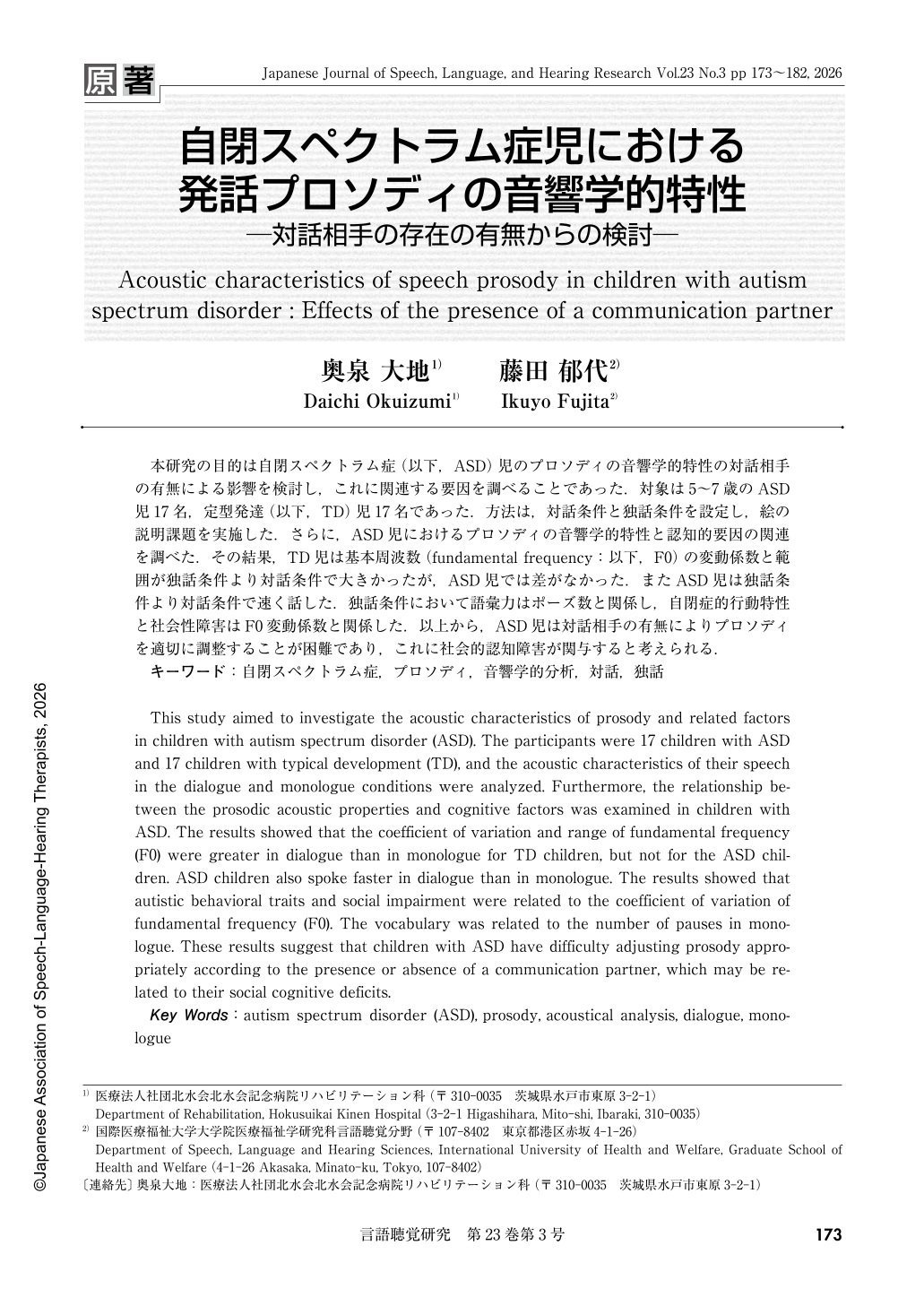
本研究の目的は自閉スペクトラム症(以下,ASD)児のプロソディの音響学的特性の対話相手の有無による影響を検討し,これに関連する要因を調べることであった.対象は5〜7歳のASD児17名,定型発達(以下,TD)児17名であった.方法は,対話条件と独話条件を設定し,絵の説明課題を実施した.さらに,ASD児におけるプロソディの音響学的特性と認知的要因の関連を調べた.その結果,TD児は基本周波数(fundamental frequency:以下,F0)の変動係数と範囲が独話条件より対話条件で大きかったが,ASD児では差がなかった.またASD児は独話条件より対話条件で速く話した.独話条件において語彙力はポーズ数と関係し,自閉症的行動特性と社会性障害はF0変動係数と関係した.以上から,ASD児は対話相手の有無によりプロソディを適切に調整することが困難であり,これに社会的認知障害が関与すると考えられる.
This study aimed to investigate the acoustic characteristics of prosody and related factors in children with autism spectrum disorder (ASD). The participants were 17 children with ASD and 17 children with typical development (TD), and the acoustic characteristics of their speech in the dialogue and monologue conditions were analyzed. Furthermore, the relationship between the prosodic acoustic properties and cognitive factors was examined in children with ASD. The results showed that the coefficient of variation and range of fundamental frequency (F0) were greater in dialogue than in monologue for TD children, but not for the ASD children. ASD children also spoke faster in dialogue than in monologue. The results showed that autistic behavioral traits and social impairment were related to the coefficient of variation of fundamental frequency (F0). The vocabulary was related to the number of pauses in monologue. These results suggest that children with ASD have difficulty adjusting prosody appropriately according to the presence or absence of a communication partner, which may be related to their social cognitive deficits.
Copyright © 2026, Japanese Association of Speech-Language-Hearing Therapists. All rights reserved.