Japanese
English
- 有料閲覧
- Abstract 文献概要
- 1ページ目 Look Inside
- 参考文献 Reference
Point
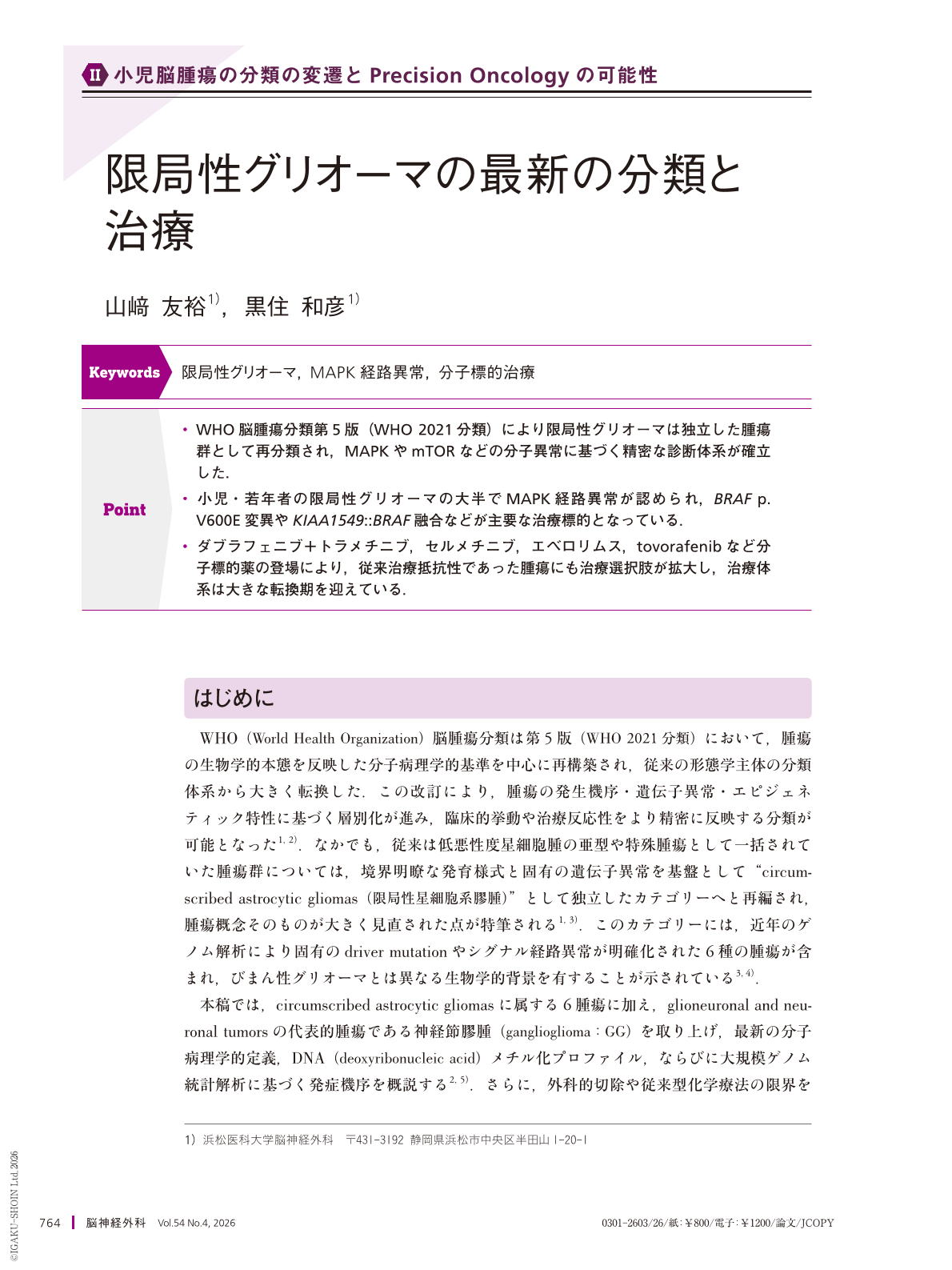
・WHO脳腫瘍分類第5版(WHO 2021分類)により限局性グリオーマは独立した腫瘍群として再分類され,MAPKやmTORなどの分子異常に基づく精密な診断体系が確立した.
・小児・若年者の限局性グリオーマの大半でMAPK経路異常が認められ,BRAF p.V600E変異やKIAA1549::BRAF融合などが主要な治療標的となっている.
・ダブラフェニブ+トラメチニブ,セルメチニブ,エベロリムス,tovorafenibなど分子標的薬の登場により,従来治療抵抗性であった腫瘍にも治療選択肢が拡大し,治療体系は大きな転換期を迎えている.
The 2021 World Health Organization (WHO) classification of tumors of the central nervous system (CNS5) marks a major shift toward molecularly integrated diagnostics, distinguishing circumscribed astrocytic gliomas and glioneuronal tumors from diffuse gliomas based on characteristic genomic and epigenetic signatures. These tumors are predominantly driven by MAPK pathway alterations, including BRAF fusions and BRAF V600E mutation, whereas others harbor mTOR pathway activation or distinct drivers, such as PRKCA and MN1. Advances in precision oncology have transformed clinical management, and targeted therapies, such as dabrafenib/trametinib and everolimus, have been established; selumetinib received expanded adult approval in Japan in 2025. Moreover, next-generation type II RAF inhibitors, exemplified by tovorafenib, and emerging combinatorial approaches targeting pathway crosstalk offer promising strategies to overcome therapeutic resistance. This review synthesizes current molecular definitions and evolving personalized treatment paradigms for circumscribed gliomas. Integrating these molecular insights into routine practice is essential for optimizing tumor control and preserving neurological function in the CNS5 era.
Copyright © 2026, Igaku-Shoin Ltd. All rights reserved.