Japanese
English
- 有料閲覧
- Abstract 文献概要
- 1ページ目 Look Inside
- 参考文献 Reference
Point
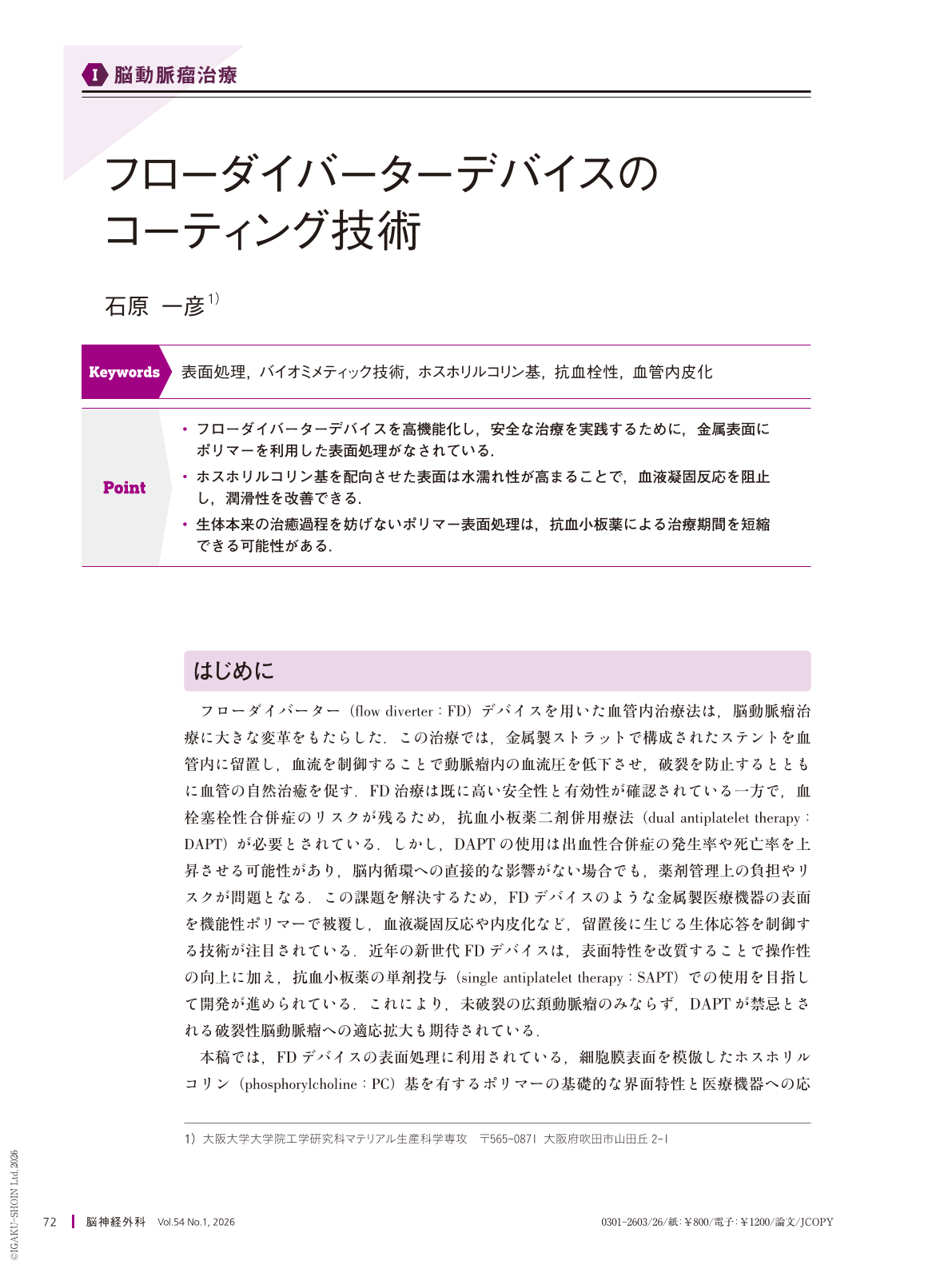
・フローダイバーターデバイスを高機能化し,安全な治療を実践するために,金属表面にポリマーを利用した表面処理がなされている.
・ホスホリルコリン基を配向させた表面は水濡れ性が高まることで,血液凝固反応を阻止し,潤滑性を改善できる.
・生体本来の治癒過程を妨げないポリマー表面処理は,抗血小板薬による治療期間を短縮できる可能性がある.
Flow diverter (FD) devices have become a standard treatment for cerebral aneurysms. FDs are braided metallic stents designed to redirect blood flow, thereby reducing intra-aneurysmal pressure, promoting vascular remodeling, and preventing rupture. Although their safety and efficacy are well established, thromboembolic risk still requires dual antiplatelet therapy (DAPT). However, DAPT increases hemorrhagic risk and mortality, even when intracranial circulation is not directly affected. To address this limitation, recent FD designs focus on improving surface biocompatibility through chemical modifications that suppress coagulation and thrombosis. The long-term objective is to enable treatment under single antiplatelet therapy, which may broaden use to ruptured aneurysms where DAPT is contraindicated. Coating metallic devices with functional polymers has been investigated to modulate biological responses, including coagulation and endothelialization. Among these materials, 2-methacryloyloxyethyl phosphorylcholine (MPC) polymers, inspired by the phospholipid structure of cell membranes, demonstrate strong hemocompatibility and clinical reliability. This article reviews the interfacial properties of MPC polymers, their applications in medical devices, and their recent integration into an FD device.
Copyright © 2026, Igaku-Shoin Ltd. All rights reserved.