Japanese
English
- 有料閲覧
PPV購入案内
2,750円 (2,500円+税10%) こちらは、1052ページから1062ページの文献です。購入には医書.jp本会員登録が必要です。
会員登録完了後に改めて上記「購入サイトへ」を選択してください。
または「購入サイトへ」選択後に「購入ログイン」、「新規会員登録」の順に進んでください。
会員登録について詳しくはをご確認ください。
- Abstract 文献概要
- 1ページ目 Look Inside
- 参考文献 Reference
要旨
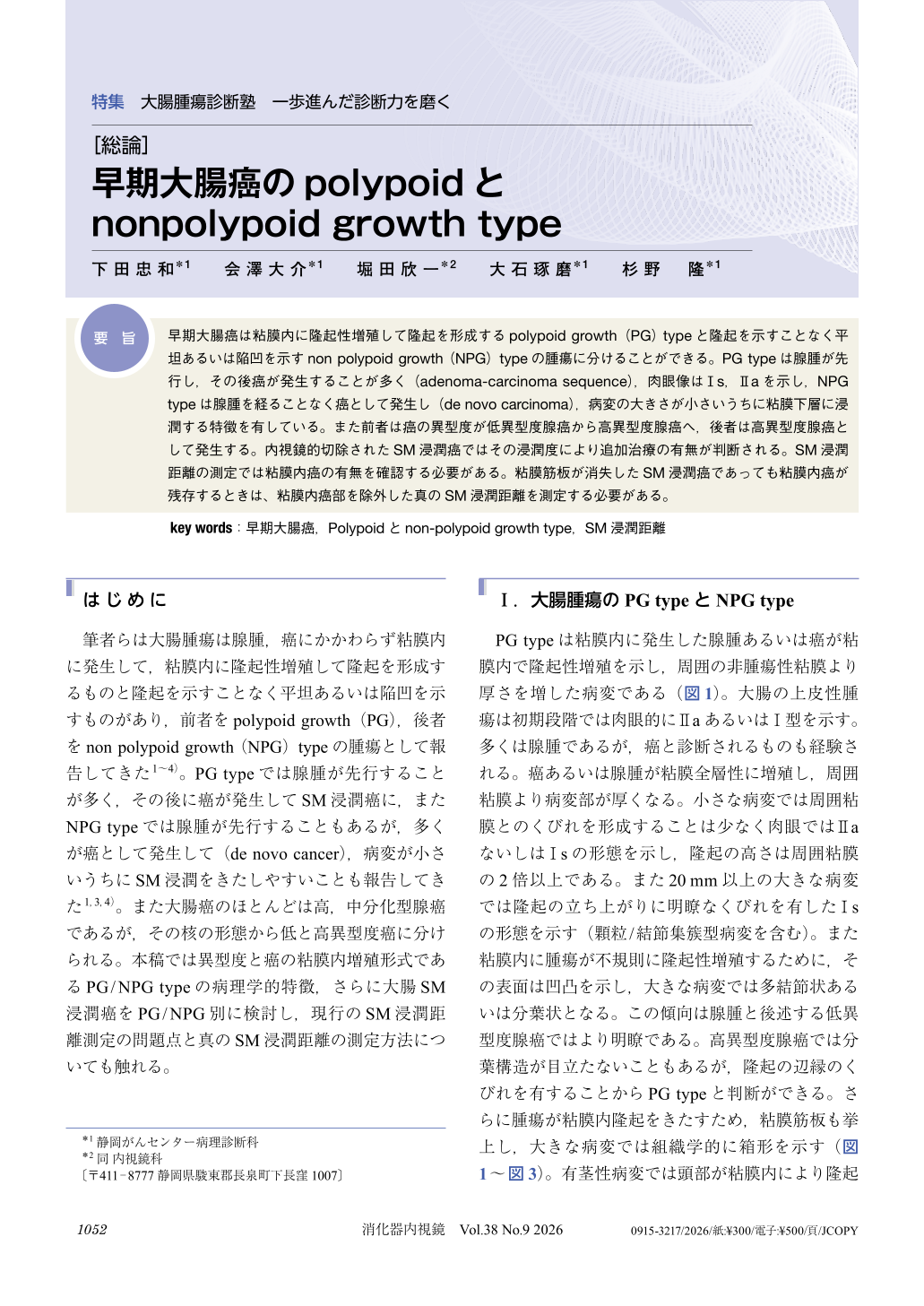
早期大腸癌は粘膜内に隆起性増殖して隆起を形成するpolypoid growth(PG) typeと隆起を示すことなく平坦あるいは陥凹を示すnon polypoid growth (NPG)typeの腫瘍に分けることができる。PG typeは腺腫が先行し,その後癌が発生することが多く(adenoma-carcinoma sequence),肉眼像はⅠs,Ⅱaを示し,NPG typeは腺腫を経ることなく癌として発生し(de novo carcinoma),病変の大きさが小さいうちに粘膜下層に浸潤する特徴を有している。また前者は癌の異型度が低異型度腺癌から高異型度腺癌へ,後者は高異型度腺癌として発生する。内視鏡的切除されたSM浸潤癌ではその浸潤度により追加治療の有無が判断される。SM浸潤距離の測定では粘膜内癌の有無を確認する必要がある。粘膜筋板が消失したSM浸潤癌であっても粘膜内癌が残存するときは、粘膜内癌部を除外した真のSM浸潤距離を測定する必要がある。
Early-stage colorectal cancers can be classified into two types: the polypoid growth (PG) type, which forms a protrusion through elevated growth within the mucosa, and the non-polypoid growth (NPG) type, which presents as a flat or depressed lesion without forming a protrusion. The PG type frequently arises from a preceding adenoma (adenoma-carcinoma sequence) and macroscopically presents as type Is or IIa; in contrast, the NPG type develops as cancer *de novo* without an adenomatous precursor and is characterized by the tendency to invade the submucosa while the lesion is still small size. Regarding histological grade, the PG type progresses from carcinoma with low-grade to high-grade atypia, whereas the NPG type arises as high-grade atypia. For submucosal (SM) invasive cancers treated via endoscopic resection, the necessity for additional treatment is determined based on the depth of invasion. Measuring the depth of SM invasion requires confirming the presence or absence of intramucosal carcinoma. Even in cases where the muscularis mucosae has disappeared due to SM invasion, if residual intramucosal carcinoma is present, the true depth of SM invasion must be measured by excluding the intramucosal carcinoma component.
© tokyo-igakusha.co.jp. All right reserved.