Japanese
English
- 有料閲覧
PPV購入案内
1,320円 (1,200円+税10%) こちらは、412ページから418ページの文献です。購入には医書.jp本会員登録が必要です。
会員登録完了後に改めて上記「購入サイトへ」を選択してください。
または「購入サイトへ」選択後に「購入ログイン」、「新規会員登録」の順に進んでください。
会員登録について詳しくはをご確認ください。
- Abstract 文献概要
- 1ページ目 Look Inside
- 参考文献 Reference
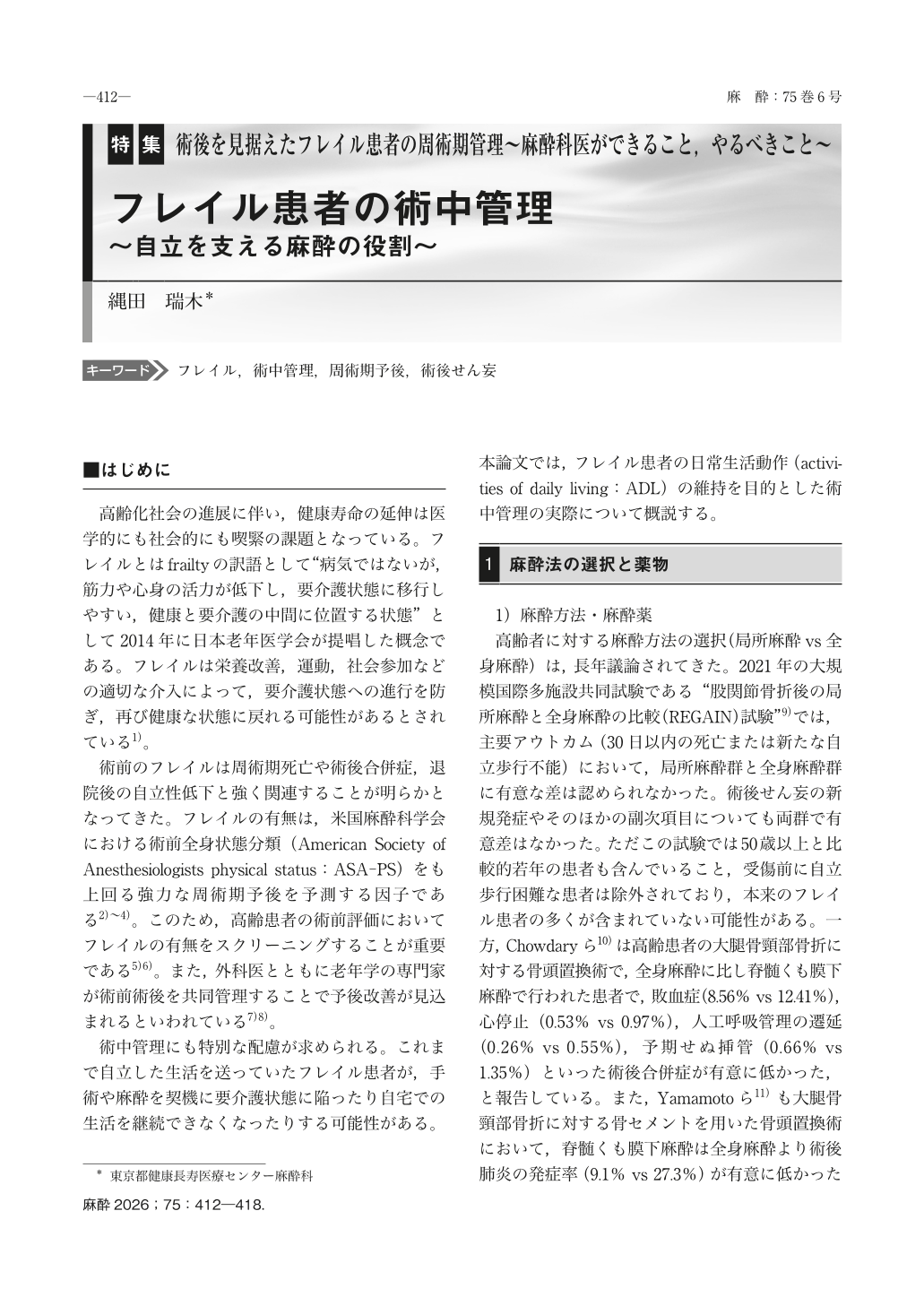
はじめに
高齢化社会の進展に伴い,健康寿命の延伸は医学的にも社会的にも喫緊の課題となっている。フレイルとはfrailtyの訳語として “病気ではないが,筋力や心身の活力が低下し,要介護状態に移行しやすい,健康と要介護の中間に位置する状態” として2014年に日本老年医学会が提唱した概念である。フレイルは栄養改善,運動,社会参加などの適切な介入によって,要介護状態への進行を防ぎ,再び健康な状態に戻れる可能性があるとされている1)。
術前のフレイルは周術期死亡や術後合併症,退院後の自立性低下と強く関連することが明らかとなってきた。フレイルの有無は,米国麻酔科学会における術前全身状態分類(American Society of Anesthesiologists physical status:ASA-PS)をも上回る強力な周術期予後を予測する因子である2)~4)。このため,高齢患者の術前評価においてフレイルの有無をスクリーニングすることが重要である5)6)。また,外科医とともに老年学の専門家が術前術後を共同管理することで予後改善が見込まれるといわれている7)8)。
術中管理にも特別な配慮が求められる。これまで自立した生活を送っていたフレイル患者が,手術や麻酔を契機に要介護状態に陥ったり自宅での生活を継続できなくなったりする可能性がある。本論文では,フレイル患者の日常生活動作(activities of daily living:ADL)の維持を目的とした術中管理の実際について概説する。
The rising prevalence of frailty in aging societies underscores the need to maintain patients’ functional independence after surgery. Frailty, a pre-disability state characterized by diminished physiological reserve and reduced resilience to stress, is a strong predictor of poor perioperative outcomes, often surpassing the accuracy of the ASA-PS classification. The anesthetic management for frail patients should thus aim not only to ensure patients’ safety but also to preserve their postoperative independence.
Although neither general nor regional anesthesia is universally superior, individualized anesthesia planning based on patients’ comorbidities and the expected surgical stress is essential. Key intraoperative strategies include light anesthesia guided by brain monitoring, the avoidance of high-risk drugs such as benzodiazepines and high-dose opioids, and the use of neuraxial or peripheral nerve blocks for multimodal analgesia. Because frail patients have a limited homeostatic reserve, the meticulous control of hemodynamics, oxygenation, and temperature is crucial to prevent organ dysfunction and promote recovery.
Although patient factors are the main contributors to postoperative delirium, anesthesiologists play a pivotal role in mitigating modifiable perioperative risks. By maintaining stable anesthesia and physiology, anesthesiologists serve as the ‘last line of defense’ against the transition from frailty to dependency.
Copyright © 2026 KOKUSEIDO CO., LTD. All Rights Reserved.