Japanese
English
- 有料閲覧
PPV購入案内
1,650円 (1,500円+税10%) こちらは、173ページから176ページの文献です。購入には医書.jp本会員登録が必要です。
会員登録完了後に改めて上記「購入サイトへ」を選択してください。
または「購入サイトへ」選択後に「購入ログイン」、「新規会員登録」の順に進んでください。
会員登録について詳しくはをご確認ください。
- Abstract 文献概要
- 1ページ目 Look Inside
- 参考文献 Reference
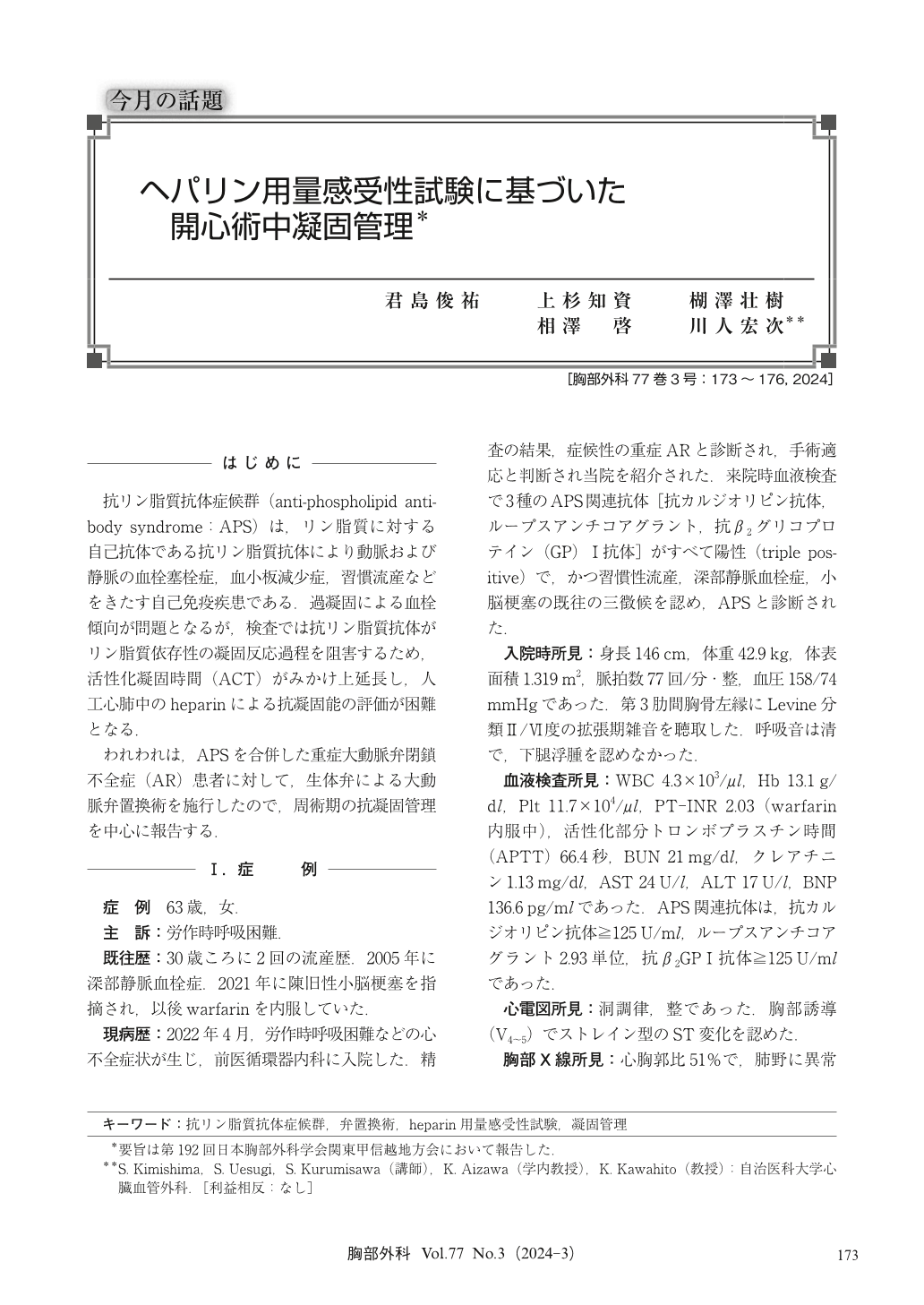
抗リン脂質抗体症候群(anti-phospholipid antibody syndrome:APS)は,リン脂質に対する自己抗体である抗リン脂質抗体により動脈および静脈の血栓塞栓症,血小板減少症,習慣流産などをきたす自己免疫疾患である.過凝固による血栓傾向が問題となるが,検査では抗リン脂質抗体がリン脂質依存性の凝固反応過程を阻害するため,活性化凝固時間(ACT)がみかけ上延長し,人工心肺中のheparinによる抗凝固能の評価が困難となる.
A 63-year-old woman with severe aortic regurgitation was admitted to our hospital due to congestive heart failure. She also had antiphospholipid syndrome (APS), necessitating strict coagulation management. Given her history of cerebellar infarction, deep vein thrombosis, and recurrent miscarriages, her thrombosis risk was higher, with all three types of antiphospholipid antibodies testing positive. Before the surgery, we created a heparin-activated clotting time (ACT) titration curve using the patient’s blood, and the calculated ACT corresponding to the target heparin concentration of 3 U/ml was 650 seconds. We planned to administer heparin according to this target during cardiopulmonary bypass. The patient underwent an aortic valve replacement (AVR) using a bioprosthesis and was discharged without complications.
© Nankodo Co., Ltd., 2024