Japanese
English
- 有料閲覧
PPV購入案内
1,650円 (1,500円+税10%) こちらは、867ページから872ページの文献です。購入には医書.jp本会員登録が必要です。
会員登録完了後に改めて上記「購入サイトへ」を選択してください。
または「購入サイトへ」選択後に「購入ログイン」、「新規会員登録」の順に進んでください。
会員登録について詳しくはをご確認ください。
- Abstract 文献概要
- 1ページ目 Look Inside
- 参考文献 Reference
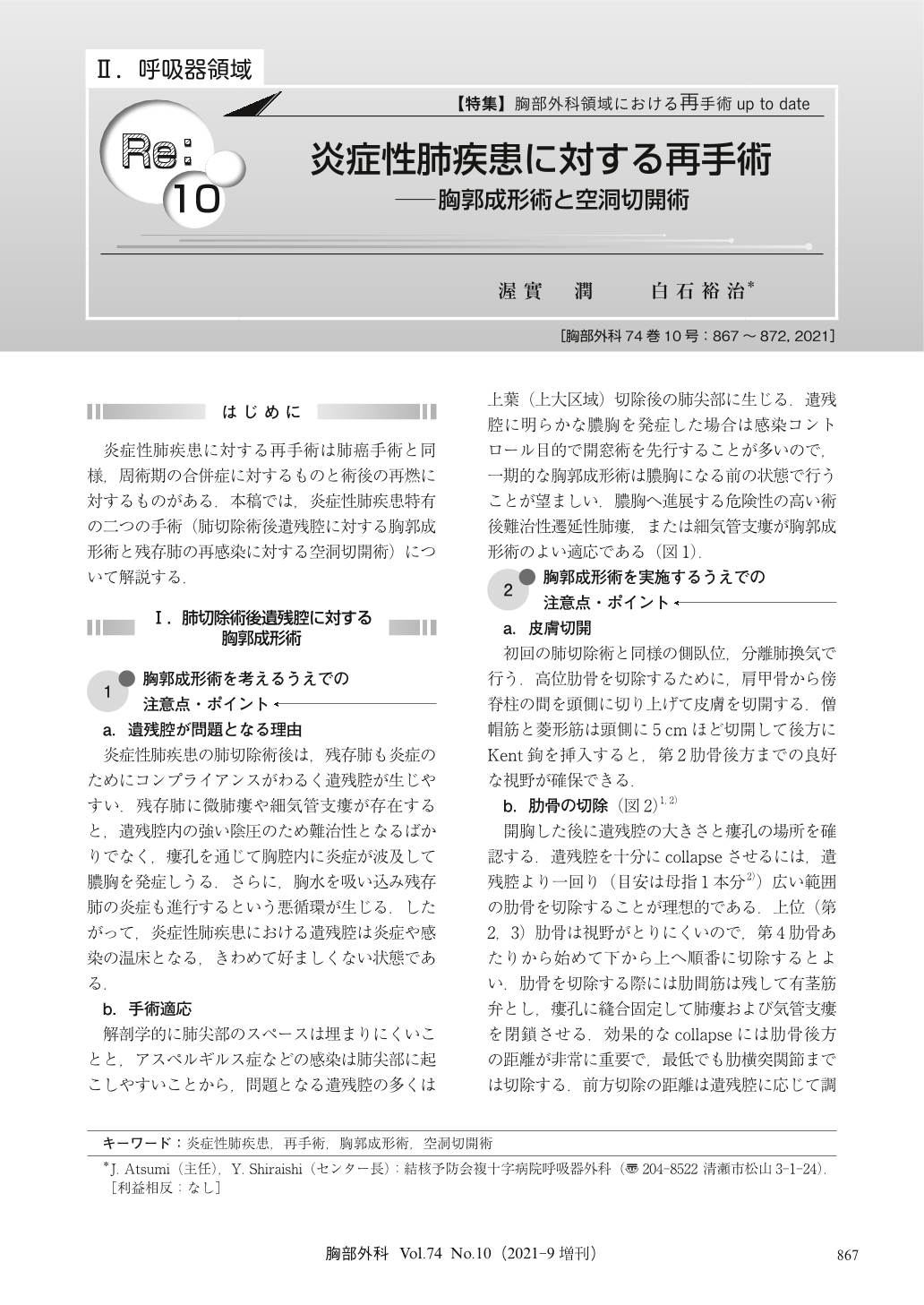
炎症性肺疾患に対する再手術は肺癌手術と同様,周術期の合併症に対するものと術後の再燃に対するものがある.本稿では,炎症性肺疾患特有の二つの手術(肺切除術後遺残腔に対する胸郭成形術と残存肺の再感染に対する空洞切開術)について解説する.
Two types of re-operations for inflammatory lung diseases are presented:thoracoplasty and cavernostomy.
Thoracoplasty is used to obliterate a residual pleural space after upper lung resection with prolonged air leak. Usually, the 2nd to the 6th ribs are resected, according to the extent of the space. Posteriorly the ribs should be removed to the costotransverse joint to achieve sufficient space obliteration. The tip of the scapula is resected in case of the resection of the 6th rib, otherwise the scapula would impinge on the 7th rib. The resection of the 1st rib should be avoided because of a subsequent severe scoliosis.
Cavernostomy is a procedure to open the infected cavity of the residual lung. Aspergillus and non-tuberculous mycobacteria are the most frequent pathogens. The site of skin incision depends on the location of the cavity:midaxially incision for an anterior cavity and paravertebral incision for a posterior cavity. Cutting “septum” in the cavity makes it a single space, contributing to sufficient drainage by gauze. The closure of the cavity will be considered after several months or years when the cavity is sterilized and the patient’s nutritional status becomes well.
These 2 procedures are effective in treating refractory lung inflammation after lung resection, although they are quite traditional.
© Nankodo Co., Ltd., 2021