Japanese
English
- 有料閲覧
PPV購入案内
1,320円 (1,200円+税10%) こちらは、56ページから64ページの文献です。購入には医書.jp本会員登録が必要です。
会員登録完了後に改めて上記「購入サイトへ」を選択してください。
または「購入サイトへ」選択後に「購入ログイン」、「新規会員登録」の順に進んでください。
会員登録について詳しくはをご確認ください。
- Abstract 文献概要
- 1ページ目 Look Inside
- 参考文献 Reference
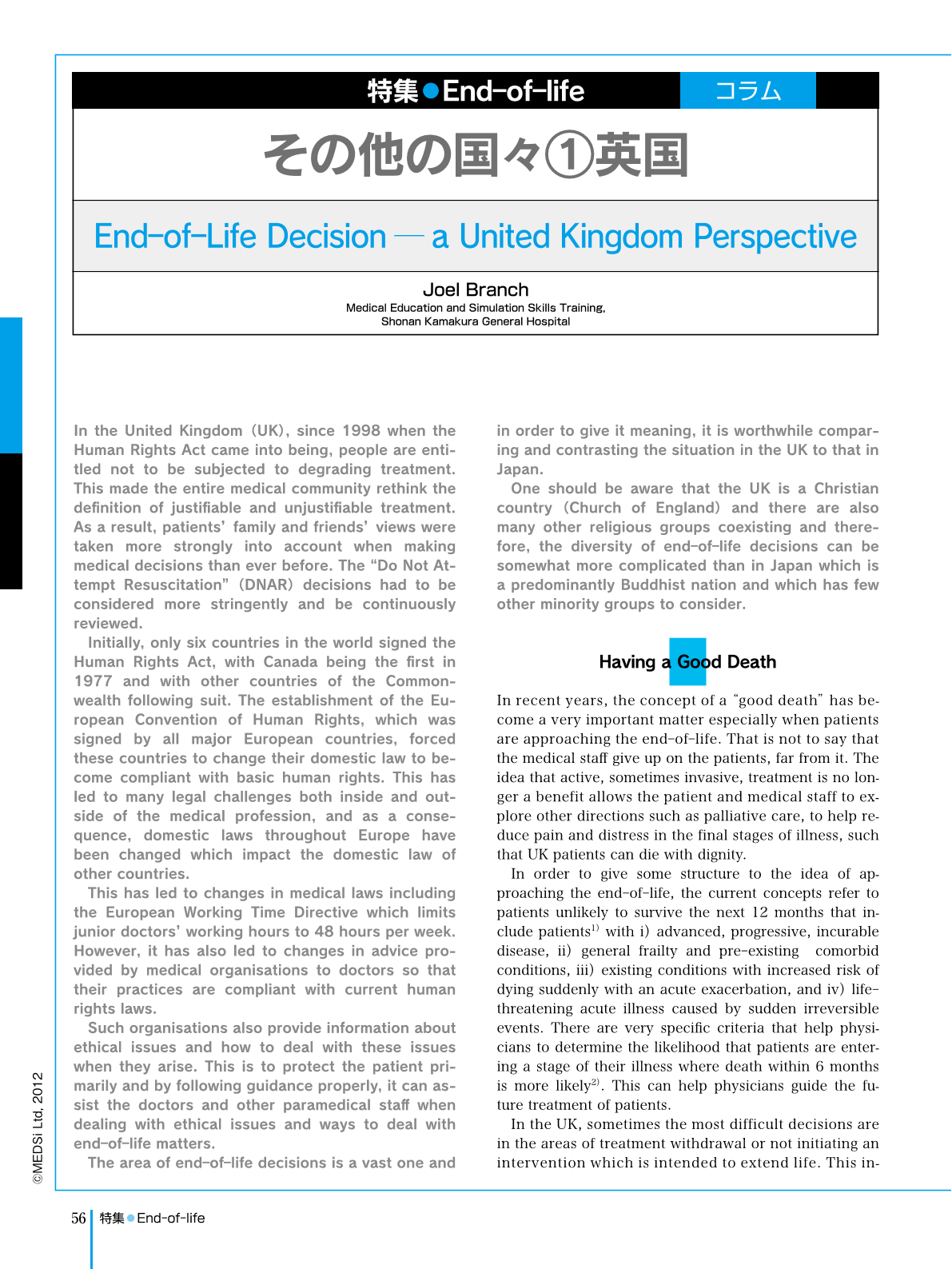
In the United Kingdom(UK), since 1998 when the Human Rights Act came into being, people are entitled not to be subjected to degrading treatment. This made the entire medical community rethink the definition of justifiable and unjustifiable treatment. As a result, patients' family and friends' views were taken more strongly into account when making medical decisions than ever before. The “Do Not Attempt Resuscitation” (DNAR) decisions had to be considered more stringently and be continuously reviewed.
Initially, only six countries in the world signed the Human Rights Act, with Canada being the first in 1977 and with other countries of the Commonwealth following suit. The establishment of the European Convention of Human Rights, which was signed by all major European countries, forced these countries to change their domestic law to become compliant with basic human rights. This has led to many legal challenges both inside and outside of the medical profession, and as a consequence, domestic laws throughout Europe have been changed which impact the domestic law of other countries.
This has led to changes in medical laws including the European Working Time Directive which limits junior doctors' working hours to 48 hours per week. However, it has also led to changes in advice provided by medical organisations to doctors so that their practices are compliant with current human rights laws.
Such organisations also provide information about ethical issues and how to deal with these issues when they arise. This is to protect the patient primarily and by following guidance properly, it can assist the doctors and other paramedical staff when dealing with ethical issues and ways to deal with end-of-life matters.
The area of end-of-life decisions is a vast one and in order to give it meaning, it is worthwhile comparing and contrasting the situation in the UK to that in Japan.
One should be aware that the UK is a Christian country (Church of England) and there are also many other religious groups coexisting and therefore, the diversity of end-of-life decisions can be somewhat more complicated than in Japan which is a predominantly Buddhist nation and which has few other minority groups to consider.
Copyright © 2012, "MEDICAL SCIENCES INTERNATIONAL, LTD." All rights reserved.