Japanese
English
- 有料閲覧
PPV購入案内
1,320円 (1,200円+税10%) こちらは、311ページから316ページの文献です。購入には医書.jp本会員登録が必要です。
会員登録完了後に改めて上記「購入サイトへ」を選択してください。
または「購入サイトへ」選択後に「購入ログイン」、「新規会員登録」の順に進んでください。
会員登録について詳しくはをご確認ください。
- Abstract 文献概要
- 1ページ目 Look Inside
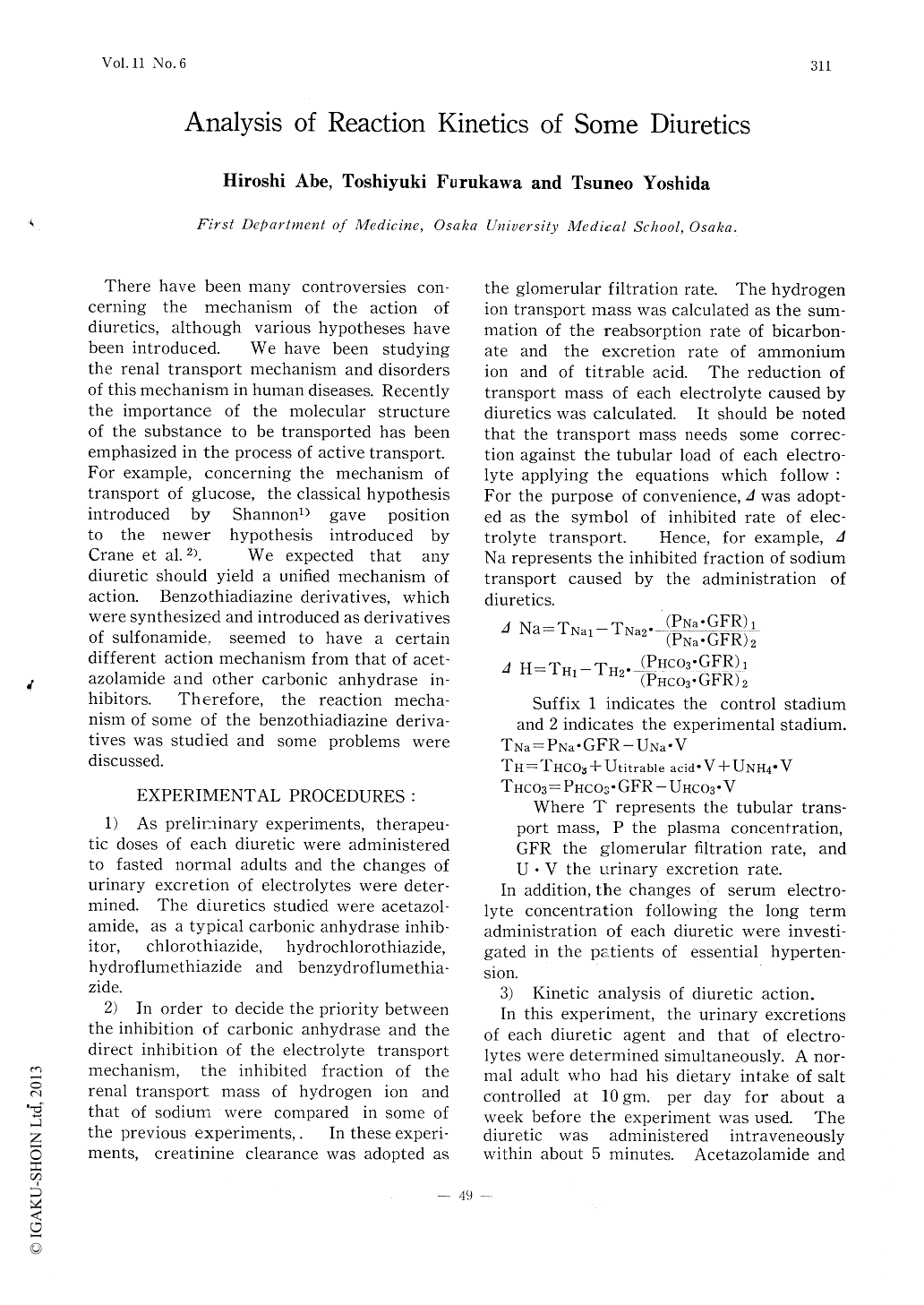
1.The reaction mechanism of newer synthesized sulfonamide derivative benzothiadiazines, was investigated in human subjects.They were acetazolamide, chlorothiazide,hydrochlorothiazide, hydroflumethiazide, and benzydroflumethiazide.
2.Results obtained from the preliminary experiments with short term and long term administration of diuretics suggested that the carbonic anhydrase inhibition may not be the specific action mechanism of these diuretics and may be only an attendant effect.
a)In the short term experiments, the increment of sodium excretion caused by each diuretic was of the same order of magnitude but that of anions reflected the carbonic anhydrase inhibiting activity of each diuretic.
b)In the long term experiments, the changes of serum electrolytes concentration following the long term administration of each diuretic reflected the carbonic anhydrase inhibiting activity.
c)In certain cases of the short term experiments, the inhibited fractions of transport mass of electrolytes were calculated.The inhibited fraction of sodium transport,i.e.,�Na, invariably exceeded that of hydrogen, i. e.,�H.It was seen not only in the cases of the benzothiadiazines but also in that of acetazolamide.
3.Reaction kinetics of the diuretic effect of these diuretics were analyzed from the relation between the excreted amount of the diuretic and that of the electrolytes.In this experiment, urinary excretions of the diuretic compound and electrolytes were determined simultaneously following the intravenous administration of each diuretic to a fasted normal adult.The relation between the urinary excretion rate of diuretics and that of electrolytes resembled to the one seen between substrate concentration and reaction velocity in any enzymic reaction.Therefore, it is suggested that the mode of diuretic action may be a first order reaction between the diuretic agent and the supposed electrolyte carrier system.
4.In the kinetic experiment, the diminution of diuretic effect was observed when the excretion of diuretic agent exceeded a certain limit.This phenomenon may be explained by assuming that the renal tubular transport of sodium is the difference between the ion movement in the direction of capillary to tubular lumen and that of the opposite direction.
5.The clinical applications of the dose response curve obtained from the kinetic analysis were discussed.
6.The significance of the diuretic agent as the specific inhibitor of the electrolyte transport system of the studies on active transport mechanism of electrolyte was discussed.
Copyright © 1960, THE ICHIRO KANEHARA FOUNDATION. All rights reserved.