Japanese
English
- 有料閲覧
PPV購入案内
1,320円 (1,200円+税10%) こちらは、245ページから249ページの文献です。購入には医書.jp本会員登録が必要です。
会員登録完了後に改めて上記「購入サイトへ」を選択してください。
または「購入サイトへ」選択後に「購入ログイン」、「新規会員登録」の順に進んでください。
会員登録について詳しくはをご確認ください。
- Abstract 文献概要
- 1ページ目 Look Inside
I.はじめに
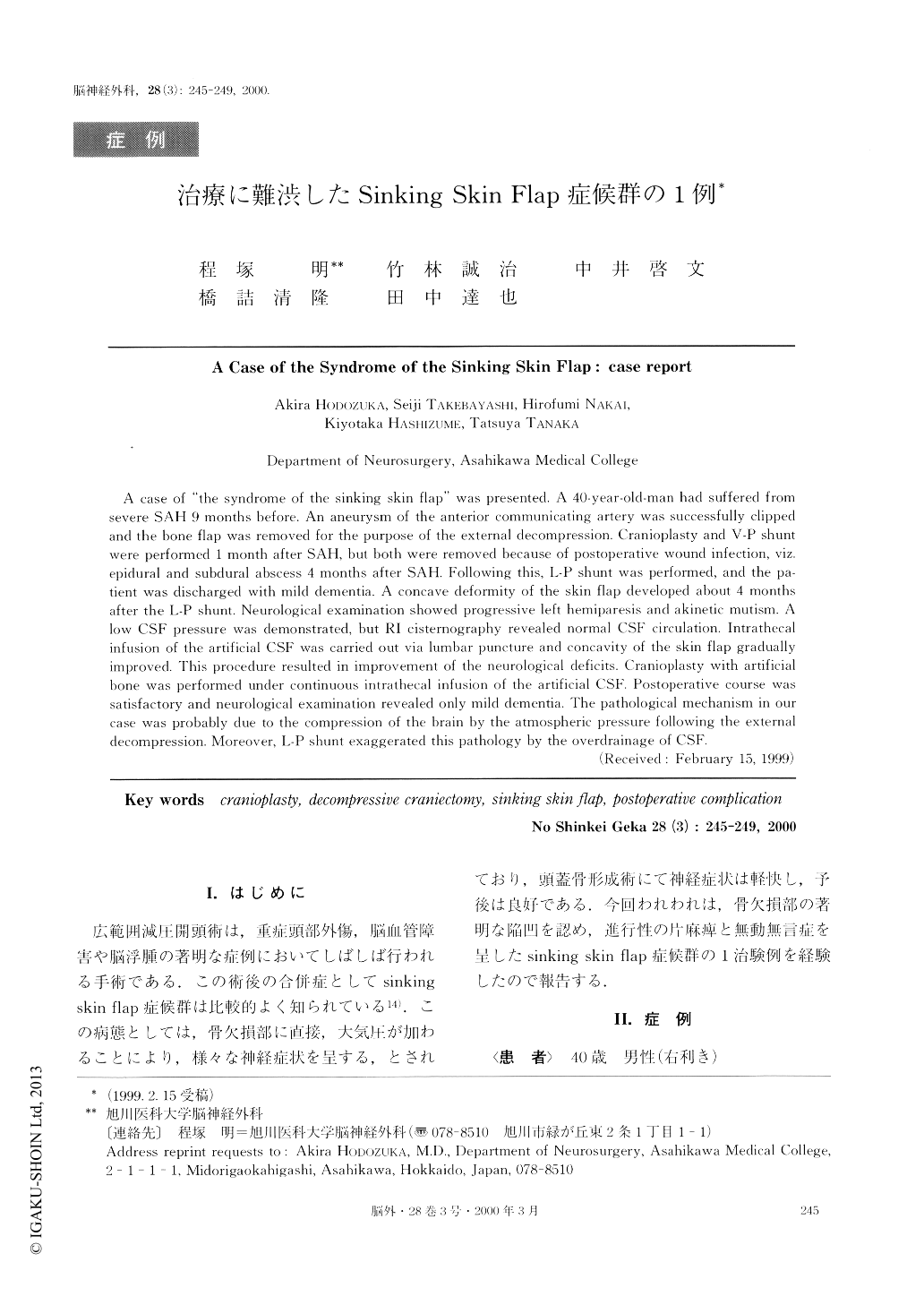
広範囲減圧開頭術は,重症頭部外傷,脳血管障害や脳浮腫の著明な症例においてしばしば行われる手術である.この術後の合併症としてsinking skin flap症候群は比較的よく知られている14).この病態としては,骨欠損部に直接,大気圧が加わることにより,様々な神経症状を呈する,とされており,頭蓋骨形成術にて神経症状は軽快し,予後は良好である.今回われわれは,骨欠損部の著明な陥凹を認め,進行性の片麻痺と無動無言症を呈したsinking skin flap症候群の1治験例を経験したので報告する.
A case of “the syndrome of the sinking skin flap” was presented. A 40-year-old-man had suffered from severe SAH 9 months before. An aneurysm of the anterior communicating artery was successfully clipped and the bone flap was removed for the purpose of the external decompression. Cranioplasty and V-P shunt were performed 1 month after SAH, but both were removed because of postoperative wound infection, viz. epidural and subdural abscess 4 months after SAH. Following this, L-P shunt was performed, and the pa-tient was discharged with mild dementia. A concave deformity of the skin flap developed about 4 months after the L-P shunt. Neurological examination showed progressive left hemiparesis and akinetic mutism. A low CSF pressure was demonstrated, but RI cisternography revealed normal CSF circulation. Intrathecal infusion of the artificial CSF was carried out via lumbar puncture and concavity of the skin flap gradually improved. This procedure resulted in improvement of the neurological deficits. Cranioplasty with artificial bone was performed under continuous intrathecal infusion of the artificial CSF. Postoperative course was satisfactory and neurological examination revealed only mild dementia. The pathological mechanism in our case was probably due to the compression of the brain by the atmospheric pressure following the external decompression. Moreover, L-P shunt exaggerated this pathology by the overdrainage of CSF.
Copyright © 2000, Igaku-Shoin Ltd. All rights reserved.