Japanese
English
- 有料閲覧
PPV購入案内
1,320円 (1,200円+税10%) こちらは、645ページから650ページの文献です。購入には医書.jp本会員登録が必要です。
会員登録完了後に改めて上記「購入サイトへ」を選択してください。
または「購入サイトへ」選択後に「購入ログイン」、「新規会員登録」の順に進んでください。
会員登録について詳しくはをご確認ください。
- Abstract 文献概要
- 1ページ目 Look Inside
I.はじめに
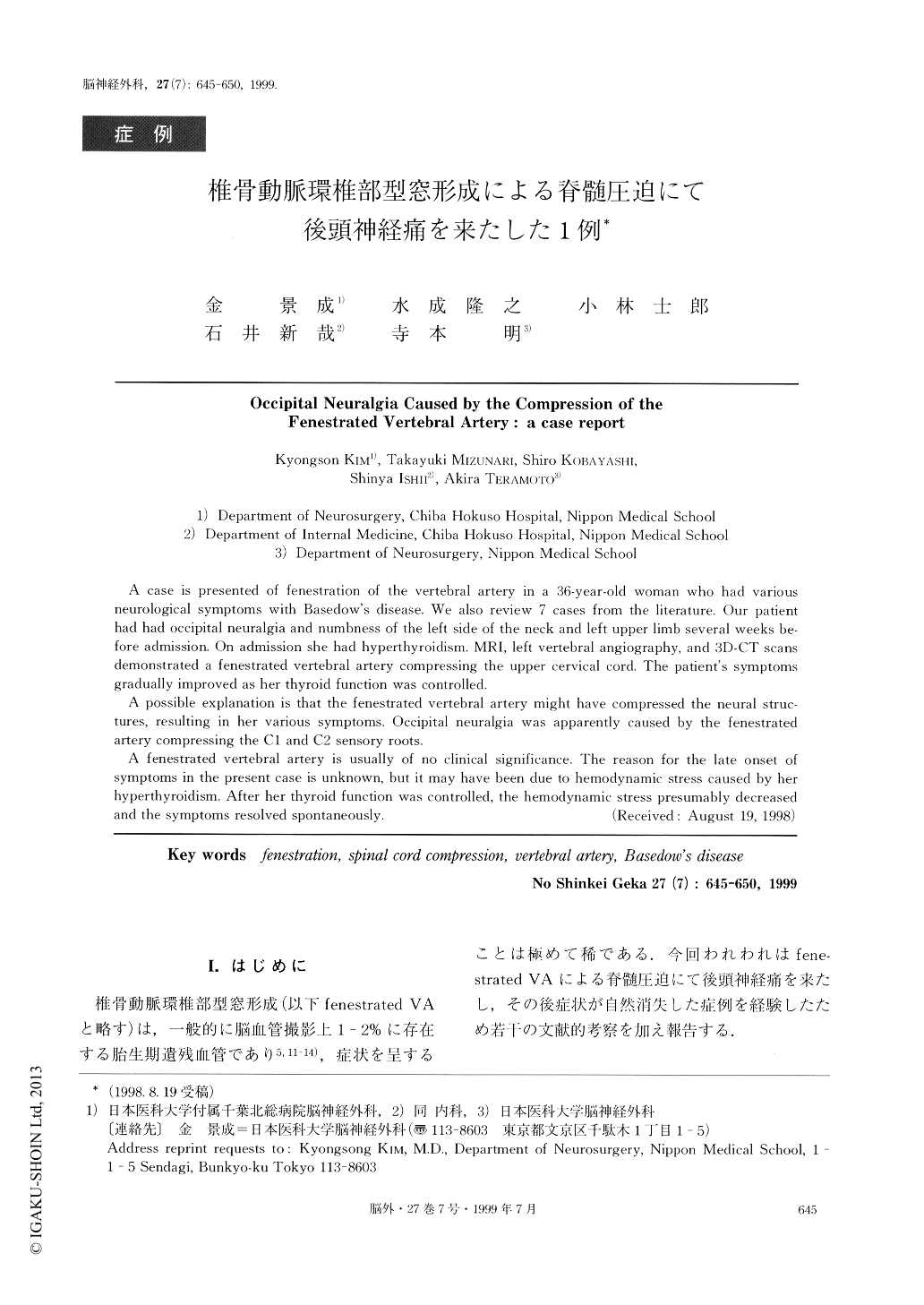
椎骨動脈環椎部型窓形成(以下fenestrated VAと略す)は,一般的に脳血管撮影上1-2%に存在する胎生期遺残血管であり5,11-14),症状を呈することは極めて稀である.今回われわれはfene-strated VAによる脊髄圧迫にて後頭神経痛を来たし,その後症状が自然消失した症例を経験したため若干の文献的考察を加え報告する.
A case is presented of fenestration of the vertebral artery in a 36-year-old woman who had variousneurological symptoms with Basedow's disease. We also review 7 cases from the literature. Our patienthad had occipital neuralgia and numbness of the left side of the neck and left upper limb several weeks be-fore admission. On admission she had hyperthyroidism. MRI, left vertebral angiography, and 3D-CT scansdemonstrated a fenestrated vertebral artery compressing the upper cervical cord. The patient's symptomsgradually improved as her thyroid function was controlled.
A possible explanation is that the fenestrated vertebral artery might have compressed the neural struc-tures, resulting in her various symptoms. Occipital neuralgia was apparently caused by the fenestratedartery compressing the C1 and C2 sensory roots.
A fenestrated vertebral artery is usually of no clinical significance. The reason for the late onset ofsymptoms in the present case is unknown, but it may have been due to hemodynamic stress caused by herhyperthyroidism. After her thyroid function was controlled, the hemodynamic stress presumably decreasedand the symptoms resolved spontaneously.
Copyright © 1999, Igaku-Shoin Ltd. All rights reserved.