Japanese
English
- 有料閲覧
PPV購入案内
1,320円 (1,200円+税10%) こちらは、775ページから779ページの文献です。購入には医書.jp本会員登録が必要です。
会員登録完了後に改めて上記「購入サイトへ」を選択してください。
または「購入サイトへ」選択後に「購入ログイン」、「新規会員登録」の順に進んでください。
会員登録について詳しくはをご確認ください。
- Abstract 文献概要
- 1ページ目 Look Inside
I.はじめに
舌下神経鞘腫は稀な良性腫瘍で,舌の萎縮や麻痺に気付かれず長期間放置されることが多いが,近年の画像診断,顕微鏡手術の進歩により治療成績は向上している.今回われわれは,舌下神経管周囲の骨を著明に破壊し頭蓋内外に進展した巨大なdumbbell-shapedの舌下神経鞘腫の1例を経験したので報告する.
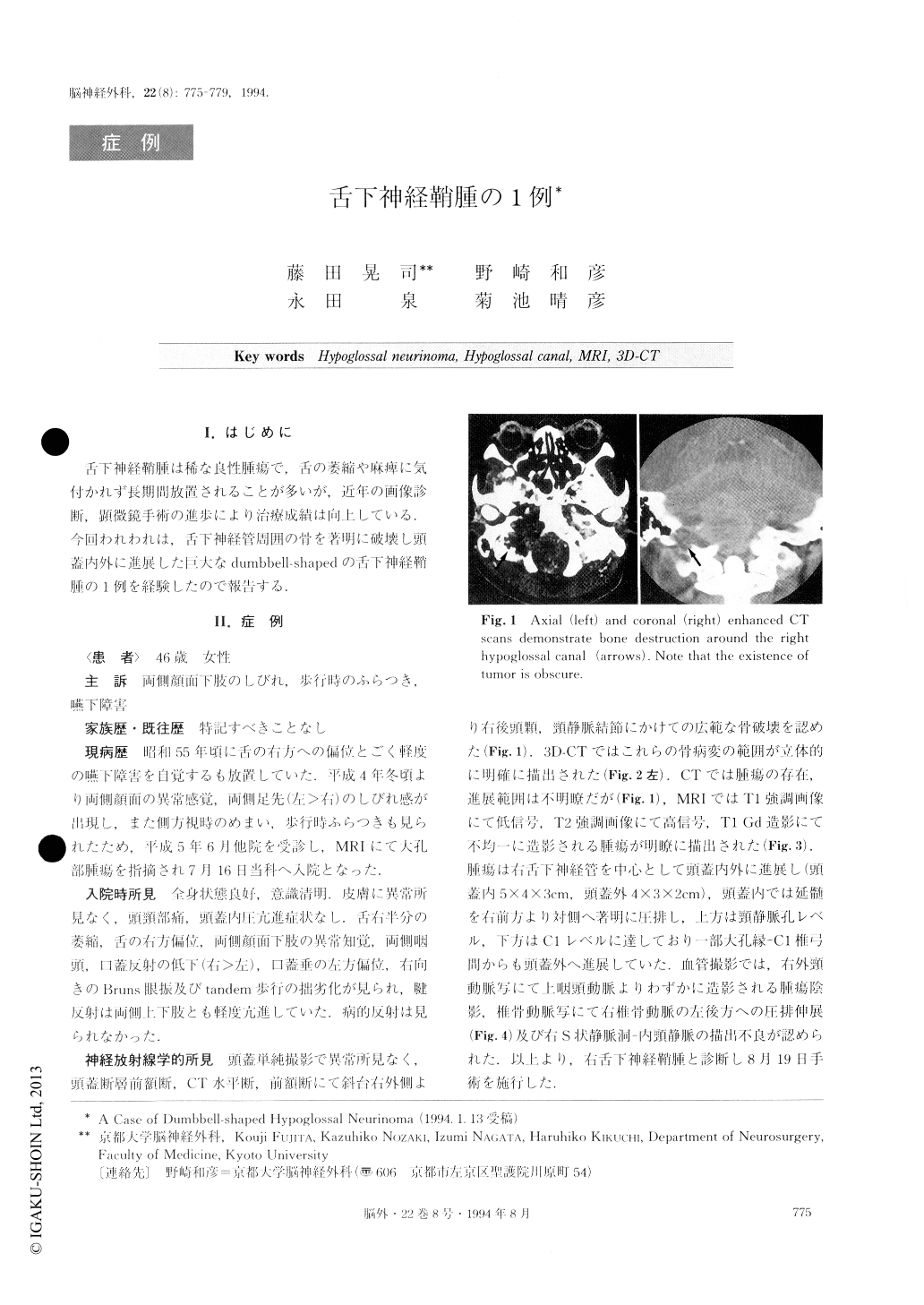
The authors report a case of dumbbell-shaped hypo- glossal neurinoma. A 46-year-old female was admitted to our clinic with a history of right hemiatrophy of the tongue for more than 10 years and bilateral paresthesia on the face and legs for half a year. Neurological find- ings on admission were right hypoglossal palsy, atte- nuation of right gag and palatal reflex, mild truncal atax- ia, right Bruns nystagmus, bilateral paresthesia on the face and legs (left>right) , bilateral hyper-reflexia on the extremities. No sign of increased intracranial pres- sure was noted. Conventional computed tomography de- monstrated the bone destruction around the right hypoglossal canal, and three-demensional computed tomography clearly revealed the extent of the bone des- truction. Magnetic resonance imaging showed a large dumbbell-shaped mass extending both intra-and extra-cranially through the right hypoglossal canal, which severely compressed the brainstem postero-medially. Right suboccipital craniotomy with Cl laminectomy was performed in the prone position, and the occipital bone was drilled far-laterally around the Foramen Mag-num with right occipital condyle rongeured to expose the intracanallicular mass.The mass was totally re-moved except around the IX Xth cranial nerves near the jugular foramen. Hypoglossal neurinoma is rare, and our case is the 62nd case, and the 15th dumbbell-shaped case in the literature. Hypoglossal nerve palsy is characteristic in dumbbell-shaped hypoglossal neuri-noma. Enlargement of the hypoglossal canal can be de-tected by conventional and three-dimensional CT. MRI is more effective than CT in revealing the mass. Total removal of the dumbbell-shaped tumor requires that the hypoglossal canal can be exposed sufficiently. If there is attachment to the brainstem and lower cranial nerves, the neurinoma should not be dissected because of the severe neurological deterioration that would be caused.
Copyright © 1994, Igaku-Shoin Ltd. All rights reserved.