Japanese
English
- 有料閲覧
PPV購入案内
1,320円 (1,200円+税10%) こちらは、1167ページから1178ページの文献です。購入には医書.jp本会員登録が必要です。
会員登録完了後に改めて上記「購入サイトへ」を選択してください。
または「購入サイトへ」選択後に「購入ログイン」、「新規会員登録」の順に進んでください。
会員登録について詳しくはをご確認ください。
- Abstract 文献概要
- 1ページ目 Look Inside
- 参考文献 Reference
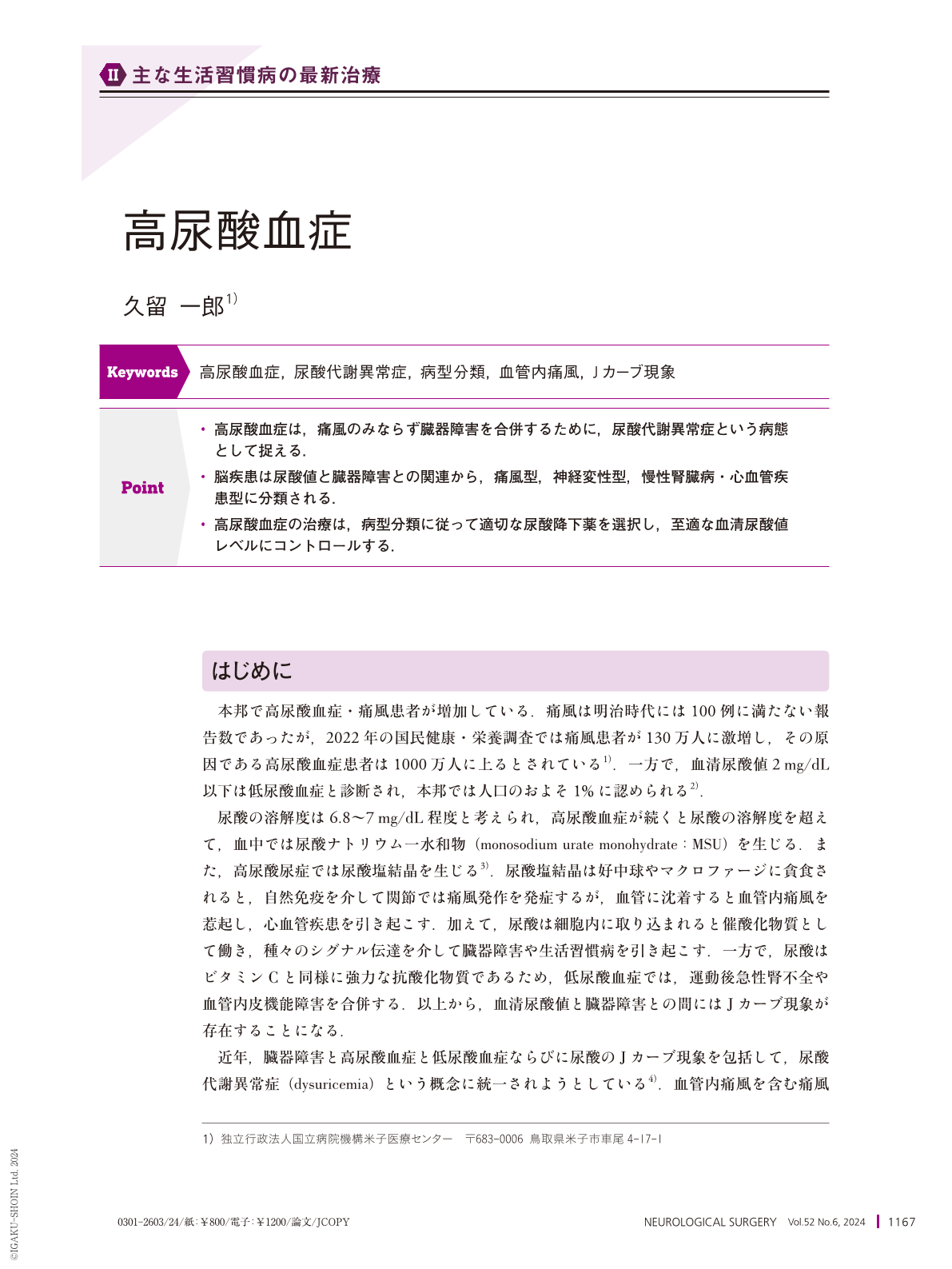
Point
・高尿酸血症は,痛風のみならず臓器障害を合併するために,尿酸代謝異常症という病態として捉える.
・脳疾患は尿酸値と臓器障害との関連から,痛風型,神経変性型,慢性腎臓病・心血管疾患型に分類される.
・高尿酸血症の治療は,病型分類に従って適切な尿酸降下薬を選択し,至適な血清尿酸値レベルにコントロールする.
Hyperuricemia causes not only gout but also organ damage, such as through cerebrovascular, cardiovascular, and lifestyle-related diseases. The relationship between the serum urate(SUA)level and organ damage has recently been redefined as dysuricemia, as follows: 1)SUA level is positively associated with the occurrence of gout and intra-arterial gout(gout pattern); 2)occurrence of neurodegenerative diseases is negatively correlated with SUA level(ND pattern); and 3)the relationship between SUA level and chronic kidney disease(CKD)and cardiovascular disease(CVD)forms a J-shaped curve(CKD/CVD pattern). CVDs accompanied by dysuricemia include gout, ND, and CKD/CVD patterns; therefore, optimal SUA levels must be maintained to reduce organ damage. Thus, appropriate urate-lowering agents should be selected based on the type of hyperuricemia and prescribed for lowering the SUA levels toward the optimal value. Xanthine oxidase inhibitors are prescribed for hyperuricemic patients with renal overload and uricosuric agents for hyperuricemic patients with renal undersecretion.
Copyright © 2024, Igaku-Shoin Ltd. All rights reserved.